A decision is generally not taken in isolation as it is affected by previous behavior as well as by consequences anticipated in the future.
It is therefore necessary to understand Decision-Making as a process as the question of final selection of choice from alternatives should not result in false emphasis ignoring the lengthy complex process which precedes that final choice.
The Decision-Making process can be divided as shown
- Defining the problem: The process begins with the recognition of a problem that requires a decision. Clear definition is critical as the right answer can be found with the right questions.
- Analyzing the problem and Gathering Information: The analysis of a problem even classifies the problem. Classification is necessary inorder to know who should set the decision and who should be consulted in making it.The problem should be classified in view the following guidelines :
- The nature of the decision problem, i.e Whether it is strategic or it is routine;
- The impact of the decision;
- The periodicity of decision;
- The futurity of the decision;
- The limiting or strategic factor relevant to decision.
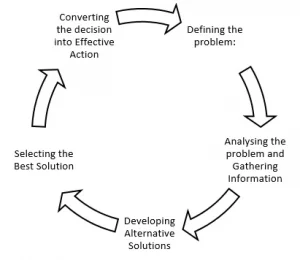
- Developing Alternative Solutions:Developing alternative solutions to the problem is a very important step in the decision making process. The finding of alternative solutions helps to Choose best decision, after a careful evaluation of the most desirable course of action in the situation. Of course, even after ascertaining alternative solutions, an executive can make a mistake in making the decision or in his final choice. Whilst considering alternative solutions, a good principle to observe is to ask, “What could be the consequences if no action at all is taken?”.
- Selecting the Best Solution :In order to choose the best alternative, one will have to evaluate the available alternatives. There are various ways to evaluate alternatives. The most common method is through intuition i.e., choosing a solution that seems to be a good idea at that time. There is an inherent danger in this process because an executive’s action may be wrong on certain occasions. A second way to choose the best alternative Aweigh the consequences of one against those of the other. Peter Drucker has laid down four criteria in order to evaluate the consequences of various alternatives.
- Risk: Executie Weighs the risks of each course of action.
- Economy of effort: Benefit of the course of action
- Timing: Checks whether the situation demands the course of action
- Limitation of resources
- Converting the decision into Effective Action :
- After a solution has been sealed applying the above criteria, steps must be taken to translate it into effective action.
- A decision should be presented to the people who are to take part in its execution, in language they can understand.
- The working group should be given the opportunity to participate in the decision making process, preferably at the stage of developing alternatives. This can help improve the quality of the final decision by revealing points which may have been overlooked by the executive and uncovering obstacles in the way of its execution.
- Such participation can also provide those who are to execute the decision with a sense of responsibility and thus secure their co-operation in execution, which was the reason for the adoption of the elaborate decision making process.
There are many models of decision-making behavior. These models attempt to determine the extent of rationality of the decision-maker. Some of the important models are :
Simon’s Bounded Rationality Model:
- Simon analysed comprehensively the rationality aspect of the decision-making process.
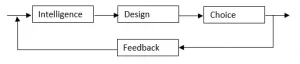
- The stages of decision making suggested by Simon is as follows:
- Simon believed that total rationality is impossible in administrative behaviours.Therefore, maximising decisions is not possible.
- He argues that human behavior in organizational setting is characterised by ‘bounded rationality’ (limited rationality) leading to ‘satisfying decision’ as against ‘maximising decisions’ (optimising decisions).
- ‘Satisfying, decision implies that a decision-maker chooses an alternative which is satisfactory or good enough. Some of the factors responsible for bounded rationality leading to satisficing decisions are
- Dynamic nature of organizational objectives;
- Imperfect information as well as limited capacity to process the available information;
- Time and cost constraints
- Environmental forces or external factors;
- Personal factors like preconceived notions, habits, etc
- Organization factors like procedures, rules, channel of communication
Lindblom’s Incremental Model:
Charles E. Lindblom in his article ‘‘The Science of Muddling Through’’ (1959) advocated the ‘‘Incremental model of Decision-Making.’
Indeed, the decision-makers always continue the existing programmes and policies with some modification…. What actually occurs in administrative decisions is ‘incrementalism’, that is, virtual continuation of the previous activities with few changes.
Thus, Lindblom argues that the past activities and experiences are used by the administrators to make future decisions.
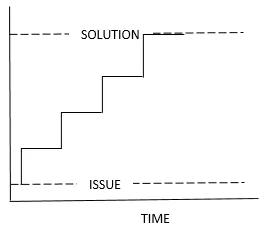
He highlights two concepts to describe the actual decision-making process in administration–marginal incrementalism and ‘partisan mutual adjustment’.
Instead of changing the whole area where the issue arises, small and partial adjustments should be made mutually which will pass on gradually or without any conflict spread to whole by little that is incrementally.
Issue with incremental model is that it may not be a best optimal solution
Etzioni’s Mixed Scanning Model
Etzioni in his famous article ‘‘Mixed Scanning:A Third-Approach to Decision Making’’ has advocated an intermediate model that combines the elements of both rational model and incremental model. Hence, it is called a mixed scanning model.
Etzioni believed that at the beginning the whole issue had to be addressed. Later detailed scrutiny of smaller areas requiring urgent attention.
It is mainly because unless the whole area is not seen, a problem cannot be identified & smaller areas will not come into focus.. Also incremental models discourage social innovation and the issues are not static.
Yehezkel Dror’s Optimal Model:
- Dror in his book ‘‘Public Policy-making Re-examined’’advocated a public policy-making model of decision-making.
- He argues that his ‘optimal model is superior to all the existing normative models of decision-making. Dror advocates the optimal model integrating and supplementing the strength of various models, at same time avoiding their weaknesses.
- He claims his optimal model to be a fusion of the economically rational model with the extra-rational model.
- The optimal model, according to Dror, has five major characteristics. They are :
- It is qualitative not quantitative;
- It has both rational and extra-rational components;
- It is a basic rationale to be economically rational;
- It deals with meta policy-making
- It has much built-in feedback
Tools And Techniques Used
Decision Matrix
A decision matrix is a technique that contains values that helps you to identify and analyze the performance of the system.
The elements of a decision matrix show results depend on specific criteria.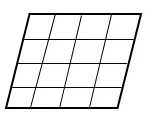
T-Chart
This chart is used when weighing the pluses and minuses of the options.
It ensures that all the positives and negatives are taken into consideration when making a decision.
This is also known as creating a pros and cons list
Decision Tree
A decision tree is a specific type of flow chart used to visualize the decision-making process by mapping out different courses of action, as well as their potential outcomes.
Conjoint Analysis
Conjoint analysis is a survey-based statistical technique used in market research that helps determine how people value different attributes that make up an individual product or service i.e, identifying consumer preference.
Pareto Analysis
Pareto Analysis is a method for decision-making.
It is also known as 80/20 rule meaning, 20% of your activities will account for 80% of your results.
It is used for prioritizing possible changes by identifying the problems and resolving them.
SWOT Diagram
SWOT stands for Strengths, Weaknesses, Opportunities, and Threats.
SWOT Diagram is an important management application that helps any organization to assess its current situation.
It works as a basic guide for strategic planning.
Qualitative and Quantitative Techniques
| Quantitative Techniques | Qualitative Techniques |
| PERT,CPM | Application of intuition |
| Simulation | Decision making under influence of emotions |
| Game Theory | Influence of values & norms |
| Probability | Influence of attitudinal predispositions |
| Cost Benefit Analysis |