Why in NEWS?
For the first time, India will host the annual G-20 Summit in 2022 since its origin in 1999.
G20 is an international forum for the Governments and Central Bank Governors from 19 countries and the European Union. It was formed in 1999 to discuss policies relating to financial stability. It brings important industrialized and developing countries to discuss important issues in the global economy.
Evolution of G20
After the Asian Financial crisis of 1997-99, the G7 finance ministers agreed to establish the G20 Finance Ministers and Central Bank Governors meeting in 1999.
It was created in response to both to the financial crises that arose in a number of emerging economies in the 1990s and to a growing recognition that some of these countries were not adequately represented in global economic discussion and governance.
Its agenda was expanded since 2008 (amid 2008 Financial crisis) to Heads of governments / Heads of states as well as foreign ministers, along with Finance Minister
Read Full GS Notes
Objectives of G20
- policy coordination between its members in order to achieve global economic stability, sustainable growth.
- to promote financial regulations that reduce risks and prevent future financial crises.
- to create a new international financial architecture.
Features of G20
- Members of the G20 are – Argentina, Australia, Brazil, Canada, China, France, Germany, India, Indonesia, Italy, Japan, Republic of Korea, Mexico, Russia, Saudi Arabia, South Africa, Turkey, the United Kingdom, the United States, and the European Union.
- G20 members account for more than 80% of world GDP, 75% of global trade and 60% of the population.
- G20 has two working tracks:
- Finance Track: The primary focus is on global economic and financial issues such as monetary, fiscal and exchange rate policies, infrastructure investment, financial regulation, financial inclusion and international taxation.
- Sherpa Track: The focus is on broader issues such as political engagement, anti-corruption, development, trade, gender equality, energy and climate change.
- G20 does not have a permanent secretariat or staffs – its agenda and activities are established by the rotating Presidencies, in cooperation with the membership.
- A “Troika“, represented by the country that holds the Presidency, its predecessor and its successor, works to ensure continuity within the G20
Its membership features both developed and emerging markets from all continents, making it big enough to be globally representative and the world’s most impactful global forum.
Importance of G20
Influence on the policies of the countries around the world – G20 allows the leaders of the world’s major economies to work together to lift growth in mutually-supportive ways and align their domestic policies to the decisions taken by the grouping.
Support to Developing countries – G20 works with developing countries, particularly low-income countries to support them in implementing their nationally driven policies and priorities which are needed to fulfil international goals.
Inclusive Global Growth – G20 plays a critical role in creating an enabling environment for inclusive global growth and development. Its work on ensuring financial stability, promoting growth and avoiding and managing crises is critical in supporting the opportunities.
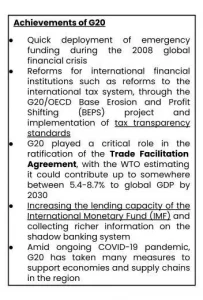
Addresses Diverse issues – It addresses several issues include the advancement of women in the job market, the 2030 Agenda for Sustainable Development, climate change, global health, anti-terrorism and inclusive entrepreneurship, among others.
Helps in reshaping the governance of global finance, as done by developing strict rules on the “too big to fail” problem, increasing the lending capacity of the International Monetary Fund (IMF) and collecting richer information on the shadow banking system.
Helps in strategic balancing among countries – G20 provides a platform for countries to conduct various bilateral and plurilateral meetings such as JAI (Japan-America-India), RIC (Russia-India-China) which tries to address conflicting interests of various groupings on one platform.
India has been a founding member of G20 process and has played an active role in proposing new ideas and finding solutions.
Read Full GS Notes
India & G20
- India’s participation in the G20 process stems from the realization that as a major developing economy India has a vital stake in the stability of the international economic and financial system.
- India has been actively involved in the G20 preparatory process both at the Sherpas Track and the Financial Track since its inception
- India’s agenda at the G20 Summits is driven by the need to bring in greater inclusivity in the financial system, to avoiding protectionist tendencies and above all for ensuring that growth prospects of developing countries do not suffer.
- India has strived to ensure that the focus of the global community remains on the need to ensure adequate flow of finances to emerging economies to meet their developmental needs.
- Taxing global digital companies – India has made a strong case for adoption of “significant economic presence” concept for taxing global digital companies.
- India had introduced this concept in the Income Tax Act for taxation of non-residents in India or global digital companies.
India remains committed to the G20 process for achieving a stable, inclusive and representative global economic and financial system.
Challenges in G20
No Enforcement mechanism – The G20’s toolkit ranges from simple exchanges of information and best practices to agreeing common, measurable targets, to coordinated action. None of this is achieved without consensus, nor is it enforceable, except for the incentive of peer review and public accountability.
Not legally binding – the decisions are based on discussions and consensus which culminates in the form of declarations. These declarations are not legally binding. It’s just an advisory or consultative group of 20 members.
The exclusivity of its membership has attracted criticism. The group represents a massive share of global economy and its decisions can impact non-member countries.
Critics also point at disproportionate representation of African countries.
Not all resolutions passed at the G20 Summit are fully implemented as only 10% of world countries are included in G20 decision-making, thereby denting the organization’s authority.
G20 authority is also weakened since some major members sometimes fail to fulfil their commitments (e.g., the delay of the IMF reform due to resistance from the U.S. Congress).
Boycotting Osaka Track – India, South Africa, and Indonesia have boycotted the “Osaka Track” on the “digital economy”, as it overtly undermines “multilateral” principles of consensus-based decisions in global trade negotiations, and denies “policy space” for digital-industrialisation in developing countries.
It is an initiative launched by Japan PM in G20 Summit 2019 that seeks the removal of prohibitions on data localisation and urges nations to negotiate rules on data flows, cloud computing among others.
Way Forward
G20 must provide the vision to bind all the countries especially the emerging markets like Indonesia, India, Brazil and Mexico which are new actors in global governance to support coordinated actions on major global issues and promote global public goods.
G20 should strengthen its ties with the UN to give the Organisation and all of its relevant institutions full agency in promoting development.
Redoubled efforts are also needed in fields like infrastructure and food security so as to address the North-South imbalance.
Amid COVID-19 pandemic, G20 role will be critical to build robust global supply chains and strengthen international investment for economic recovery.
The G20 cannot be a panacea for the world’s problems. But over the past 10 years, the G20 has been an important forum for international cooperation. Effective global governance, like the G20, is essential as rising powers seek opportunities to influence and contribute to the global order.