
Henry Fayol is considered as the founder of the ‘Management Process School’.
His book ‘General & Industrial Management’(Administration industrielle et générale) offers a theory and principles of management.
Administrative Theory
Fayol had 2 major views:
- Science of management should replace the rule of thumb.
- Universality of Administrative Theory.
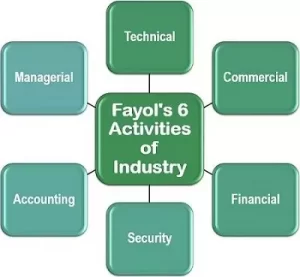
He classified the totality of Industrial undertaking into 6 functional groups as shown in (fig
He believed that except management all the 5 groups are sectional in nature whose functions can be performed in isolation.
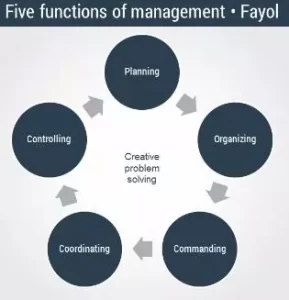
He identified 5 elements of management which are shown in (fig 2).
- Planning (Prevoyance)-To anticipate and outlining the path through which the goals can be achieved.
- Organization- Systematic way of material organization and human organization .
- Commanding(Directing)-Administration should be able to direct the man power. It should be clear of the responsibilities of the subordinates and authorities it enjoys.
- Coordination- Bringing harmony among various units and individual functionaries.
- Control- Ensuring the performance of the workers are within the limits of norms and regulations of organization through techniques of reward and punishment.
Principles of Administration
He states that principles of administration are not rigid. On the contrary, they must be capable of adaptation to various enterprises and settings.
He dealt with the functional and structural aspects of an organization through his 14 principles
- Division of Work : Specialization of labor produces more and better work with the same effort. But he cautioned that the division of work should be optimum otherwise it may lead to overlapping and confusion.
- Authority & Responsibility:Authority is the right to extract obedience from subordinates.The authority of individual should commensurate with responsibility
- Discipline: Obedience should be observed in accordance with the standing agreements between the firm and its employees.
- Unity of Command:It means one subordinate should be accountable to only one super ordinate. This idea is contradictory to Taylor’s ‘Functional foremanship’ where one worker was working under 8 functional foremen. However, Taylor’s foremanship was defended on the idea that one worker had to do one specific job, thus each worker worked under a forman.
- Unity of direction: One head and one plan for each activity.
- Subordination of individual interest to general interest: The interest of one employee or group of employees should not prevail over that of the total organization.
- Remuneration of personnel: The payment should be fair and just and afford satisfaction of both personnel and the firm.
- Centralisation: The power was concentrated at the hands of higher functionaries. The degree of initiative left to managers varies depending upon top managers, subordinates and business conditions. For instance, if the employer trusts the employee then the employer may decentralize the authority to the employee.
- Scalar chain (Hierarchy):
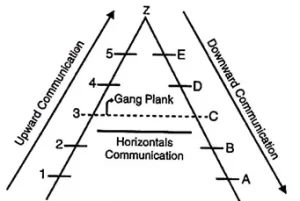
Hierarchy is a vertical perspective. When all the layers or hierarchies or positions are taken together from top to bottom, then it is referred as the Scalar Chain. Each layer is bind to another layer through a relation called line of control or chain of command. He believed that the line of authority should not be broken, as it enables to maintain authority and discipline the organization. But Fayol came up with an exception called Gangplank, which is a jumping technique in which the concerned official establishes a relation with the immediate superior and they interact directly and solve the problem.
10.Order(Placement): Once the basic job structure has been devised, it is the placing of the right man at the right place.
11.Equity: For the personnel to be encouraged to fulfill their duties with devotion and loyalty there must be equity based on kindness and justice in employer-employee relations i.e, equity in terms of distribution of responsibility and reward.
12.Stability of tenure: Tenure is critical to the growth of organization as it should not be short that the position of an individual is undermined. On the other hand, it should not be long that complacency creeps in. Suitable conditions are to be created to minimize turnover of employees.
13.Initiative: The ability to think afresh would act as a powerful motivator of human behavior.
14.Esprit de Corps: Harmony, union among the personnel of an organization is a source of great strength in the organization.
UPSC Full Optional Subjects List
Need for Administrative Training
Fayol is the pioneer in suggesting the need for systematic training in administration.
Need for training is everywhere greater in accordance with the position occupied.
He suggests training is a continuous process and considers an officer in an organization as a teacher to his immediate subordinate.
Criticism
Peter Drucker:
- Criticized Fayol for imposing a mechanistic model of an ‘ideal or universal’ organization on a living business.
- Anything more complex, more dynamic or entrepreneurial than a typical mining firm demands performance capacities which functional principles do not possess as the empirical base used by Fayol for generating full-fledged theory is too narrow. He proceeded to theorize functionalism only on the basis of functions undertaken in a manufacturing company.
Gullick & Urwick: Application of the Unity of command principle would overwhelm the chief executive with problems of coordination. According to Fayol’s principle, conflict can be resolved through the chief executive but for a larger organization, difficulty in communication and coordination would lead to chaos and disharmony.
Simon & Chester Barnard: Managerial organization cannot be explained purely in terms of set of principles. They suggest that actual behavior of organizational participants departs in many ways from behavior that is planned.
Many thinkers criticized Fayol for overlapping principles
- Equity and Remuneration are almost the same.
- Scalar chain encompassed both Unity of Command and Authority & Responsibility.
- Subordination of individual interest to general interest was quite similar to Centralization.