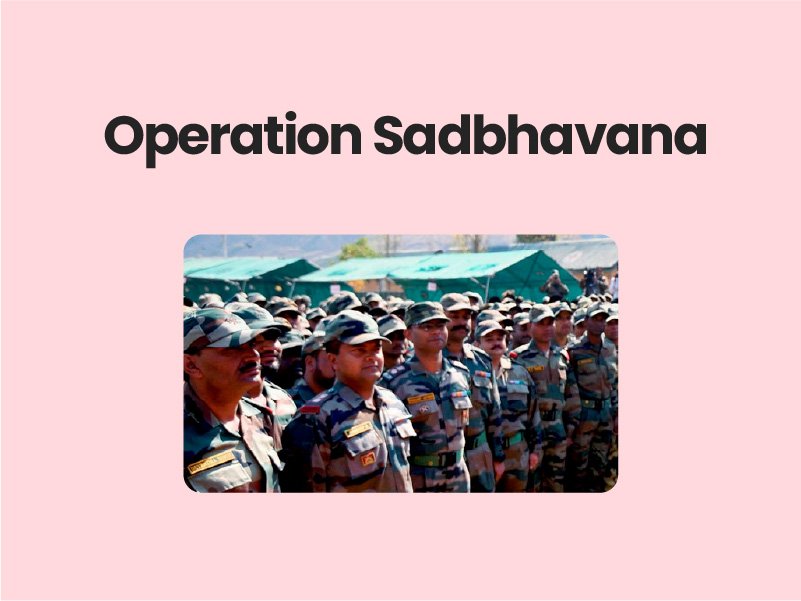
Operation Sadbhavana
The Indian Army finds itself at the crossroads of insurgency and terrorism in many regions of the country, with an ongoing war against terror that probably is one of the longest running in the world.
- the Indian military leadership has evolved the strategy of “sadbhavana” as a means to achieve the end that every soldier wants, that is, lasting peace.
- The remote Himalayan locales of Ladakh in the Indian state of Jammu and Kashmir are on the fringes of an ongoing informal insurgency. Because neglect and lack of development are characteristic of existence in border towns and villages, feelings of marginalization are widely prevalent.
- Myopic objectives and a perceived lack of genuine compassion and concern for the denizens of this region among administration members, who are often viewed as stooges of the national government, have widened the chasm between the hinterland populace and the “favored” residents of the Kashmir vale.
- Under operation sadbhavana, recently army sponsored educational and national integration tour for Jammu and Kashmir youths.
Read GS Notes
METHODS Operation Sadbhavana :
- Indian Army units have undertaken various development projects in the fields of education, community development, vocational training, and ecology as a part of Operation Sadbhavana.
- Civic action programs undertaken for the local populace are small-scale community projects aimed at the development of the people of this area to allow them to lead long healthy lives, to acquire knowledge, and to have access to resources needed for a decent standard of living.
- The civil administration is unable to cope with the aspirations of the people of this remote and inaccessible area because of the prevailing security situation and poor communication links and infrastructure.
The key result areas under Operation Sadbhavana are:
(a) primary education,
(b) comprehensive health care,
(c) adult literacy and vocational training,
(d) enhancement of agricultural output,
(e) assistance in electrification and establishment of communication networks,
(f) adoption of villages for integrated development,
(g) empowerment of women, and
(h) employment generation.
The Ladakh region is characterized by rugged mountains and narrow valleys, with poor communication links and long periods of isolation, especially in winter. The villages are scattered in pockets and located in inaccessible areas. Given the inadequacies of the existing governmental infrastructure in the region, the military medical units use their excess capacity to fill the gap in essential services for the civilian populace.
Conclusion:
The Operation Sadbhavana initiatives of the Indian military can be viewed as a success only when certified as such under the harsh scrutiny of history, eventually being considered a victory in retrospect. The real return on the investment in the people, as a form of nation building, is in long-term patriotism and regional development.
Future civil-military operations must include a method for quantifying the impact of activities on the health and other developmental aspects of the civilian population, as part of the initial operational planning. Planners must also develop a prospective strategic communications plan, including a detailed audience analysis, early in the planning stages for such operations.
Read Also Juice Jacking