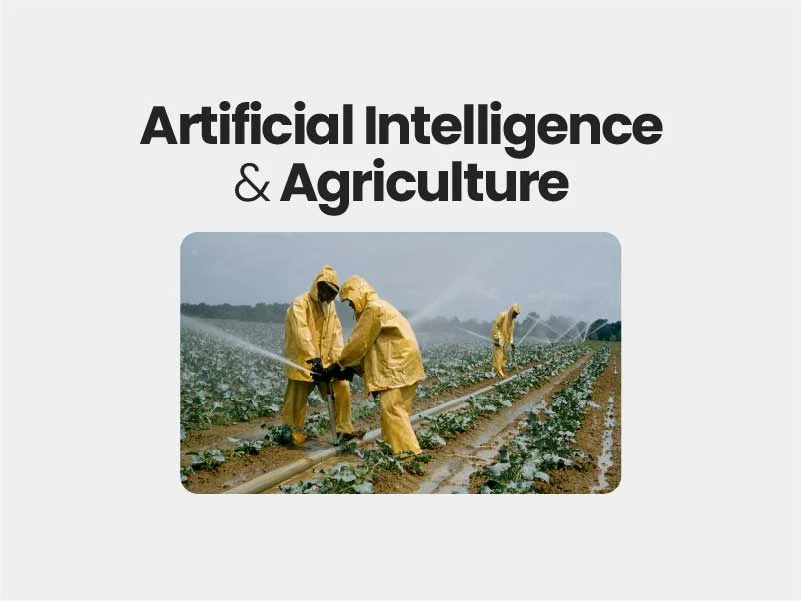
Artificial Intelligence and Agriculture
- Artificial intelligence (AI) is silently but increasingly entering Indian agriculture and hence affecting our society at large. Even though machine learning (which is a subset of AI) has been used for classifications and prediction purposes for, to cite a few, food grading and crop yield forecasting, recently, the new set of deep learning algorithms have heralded the possibilities of taking the research and applications of AI to much higher levels and with much more accuracy.
- Similarly, other AI techniques are making inroads in all fields including agriculture. Amid high expectations about how AI will help the common man and also transform his mind set, thoughts and attitude towards the benefits that it may bring, there are certain concerns about the ill-effects of such sophisticated technologies as well. In the end, if AI systems can enhance farmers in terms of their social and economic wellbeing, we should be open to innovating new upcoming technologies with AI as their soul.
Use of AI in Agriculture:
- Technology powered by Artificial intelligence is ensuring the sustainability of quality food production for the coming decades.
- AI solutions are being used to diagnose pests, predict the best time to sow and gauge prices for produce. Drones, hydroponics, artificial lights and AI-powered cameras are protecting crops from wild animals.
- The agriculture industry is turning to AI for solving the double trouble of the food crisis and food wastage in the wake of locust swarms, climate change, droughts and floods.
- The land owners can have a virtual conversation on the platform and have their basic queries answered instantly. They can also keep tabs on the latest innovations they ought to know about.
- Tackling the Labour Challenge
AI can Benefit Agriculture:
1) Growth driven by IoT
Huge volumes of data are generated every day in both structured and unstructured format via IoT (internet of things). These relate to data on historical weather pattern, soil reports, new research, rainfall, pest infestation, images from drones and cameras and so on. Cognitive IOT solutions can sense all this data and provide strong insights to improve yield.
2) Soil testing
Two technologies that stand for intelligent data fusion are Proximity Sensing and Remote Sensing. One use case of this high-resolution data is Soil Testing. While remote sensing requires sensors to be built into airborne or satellite systems, proximity sensing requires sensors in contact with soil or at a very close range. This helps in soil characterization based on the soil below the surface in a particular place.
3) Image-based insight generation
Drone-based images can help in in-depth field analysis, crop monitoring, scanning of fields and so on. They can be combined with computer vision technology and IOT to ensure rapid actions by farmers. These feeds can generate real time weather alerts for farmers.
4) Detecting crop diseases
Images of various crops are captured using Computer Vision Technology under white/UV-A light. Farmers can then arrange the produce into separate stacks before sending it to the market. Pre-processing of images ensures the leaf images are segmented into areas for further diagnosis. Such a technique would identify pests more distinctly.
5) Optimal mixture of agri products
Based on multiple parameters like soil condition, weather outlook, type of seeds, infestation around a certain area, cognitive computing makes recommendations to farmers on the simplest choice of crops and seeds. The advice is further personalized basis on the farm’s requirement, local conditions, and past successes. External factors like marketplace trends, prices or consumer needs can also be factored in through artificial intelligence.
6) Monitoring crop health
Remote sensing techniques alongside hyper spectral imaging and 3D laser scanning are essential to create crop metrics across thousands of acres. It could usher in a revolutionary change in terms of how croplands are monitored by farmers in terms of time and energy. This technology will monitor crops along their entire life-cycle and generate reports for detecting anomalies, if any.
Conclusion:
- AI has both non-biological and human aspects embedded in it. Needless to say, diffusion of AI in all application arenas will also bring a paradigm shift in the way we do research and development in agriculture now.
- AI systems require continuous feeding of new information and increasing the amount of information in the backend databases used for performing tasks with almost accuracy, including mapping the history of and guiding the predictions from such systems.
- In this way, the AI systems will get evolved over time akin to human perfection in addition to adaptability.
Best Books for UPSC Preparation Check Now
Enroll today with the best civils service academy and take your first step towards your Civils journey.
Feel free to reach out to us for any inquiries, collaborations, or support. We’re here to help.