RTI Act and the Judiciary
Why in news?
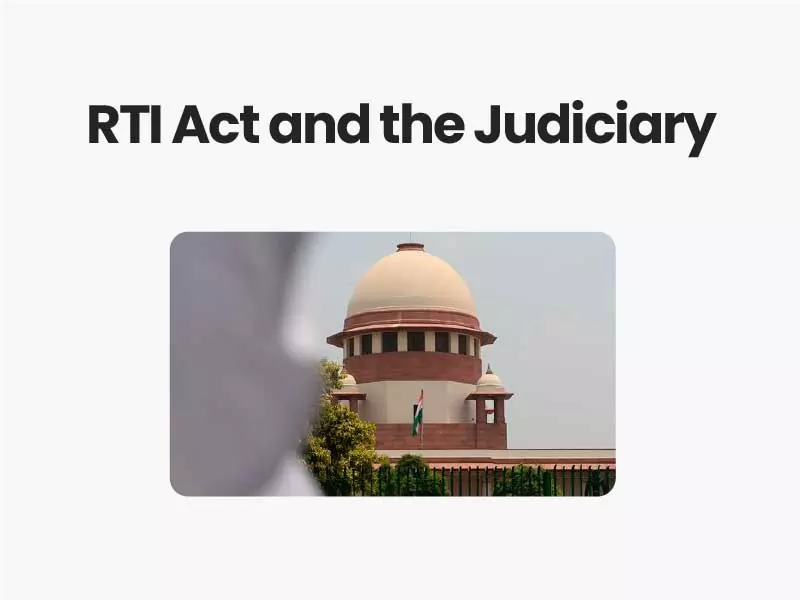
Recently, the Supreme Court of India held that the office of the Chief Justice of India (CJI) is a public authority and falls within the ambit of the Right to Information Act.
A five-judge Constitution bench headed by Chief Justice Ranjan Gogoi gave the ruling.
Background:
Previously, the Delhi High Court judgment which ruled that office of the Chief Justice comes under the purview of RTI. A plea was filed by Supreme Court Secretary-General challenging Delhi High Court’s order.
The concept of judicial independence is not a judge’s personal privilege but responsibility cast on the person, the HC had said in its ruling.
RTI Act, 2005
Under the RTI Act, 2005, every public authority has to provide information to persons requesting for the information under the Act.
Public Authority includes the body constituted by or under the Constitution. Article 124 of the Constitution deals with the establishment of the Supreme Court of India.
Information includes any material in any form, including records, documents, memos, e-mails, etc.
Highlights
- The Supreme Court is a “public authority” and the office of the CJI is part and parcel of the institution. Hence, if the Supreme Court is a public authority, so is the office of the CJI.
- The Judiciary cannot function in total insulation as judges enjoy a constitutional post and discharge public duty.
- However, Right to Privacy is an important aspect and has to be balanced with transparency while deciding to give out information from the office of the Chief Justice of India.
- RTI cannot be used as a tool of surveillance and that judicial independence has to be kept in mind while dealing with transparency.
- On the issue related to the appointment of judges, the Supreme Court held that only the names of the judges recommended by the Collegium for appointment can be disclosed, not the reasons.
Read Also Gig Economy. Checks and Balances System
Outcomes
- The office of the CJI will now entertain RTI applications.
- The Ruling is an example for other bodies such as political parties, a number of schools, trusts and public-private partnerships who resist categorisation as public authorities under the Act.
- However, it has been seen that Officessuch as those of the Prime Minister and the President which are public authorities under the RTI Act has often denied information quoting separate observations by the Supreme Court.
- Officials need to furnish only such information which already exists and is held by the public authority and not collate or create information, that is
- The nation does not want a scenario where 75% of the staff of public authorities spends 75% of their time in collecting and furnishing information to applicants instead of discharging their regular duties.
Enroll today with the best civils service academy and take your first step towards yours Civils journey.
Feel free to reach out to us for any inquiries, collaborations, or support. We’re here to help.