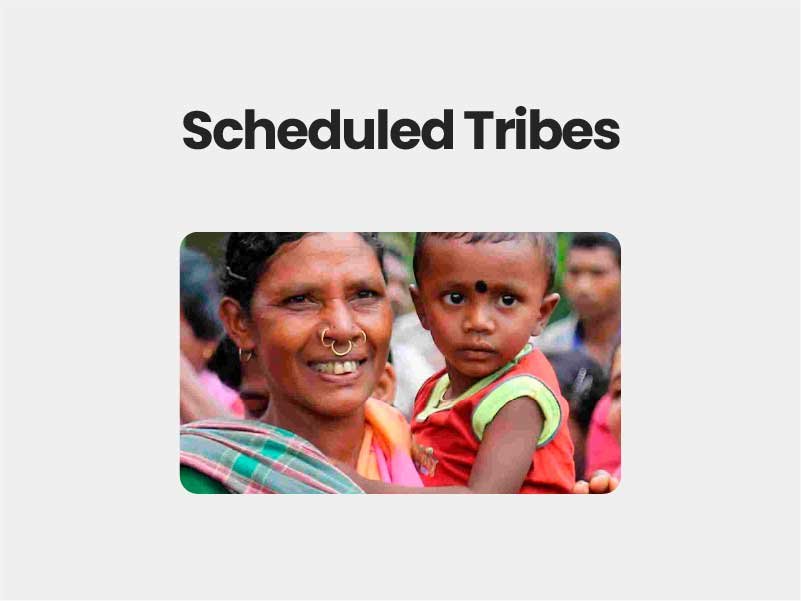
Scheduled Tribes
The Constitution of India does not define Scheduled Tribes as such. Article 366(25) refers to ST as those communities who are scheduled in accordance with Article 342 of the Constitution. According to Article 342 of the Constitution, the ST are the tribes or tribal communities or part of or groups within these tribes and tribal communities which have been declared as such by the President through a public notification. As per the 1991 Census, the Scheduled Tribes account for 67.76 million representing 8.08 percent of the country’s population. ST are spread across the country mainly in forest and hilly regions.
The essential characteristics of these communities are:
- Primitive Traits
- Geographical isolation
- Distinct culture
- Shy of contact with the community at large
- Economically backwards
Distribution
The Scheduled Tribes are notified in 30 States/UTs and the number of individual ethnic groups notified as ST are 705.
Broadly the STs inhabit two distinct geographical areas – Central India and the North- Eastern Area. More than half of the Scheduled Tribe population is concentrated in Central India, i.e., Madhya Pradesh (14.69%), Chhattisgarh (7.5%), Jharkhand (8.29%), Andhra Pradesh (5.7%), Maharashtra (10.08%), Orissa (9.2%), Gujarat (8.55%) and Rajasthan (8.86%). The other distinct area is the North East (Assam, Nagaland, Mizoram, Manipur, Meghalaya, Tripura, Sikkim and Arunachal Pradesh).
Read Also Particularly Vulnerable Tribal Groups
Scheduled Tribes – Constitutional provisions
- Article 46: The State shall promote with special care, the educational and economic interests of the weaker sections of the society and in particular, of the Scheduled Castes and Scheduled Tribes and shall protect them from social injustice and all forms of exploitation.
Reservation in the educational institution has been provided in Article 15(4) while reservation in posts and services has been provided in Article 16(4), 16(4A) and 16(4B) of the Constitution.
- Article 23: prohibits traffic in human beings and the beggar and other similar forms of forced labour have a special significance for Scheduled Tribes. In pursuance of this Article, Parliament has enacted the Bonded Labour System (Abolition) Act, 1976.
- Article 24: prohibits employment of children below the age of 14 years in any factory or mine or in any other hazards activity is also significant for Scheduled Tribes as a substantial portion of child labour engaged in these jobs belong to Scheduled Tribes.
- Article 243D: reservation of Seats for ST in Panchayats.
- Article 330: reservation of seats for ST in the House of the People.
- Article 332: reservation of seats for Scheduled Tribes in Legislative Assemblies of the States.
- Article 334: reservation of seats for Scheduled Castes and Scheduled Tribes in the Lok Sabha and the State Vidhan Sabhas (and the representation of the Anglo-Indian Community in the Lok Sabha and the State Vidhan Sabhas by nomination) would continue up to January 2020.
Acts and rules
- Forest rights act 2006: The Scheduled Tribes (STs) and Other Traditional Forest Dwellers (OTFDs) (Recognition of Forest Rights) Act, 2006 is being implemented to recognize and vest the forest rights and occupation in forest land to forest-dwelling Scheduled Tribes
- Protection of civil rights act: An Act to prescribe punishment for the preaching and practice of – “Untouchability” for the enforcement of any disability arising therefore for matters connected therewith
- SC/ST Prevention of atrocities act: An Act to prevent the commission of offences of atrocities against the members of the Scheduled Castes and the Scheduled Tribes, to provide for Special Courts for the trial of such offences and for the relief and rehabilitation of the victims of such offences and for matters connected therewith or incidental thereto.
- Provision of panchayats act 1996: It mandates that the Gram Sabha or the Panchayats at the appropriate level shall be consulted before making the acquisition of land in the Scheduled Areas or development projects and before resettling or rehabilitating persons affected by such projects in the Scheduled Areas.
National Commission for Scheduled Tribe
NCST was established by amending Article 338 and inserting a new Article 338A in the Constitution through the Constitution (89th Amendment) Act, 2003. By this amendment, the erstwhile National Commission for Scheduled Castes and Scheduled Tribes was replaced by two separate Commissions namely- (i) the National Commission for Scheduled Castes (NCSC), and (ii) the National Commission for Scheduled Tribes (NCST).
NCST is empowered to investigate and monitor matters relating to safeguards provided for STs under the Constitution or under other laws or under Govt. order. The Commission is also authorized to inquire into specific complaints relating to rights and safeguards of STs and to participate and advise on the Planning Process relating to the socio-economic development of STs and to evaluate the progress of their development under the Union and States.
Read Also Agroecology
The Tribal Sub Plan (TSP) strategy
The Tribal Sub Plan (TSP) strategy is a Government of India initiative aimed for the rapid socio-economic development of tribal people. The funds provided under the Tribal Sub Plan of the State have to be at least equal in proportion to the ST population of each State or UTs. Similarly, Central Ministries/Departments are also required to earmark funds out of their budget for the Tribal Sub-Plan. As per guidelines issued by the Planning Commission, the Tribal Sub Plan funds are to be non-divertible and non-lapsable. The National Commission for Scheduled Tribes is vested with the duty to participate and advise in the planning process of socio-economic development of STs, and to evaluate the progress of their development under the Union and any State.
Enroll today with the best civils service academy in Trivandrum and take your first step towards your Civils journey. Feel free to reach out to us for any inquiries, collaborations, or support. We’re here to help.