
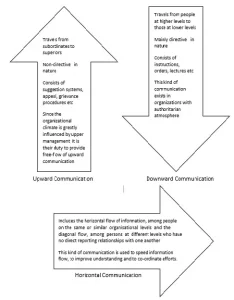
Communication in organization is a two-way process. Moreover, it is a process that takes place upward, downward and laterally throughout the organisation.
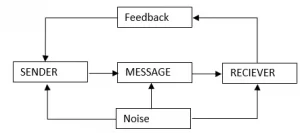
The communication process as shown in the following figure, involves the sender, the transmis-sion of a message through the selected channel and the receiver.

- Downward Communication:
- Katz and Kahn have identified five general purposes of superior-subordinate communication in an organization :
- To give specific task directives about job instructions;
- To give information about organizational procedures and practices;
- To provide information about the rationale of the job;
- To tell subordinates about their performance;
- To provide ideological information to facilitate the indoctrination of goals.
- Katz and Kahn have identified five general purposes of superior-subordinate communication in an organization :
- Upward Communication:
- Unfortunately, this flow is often hindered by administrators in the communication chain who filter the messages and do not transmit all the information—especially unfavorable news—to their bosses.
- Crosswise Communication:
- A communications scholar has summarized four of the most important purposes of crosswise (interactive) communication
- Task coordination
- Problem solving
- Information sharing
- Conflict resolution
- A communications scholar has summarized four of the most important purposes of crosswise (interactive) communication
- Crosswise Communication:
Morale is used to describe the capacity of the people to maintain belief in an institution or goal or even in oneself.
According to Alexander H Leighton “morale is the capacity of a group of people to pull together persistently and consistently in pursuit of common purpose”
The high morale is characterised by a state of enthusiasm, confidence and spiritedness and the low morale is characterised by lack of interest, diffidence and weakness.
Generally it is believed that high morale will lead to high productivity. However,Prof Keith Davis points out that there is not always a positive correlation between the two. There can be high production with low morale.
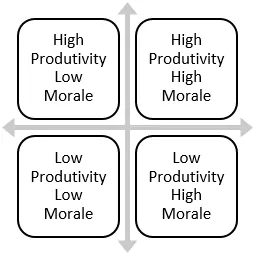
Research carried out by Renis Likertindicated the fact that there can be different combinations of morale and productivity as shown in the figure. High morale and high productivity; High morale and low productivity; low morale and high productivity; low morale and low productivity. However in the final analysis the manager has to work to improve the morale of the employees.
High morale makes the work more pleasant and will go a long way in improving the work climate.
Factors affecting morale
Some of the important factors affecting the morale are
Personnel Management: process & techniques
- According to Chester Barnard, an organization is a set of functions and an assemblage of socially interacting individuals.
- The organization can attain its maximum efficiency when every individual in the organization performs at their optimum level.
- To ensure maximum efficiency several tools and techniques are used like promotion, process of recruitment, training, grievance redressal mechanism and career development affecting the morale of the individuals.
Human relations
- Human relations are concerned with all those elements that affect the interpersonal relations having components like leadership, decision making, communication and motivation
- Leadership affects the morale of the organisation.The actions of managers exert a strong influence over the morale of the workforce. Fair treatment, equitable reward and recognition for good work affect morale. Likert’s employee centered leadership goes along with the morality building for workers.
- Decision Making should also be dependent on the situation. For instance, if the organization is populated with mature individuals then the decision should be inclusive and if populated with immature personalities then directive and coercive decisions should be enforced.
- Motivation is directly linked with the morale
- When an organization is populated with unskilled workers and has to perform standard and repetitive jobs, then top down communication will enhance the morale of individuals. In case of non standardized jobs, the workers will be skilled and mature therefore free flow of communication will sustain high morale of the organisation.
Organizational Environment
- The goal of the organization influences the attitudes of employees if the goals are acceptable to workers to develop a positive feeling towards the job and organization.
- A clear structure with well defined duties and responsibilities encourages people to work with confidence.
- The reputation of the company is the another important factor as it makes the worker more proud and build a spirit of loyalty
- Poor attitude of co-workers influences others.
Morale And Efficiency
The organization can attain its maximum efficiency when every individual in the organization performs at their optimum level in cooperation with each other.
The organization efficiency is based on 2 factors- Able & Willing
Organizational efficiency is largely determined by the degree of the individuals integration to organization by bridging the gap between the organizational and individual goals.
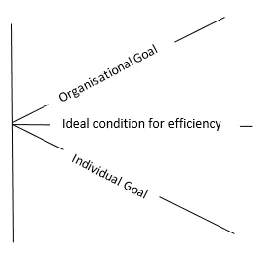
In Fact it is expressed by many theorists -Fusion by Argyris, transactional influence by McGregor and Integrating Influence system of Likert.
High morality plays a critical role in reducing the differences. On the contrary, low morale builds frustration and leads to divergence of individual and organizational goal