Cage Aquaculture
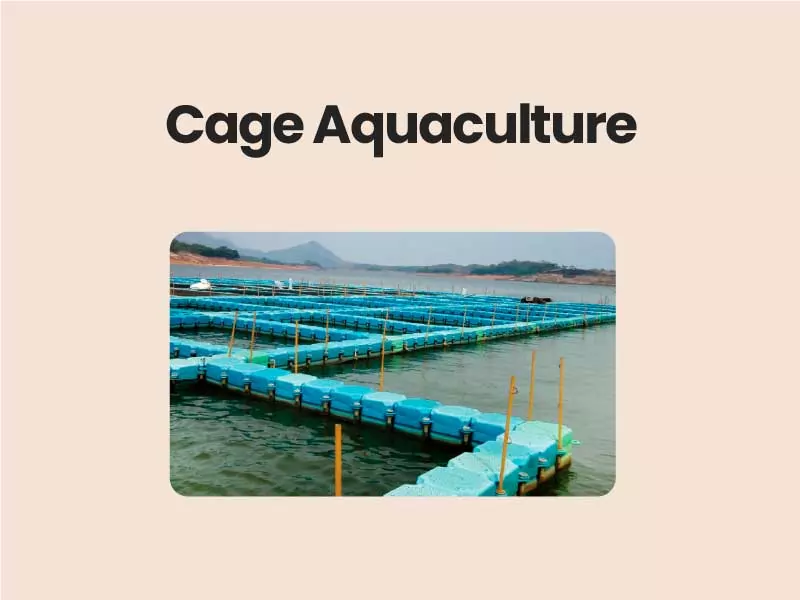
Cage aquaculture involves the growing of fishes in existing water resources while being enclosed in a net cage which allows free flow of water. It is an aquaculture production system made of a floating frame, net materials and mooring system (with rope, buoy, anchor etc.)
with a round or square shaped floating net to hold and culture a large number of fishes and can be installed in reservoirs, river, lake or sea.
A catwalk and handrail is built around a battery of floating cages.
There are 4 types of fish-rearing cages namely:
i) Fixed cages
ii) Floating cages
iii) Submerged cages
iv) Submersible cages.
Economically speaking, cage culture is a low impact farming practice with high returns and least carbon emission activity.
Farming of fish in an existing water body removes one of the biggest constraints of fish farming on land, ie., the need for a constant flow of clean, oxygenated water.
Cage farms are positioned in such a way to utilize natural currents, which provide the fish with oxygen and other appropriate natural conditions.
In view of the high production attainable in the cage culture system, it can play a significant role in increasing the overall fish production in India.
Suitable locations in India’s long coastline, vast brackish water areas available in coastal states and other underutilized water bodies can be better utilized by adopting cage culture.
Since the investment is low and requires very little / no land area, this farming method is ideal for small-scale fisherfolks as an alternative income source.
This can be taken up as a household / women activity since labour involved is minimal and can be managed by a small family. The design of the cage and its accessories can be tailor-made in accordance to the individual farmer’s requirements.
Advantages
- Many types of water resources can be used, including lakes, reservoirs, ponds, strip pits, streams and rivers which could otherwise not be harvested.
- A relatively low initial investment is required in an existing body of water.
- Harvesting is simplified.
- Observation and sampling of fish is simplified.
- Allows the use of the pond for sport fishing or the culture of other species.
- Less manpower requirement.
- Generation of job opportunities for unemployed youth and women.
- Additional income to fishers during closed seasons.
Disadvantages
Cage culture also has some distinct disadvantages. These include:
- Feed must be nutritionally complete and kept fresh.
- Low Dissolved Oxygen Syndrome (LODOS) is an ever present problem and may require mechanical aeration.
- Fouling of the net cage.
- The incidence of disease can be high and diseases may spread rapidly.
- Vandalism or poaching is a potential problem.
- Navigation issues.
- Accumulation of unused feed and excreta will lead to water pollution as well as eutrophication.
- Change in water quality parameters.
- Conflicts within the local community.
- Predation by aquatic mammals and birds.
- Escapement.
- Overcrowding of aquatic organisms in cages
Enroll today with the best civils service academy and take your first step towards your Civils journey.
Feel free to reach out to us for any inquiries, collaborations, or support. We’re here to help.