
Impact of climate change on cryosphere
Impact of climate change on cryosphere The cryosphere is a large and important component of our earth, which has a profound impact and in turn is hugely impacted by climate and climate change. The cryosphere comprises of the Earth’s ice – notably the Arctic, the Antarctic, and the world’s glaciers. Arctic sea ice began to decline around 1900, with a more accelerated ice loss since the 1950s. Since 1979, satellite records have confirmed an overall decline in summer sea ice coverage of around 13% per decade. Although fears that Arctic sea ice would reach a ‘tipping point’ and rapidly disappear currently seem to be unfounded, the mainstream view of scientists is that we will see ice-free summers in the Arctic Ocean within the next few decades. Process and Climate Change Cryosphere process and climate change: Objectives: To study the fundamental processes involved in the biogeochemical cycling (measurements of processes and factors influencing the same) within the snow packs as well as during the subsequent transformation to firn and ice in the polar and other region and elsewhere. To study the biotic components in the cryosphere responsible for meditating the exchange processes. To study the glaciological processes, accumulation patterns and snow layering characteristics for understanding the fundamental processes influencing the temporal records of ice. To reconstruct the environment variables like temperature, precipitation, aerosols, and sea ice conditions during the past 200-2000 years with annual to sub-annual resolution to better understand the recent climate change in polar/tropical region and their global teleconnections. To decipher the role of various internal and external forcing mechanisms on polar and global climate on a decadal centennial and millennial time scales. Effects of Cryosphere on global climate: Water cycling Carbon trapping agents Maintaining global temperatures IPCC’s Report The IPCC prepares comprehensive Assessment Reports about the state of scientific, technical and socio-economic knowledge on climate change, its impacts and future risks, and options for reducing the rate at which climate change is taking place. However, IPCC does not conduct its own research. Global Warming of 1.5° C: A special report, which was commissioned to specifically explore the scientific feasibility of the 1.5°C goal set in the Paris Agreement, on global warming. The Assessment Report released by IPCC in 2014 was the 5th in a series of such reports. 6th Assessment Report of IPCC is expected to be released in 2022. The Intergovernmental Panel on Climate Change (IPCC) is the international body for assessing the science related to climate change. It was set up in 1988 by the World Meteorological Organization (WMO) and United Nations Environment Programme (UNEP) to provide policymakers with regular assessments of the scientific basis of climate change, its impacts and future risks, and options for adaptation and mitigation. IPCC assessments provide a scientific basis for governments at all levels to develop climate-related policies, and they underlie negotiations at the UN Climate Conference – the United Nations Framework Convention on Climate Change (UNFCCC). Key findings: The Melting of Glaciers: The melting glaciers are the dominant source of sea-level rise, exceeding the effect of thermal expansion of ocean water (due to rising temperatures). Global Mean Sea-Level: It has increased by 16 cm between 1902 and 2015, and that the rate of increase had doubled of late. Ocean Warming: Global ocean has warmed unabated since 1970 and has taken up more than 90% of the excess heat in the climate system. Albedo of snow/ice sheet is high Cryosphere has direct and indirect bearing on the global climate. Therefore, if we want to protect the biosphere then we must protect the Cryosphere. Enroll today with the best civils service academy and take your first step towards your Civils journey. Feel free to reach out to us for any inquiries, collaborations, or support. We’re here to help.. Join now
mRNA Vaccine
mRNA Vaccine In collaboration with HDT Biotech Corporation, Seattle, USA, Gennova has developed an mRNA vaccine candidate (HGCO19), with demonstrated safety, immunogenicity, neutralization antibody activity in the rodent and non-human primate models. The company is working aggressively to ensure first human injection by the end of the year, subject to Indian regulatory approvals. mRNA-1273 is the working name of Moderna’s vaccine, which is currently in Phase 1 clinical trials under the aegis of the US National Institute of Allergy and Infectious Diseases (NIAID). The mRNA means messenger RNA, which carries the genetic formula for the coding of a specific protein. The vaccine, when injected into a person for coding the spike protein, then even without the introduction of an attenuated (recognisable but not harmful) virus into the body, the body learns what the virus looks like and arms itself with the antibodies that are required to act against it. The mRNA while entering the body has managed to show an immune response in the first eight patients. The results showed that even lower doses brought an immune response to the magnitude caused by natural infection. These data indicate that mRNA-1273 has the potential to prevent Covid-19 disease. Enroll today with the best civils service academy and take your first step towards your Civils journey. Feel free to reach out to us for any inquiries, collaborations, or support. We’re here to help. Join now
Startups in India
Startups in India Startup India is a flagship initiative of the Government of India, intended to build a strong eco-system for nurturing innovation and Startups in the country that will drive sustainable economic growth and generate large scale employment opportunities. The Government through this initiative aims to empower Startups to grow through innovation and design. The action plan comprises of 19 action items spanning across areas such as “Simplification and handholding”, “Funding support and incentives” and “Industry-academia partnership and incubation”. Since its inception, 28,979, Startups across the country have been recognised by Department for Promotion of Industry and Internal Trade (DPIIT) Salient features of Startup India Action Plan Compliance Regime based on Self-Certification Startup India Hub Rolling-out of Mobile App and Portal Legal Support and Fast-tracking Patent Examination at Lower Costs Relaxed Norms of Public Procurement for Startups Faster Exit for Startups According to data available with the SIDBI, the Startup India fund has allocated Rs 2,265 crore to Venture Capital (VC) funds at the end of March 2019, falling short of its capital allocation target by around Rs 1,000-1,200 crore. It was launched in the year 2016 with the corpus of Rs.10,000 crore, to be built over 14th and 15th Finance Commission cycles. SIDBI manages the fund. A venture capital (VC) fund is a sum of money that investors commit for investment in early-stage companies. Government Innitiatives: Setting up of 7 New Research Parks Modeled on the Research Park Setup at IIT Madras Promoting Startups in the Biotechnology Sector NIDHI (National Initiative for Developing and Harnessing Innovations) Uchhattar Avishkar Yojana Innovation and Entrepreneurship Development Centres (IEDCs) Atal Innovation Mission (AIM) with Self-Employment and Talent Utilization (SETU) Program. Way Forward: Annual Incubator Grand Challenge Promoting Startups in the Biotechnology Sector Harnessing Private Sector Expertise for Incubator Setup Organizing Startup Fests for Showcasing Innovation and Providing a Collaboration Platform Enroll today with the best civils service academy and take your first step towards your Civils journey. Feel free to reach out to us for any inquiries, collaborations, or support. We’re here to help. Join now
Biodiversity governance
Biodiversity governance Globally, the diversity of life on earth is declining due to human activities despite increasing efforts to address it. Global biodiversity loss has severe impacts on human well-being. There is an urgent need to transform the Convention on Biological Diversity, the principal global governance framework on this issue, to better respond to this challenge. National Biodiversity Strategies and Action Plans (NBSAPs) need to be significantly strengthened as concrete mechanisms for the implementation of biodiversity commitments at the national level. Biodiversity Governance in India: India is one among the 17 mega-diverse countries of the world. But many plants and animals are facing the threat of extinction. To protect the critically endangered and other threatened animal and plant species, the Government of India has adopted many steps, laws, and policy initiatives. India’s Biological Diversity Act 2002 (BD Act), is in close synergy with the Nagoya Protocol. The BD Act was hailed as an important step towards preserving India’s vast biodiversity, as it recognized the sovereign right of countries over its natural resources. The act also strengthens the country’s stand with respect to anyone claiming an intellectual property right over biodiversity-related knowledge. The CBD was designed around three objectives: “the conservation of biological diversity, the sustainable use of its components, and the fair and equitable sharing of the benefits arising out of the utilization of genetic resources”. Challenges: Access to crop genetic resources is not covered under the purview of the Nagoya Protocol, it is protected under the International Treaty on Plant Genetic Resources for Food and Agriculture. No Recognition of Traditional Knowledge Erosion Traditional Breeding Systems The Nagoya Protocol noted that each party shall consider the importance of genetic resources for food and agriculture and their special role for food security. Thus, traditional agriculture and conventional practices are exempted from the purview of benefit-sharing. Government Initiatives: The Central Bureau of Investigation (CBI) has been empowered under the Wild Life (Protection) Act, 1972 to apprehend and prosecute wildlife offenders. The State Governments have been requested to strengthen the field formations and intensify patrolling in and around the Protected Areas. The Centrally Sponsored Scheme of National Plan for Conservation of Aquatic Eco-System also provides assistance to the States for the management of wetlands including Ramsar sites in the country. Wildlife Crime Control Bureau has been established for the control of illegal trade in wildlife, including endangered species. Way forward Integration of International Treaties Financial and technical assistance is extended to the State Governments under various Centrally Sponsored Schemes, viz, ‘Integrated Development of Wildlife Habitats’, ‘Project Tiger’ and ‘Project Elephant’ for providing better protection and conservation to wildlife. Promoting Agricultural Societies Enroll today with the best civils service academy and take your first step towards your Civils journey. Feel free to reach out to us for any inquiries, collaborations, or support. We’re here to help. Join now
Urban Employment Crisis
Urban Employment Crisis Urban unemployment crept up to 9.83% in August as against 9.15% in July, according to monthly unemployment data released by CMIE. The overall national unemployment rate was at 8.35% in August as against 7.43% . India was gradually getting gripped in the pandemic, but is far higher in the pre-covid months like February, January and December when the national joblessness rate was hovering between 7.22% and 7.76%. Urban Unemployment: Urban Unemployment is mainly of three types: Industrial Unemployment: If a person has to remain unemployed for a given period due to the changes in industrial sector, such a condition is called industrial unemployment. For example, the people who migrate from rural area, in search of employment, are semi-literate and have no special training and skill. 2. Educated Unemployment: When a person is educated and is not able o find a suitable and efficient job for himself. This also occurs when there is a large number of graduates or postgraduates, but limited job opportunities and limited companies. 3. Technological Unemployment: Technological unemployment occurs when developments in technology and working practices cause some workers to lose their jobs. Technological unemployment is considered to be part of a wider concept known as structural unemployment. UPSC Prelims Mock Test Challenges to Employment: Vulnerable employment: According to the International Labour Organization, of the 535 million labour force in India in 2019, some 398.6 million have poor quality jobs. Further, the lockdown exposed the state of vulnerable employment in urban low-end informal jobs. Reverse Migration Working poors are increasing in India. Slowdown in Major Employment Generating Sector. Government Initiatives: Garib Kalyan Rojgar Abhiyaan’ launched in June: It (aimed to provide livelihood opportunities in rural India) could be an immediate relief, the ₹50,000-crore employment scheme cannot be a substitute for decent urban jobs. Given the structure of the economy and demographic profile, it is important to focus on reducing the vulnerabilities of urban informal jobs in the long run. Self Employment Programme of urban poor Mahatma Gandhi Employment Guarantee Act Way Forward: To implement employment-intensive investment policies. Prioritising Urban Infrastructure Focusing on rural development to increase employment opportunities in rural areas and to enhance the provision of services like education, health, electricity and water and sanitation services are effective means to control rural to urban migration. The focus on urban employment generation programmes. Private investments need to be facilitated by conducive contractual relations between labour and capital. Enterprise formation needs to be an integral part of the strategy, with converging interests for workers and entrepreneurs on issues related to technology and productivity enhancement. Small and micro-enterprises, the fulcrum of industrialisation, need extra support to balance the interests between labour and capital as neither have collective bargaining powers. Prioritise urban infrastructure as it accounts for a large share of total investments in the local economy. Enroll today with the best civils service academy and take your first step towards your Civils journey. Feel free to reach out to us for any inquiries, collaborations, or support. We’re here to help. join now
Polavaram Project
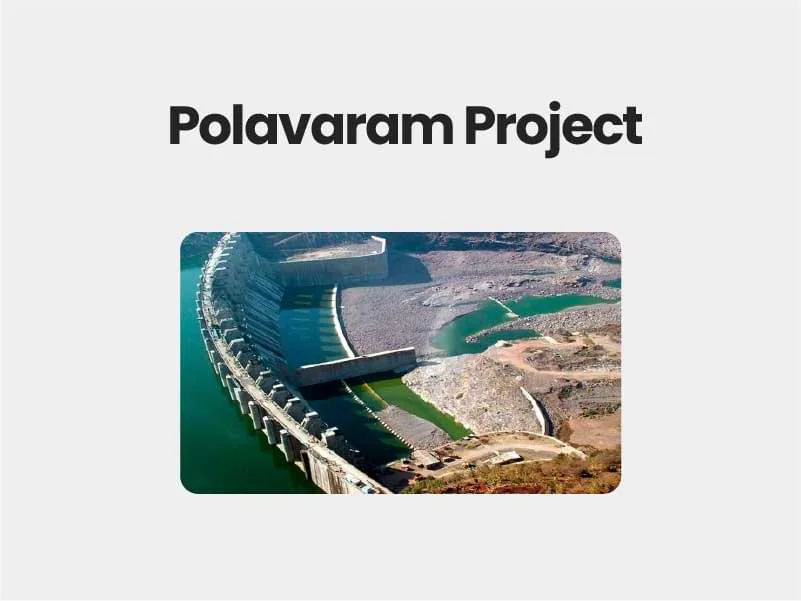
Polavaram Project Polavaram Project is a multi-purpose irrigation project. The dam across the Godavari River is under construction located in West Godavari District and East Godavari District in Andhra Pradesh state and its reservoir spreads in parts of Chhattisgarh and Orissa States also. The project is multipurpose major terminal reservoir project on river Godavari for development of Irrigation, Hydropower and drinking water facilities to East Godavari, Vishakhapatnam, West Godavari and Krishna districts of Andhra Pradesh. The Polavaram project was accorded national status in 2014 in the Andhra Pradesh Bifurcation Act and its design was changed. Objectives of Polavaram Project The Project envisages construction of Earth-cum-Rock fill dam across river Godavari. This project will supply 23.4TMC of drinking water to Visakhapatnam city and also to Vizag steel plant through its left canal It will also facilitate an inter-basin transfer of 80TMC annually to the Krishna river basin through its Right canal. It will also provide indirect benefits such as development of Pisciculture, tourism and urbanisation. Land used for the project: A total of 17,800 acres of land – 6,600 acres of forestland and 11,200 acres of revenue land – spread across 127 villages in four constituencies of West Godavari district – Polavaram, Chintalapudi, Gopalavaram and Denduluru – is being acquired for the project Features: The Project envisages construction of Earth-cum-Rock fill dam across river Godavari. The maximum height of the dam is 48 m. Benefits to Other States Odisha and Chhattisgarh shall be benefitted with 5 TMC & 1.5 TMC of irrigation water respectively Odisha and Chhattisgarh can develop & exploit pisciculture and boating facilities in their own territories 80 TMC of water in Krishna river shall be saved on account of diversion of equal amount from river Godavari. The water saved in river Krishna shall be shared between Andhra (45 TMC), Karnataka (21 TMC) & Maharashtra (14 TMC Significance for Andhra Pradesh: It will irrigate nearly 3 lakh ha of land, generate hydel power with installed capacity of 960 MW and provide drinking water facilities to 540 enroute villages covering 25 lakh populations. Read Also Sedition Law Enroll today with the best civils service academy and take your first step towards your Civils journey. Feel free to reach out to us for any inquiries, collaborations, or support. We’re here to help. join now
Regional Comprehensive Economic Partnership
Regional Comprehensive Economic Partnership The Regional Comprehensive Economic Partnership (RCEP) is a so-called mega-regional economic agreement being negotiated since 2012 between the 10 ASEAN (Association of South-East Asian Nations) governments and their six FTA partners: Australia, China, India, Japan, New Zealand and South Korea. The proposed RCEP would cover almost every aspect of economy such as goods, services, investment, economic and technical cooperation, intellectual property rights (IPR), rules of origin, competition and dispute settlement. To achieve a modern, comprehensive, high-quality, and mutually beneficial economic partnership agreement among the ASEAN Member States and ASEAN’s FTA partners. The RCEP was built upon the existing ASEAN+1 FTAs with the spirit to strengthen economic linkages and to enhance trade and investment-related activities as well as to contribute to minimizing development gap among the parties. India has dropped out of the RCEP in November 2019 in ASEAN+3 summit. Read also India- Maldives relations Enroll today with the best civils service academy and take your first step towards your Civils journey. Feel free to reach out to us for any inquiries, collaborations, or support. We’re here to help. Join now
Income Tax Appellate Tribunal (ITAT)
Income Tax Appellate Tribunal (ITAT) Income Tax Appellate Tribunal (ITAT) is a quasi-judicial institution set up in 1941 under section 5A of the Income Tax Act, 1922. Initially, it had three Benches at Delhi, Kolkata and Mumbai. But presently ITAT has 63 Benches at 27 different stations It deals with appeals under the Direct Taxes Acts namely, the Income-tax Act, 1961. The orders passed by the ITAT are final, an appeal lies to the High Court only if a substantial question of law arises for determination. ITAT draws inspiration from its motto ‘Nishpaksh Sulabh Satvar Nyay’, which means impartial, easy and speedy justice. ITAT stands out for its uniqueness of imparting justice to the litigants, by an inexpensive, easily accessible forum free from technicalities, regarded for its expert knowledge on the subject of Direct Taxes, besides rendering expeditious justice. More often than not, ITAT is referred to as ‘Mother Tribunal’ being the oldest Tribunal in the country. It is the success of the ITAT, which has prompted the Government of India to constitute similar Appellate Tribunals for indirect taxes i.e. Customs, Excise, Service Tax Appellate Tribunal (CESTAT), Central Administrative Tribunal (CAT), Railway Claims Tribunal, Foreign Exchange Appellate Board, etc. UPSC Mains Answer Writing Enroll today with the best civils service academy and take your first step towards your Civils journey. Feel free to reach out to us for any inquiries, collaborations, or support. We’re here to help. Join now
India- Maldives relations
India- Maldives relations As close and friendly neighbours, India and Maldives share ethnic, linguistic, cultural, religious and commercial links steeped in antiquity and enjoy cordial and multi-dimensional relations. India was among the first to recognise Maldives after its independence in 1965 and to establish diplomatic relations with the country. India established its mission at Malé in 1972. Importance of Maldives to India: People To People Contact Economic and Commercial Relations: India and Maldives signed a trade agreement in 1981, which provides for export of essential commodities. Growing from modest beginnings, India-Maldives bilateral trade now stands at Rs.700 crores. Indian exports to the Maldives include agriculture and poultry produce, sugar, fruits, vegetables, spices, rice, wheat flour (Atta), textiles, drugs and medicines, a variety of engineering and industrial products, sand and aggregate, cement for building etc. Indian imports primarily scrap metals from the Maldives. Under the bilateral agreement, India provides essential food items like rice, wheat flour, sugar, dal, onion, potato and eggs and construction material such as sand and stone aggregates to Maldives on favourable terms 3. Indian Business in Maldives Cultural Relations: The India Cultural Center (ICC), established in Male in July 2011, conducts regular courses in yoga, classical music and dance. ICC programmes have become immensely popular among Maldivians of all ages. Indian Community Capacity Building and Training Maldives Vs India Radicalisation Political Instability China’s strategic footprint in India’s neighbourhood has increased. The Maldives has emerged as an important ‘pearl’ in China’s “String of Pearls” construct in South Asia. The India-Maldives relationship suffered a setback when Maldives entered into a Free-Trade Agreement (FTA) with China in 2017. Significance : Geographical: Maldives’ proximity to the west coast of India. History: India and Maldives share ethnic, linguistic, cultural, religious and commercial links Geo-political: Maldives is an important aspect of India’s ‘Neighbourhood First’ policy. Trade and Tourism: India is Maldives’ 4th largest trade partner after UAE, China and Singapore. In 2018, India was the 5th largest source of tourist arrivals in Maldives. Defence: Its potential to allow a third nation’s naval presence in the area. Diaspora: Indians are the second largest expatriate community in Maldives with an approximate strength of around 22,000. Disaster Management: The Government of India has provided large-scale assistance to Maldives in the aftermath of the 2004 Indian Ocean tsunami and during the 2014 Male water crisis. Initiatives proposed: Air connectivity “bubble” for travel direct ferry service Submarine cable for telecom connectivity assistance for the Greater Male Connectivity project (GMCP) At present, India-assisted projects in the region include water and sewerage projects on 34 islands, reclamation project for the Addl island, a port on Gulhifalhu, airport redevelopment at Hanimadhoo, and a hospital and a cricket stadium in Hulhumale. Read GS Notes by Ravisankar Sarma UPSC Topper Enroll today with the best civils service academy and take your first step towards your Civils journey. Feel free to reach out to us for any inquiries, collaborations, or support. We’re here to help. Join now
Treaty of brest-litovsk
Treaty of brest-litovsk Treaties of Brest-Litovsk, peace treaties signed at Brest-Litovsk (now in Belarus) by the Central Powers with the Ukrainian Republic (Feb. 9, 1918) and with Soviet Russia (March 3, 1918), which concluded hostilities between those countries during World War I. Out Break of the Civil War: The February Revolution broke out in early March 1917 (or February, according to the Julian calendar, which the Russians used at the time); Nicholas abdicated later that month. After Lenin’s return from exile (aided by the Germans) in mid-April, he and his fellow Bolsheviks worked quickly to seize power from the provisional government, led by Alexander Kerensky, Russia’s minister of war. In early November, aided by the Russian military, they were successful. One of Lenin’s first actions as leader was to call a halt to Russian participation in the war. An armistice was reached in early December 1917 and a formal cease-fire was declared December 15, but determining the terms of peace between Russia and the Central Powers proved to be far more complicated. Negotiations began at Brest-Litovsk on December 22. Leading their respective delegations were foreign ministers Leon Trotsky (1879-1940) of Russia, Richard von Kuhlmann of Germany and Count Ottokar Czernin of Austria. In mid-February, the talks broke down when an angry Trotsky deemed the Central Powers’ terms too harsh and their demands for territory unacceptable. Fighting resumed briefly on the Eastern Front, but the German armies advanced quickly, and both Lenin and Trotsky soon realized that Russia, in its weakened state, would be forced to give in to the enemy terms. Negotiations resumed later that month and the final treaty was signed on March 3, 1918. By the terms of the Treaty of Brest-Litovsk, Russia recognized the independence of Ukraine, Georgia and Finland; gave up Poland and the Baltic states of Lithuania, Latvia and Estonia to Germany and Austria-Hungary; and ceded Kars, Ardahan and Batum to Turkey. The total losses constituted some 1 million square miles of Russia’s former territory; a third of its population or around 55 million people; a majority of its coal, oil and iron stores; and much of its industry. Lenin bitterly called the settlement “that abyss of defeat, dismemberment, enslavement and humiliation.” Read Political Crisis in Nepal Enroll today with the best civils service academy and take your first step towards your Civils journey. Feel free to reach out to us for any inquiries, collaborations, or support. We’re here to help. Join now