
Making India a biotech hub
Making India a biotech hub Aim to develop India into a global innovation hub by 2020 and Biotechnology Industry Research Assistance Council (BIRAC) has paved the way to deliver on that mandate. BIRAC Biotechnology Industry Research Assistance Council (BIRAC) is a not-for-profit Section 8, Schedule B, Public Sector Enterprise, set up by Department of Biotechnology (DBT), Government of India as an Interface Agency to strengthen and empower the emerging Biotech enterprise to undertake strategic research and innovation, addressing nationally relevant product development needs. DBT The Department of Biotechnology (DBT), under the Ministry of Science & Technology, promotes and accelerates the development of biotechnology in India, including growth and application of biotechnology in the areas of agriculture, healthcare, animal sciences, environment and industry. Advantages of Biotechnology Biotechnology is a multi-faceted domain encompassing applications in agriculture, pharmaceuticals, scientific discoveries, etc. The biotech sector can be broadly divided into five major segments: Biopharma Bio-agriculture Bio-services Bio-industrial Applications Bioinformatic The biotechnology sector in India has grown from $1.1 billion in 2003 to a mammoth $64 billion sector in 2019 and by 2024, it is expected to be a $100 billion industry. Biotech start – ups: Currently, there are over 2,700 biotech start-ups and are expected to touch the 10,000-mark by 2024. Challenges Public sector dominated Structural issues Lack of Innovation: India is currently ranked at 52nd on the Global Innovation Index (GII) 2019, with a jump of five places since last year, and 29 places in the past five years. Government Innitiatives Make in India Skill India Start-ups Way Forward Motivate our young scientists to continue this path of research and generate new ideas and solutions. Atma nirbhar Favourable industrial infrastructure and location Need for government support Enroll today with the best civils service academy and take your first step towards your Civils journey. Feel free to reach out to us for any inquiries, collaborations, or support. We’re here to help. join now
Photon for Improving Quantum Technologies
Photon for Improving Quantum Technologies Recently Scientists are working towards understanding the light emission down to a single elementary particle called photon for improving quantum technologies. Spontaneous emission can be tailored by precise engineering of the photon density of states of the elementary particles called photon using photonic structures or periodically ordered patterns; like that in a peacock feather. These structures act as a powerful tool to control the emission and propagation of light. Hence, the emission properties of quantum emitters that can even emit single photons can be tailored for applications in high efficient lasers and quantum technologies. Dr. Rajesh V.Nair, Associate Professor Department of Physics atIndian Institute of Technology-Ropar a recipient of this year’s SwarnaJayanti Fellowship of the Department of Science & Technology (DST), Government of India has achieved precise control on the light transport and emission using engineered photonic systems in the visible region of the electromagnetic spectrum. In order to cater to the requirement of single photons for high emission speed in quantum communication, Dr. Nair aims to understand the light emission down to a single photon level from the precise atomic defects in solid-state materials through the Swarnajayanti Fellowship. He proposes the emission studies of nitrogen-vacancy (NV) centers (nitrogen impurity atoms in a diamond crystal) embedded in photonic structures by modifying the photon density of states around the emitter. This is necessary for enhancing their R & D prospects in photonic quantum technologies and ultra-sensitive sensing. Along with his group, he intends to understand the modification of single photons emission rate as well as the spin properties of NV centers resulting in better intensity and rate of emission readout by measuring the intensity. The controlled manipulation of single spins and photons using defect centers, such as the NV center, is the need of the hour and would place India as the forerunner in quantum technologies. Swarnajayanti Fellowships: Govt. of India had instituted a scheme “The Swarnajayanti Fellowships” to commemorate India’s fiftieth year of Independence. Under this scheme a selected number of young scientists, with proven track record, are provided special assistance and support to enable them to pursue basic research in frontier areas of science and technology. The fellowships are scientist specific and not institution specific, very selective and have close academic monitoring.. The award consists of a Fellowship of Rs 25000/- per month in addition to the salary drawn from the parent Institute along with a Research Grant of Rs 5 lakh per annum by Department of Science and Technology for a period of 5 years, while the project submitted by the selected Fellows will be considered for funding by the Science & Engineering Research Board (SERB) as per SERB norms, for recurring and non-recurring heads. Scientists selected for the award will be allowed to pursue unfettered research with a freedom and flexibility in terms of expenditure as approved in the research plan. The project should contain innovative research idea and it should have a potential of making impact on R&D in the discipline. The duration of the fellowship will be for a period not exceeding five years. Enroll today with the best civils service academy and take your first step towards your Civils journey. Feel free to reach out to us for any inquiries, collaborations, or support. We’re here to help. join now
Shanghai Cooperation Organisation (SCO)
Shanghai Cooperation Organisation (SCO) The Shanghai Cooperation Organisation (SCO) is a eight-member multilateral organization, established on 15 June 2001 in Shanghai, China by the leaders of China, Kazakhstan, Kyrgyzstan, Russia, Tajikistan and Uzbekistan. These countries, except for Uzbekistan, had been members of the Shanghai Five group, formed on 26 April 1996 with the signing of the Treaty on Deepening Military Trust in Border Significance: The SCO has established relations with the United Nations in 2004 (where it is an observer in the General Assembly), Commonwealth of Independent States in 2005, Association of Southeast Asian Nations (ASEAN) in 2005, the Collective Security Treaty Organization in 2007, the Economic Cooperation Organization in 2007, the United Nations Office on Drugs and Crime in 2011, the Conference on Interaction and Confidence-Building Measures in Asia (CICA) in 2014, and the United Nations Economic and Social Commission for Asia and the Pacific in 2015 (ESCAP), United Nations Educational Scientific and Cultural Organisation (UNESCO) in 2018. “It will be the first time that a summit-level meeting will be held under India’s chairmanship, since it gained full membership of the organisation in 2017,” SCO has two Permanent Bodies – (i) SCO Secretariat in Beijing and (ii) Executive Committee of the Regional Anti-Terrorist Structure (RATS) in Tashkent. The Chairmanship of SCO is by rotation for a year by Member States. Presently Russia is the Chair of SCO for 2019-20. The Council of Heads of States is the apex decision-making body in the SCO. This Council meets at the SCO summits, which are held each year in one of the member states’ capital cities. The Council of Heads of Governments is the second- highest council in the organization. The Secretariat of the SCO is the primary executive body of the organization. It serves to implement organizational decisions and decrees, documents (such as declarations and agendas), functions as a document depository for the organization, arranges specific activities within the SCO framework, and promotes and disseminates information about the SCO. The official working languages of the Shanghai Cooperation organization are Chinese and Russian. The position of Dialogue Partner was established in 2008 in accordance with Article 14 of the SCO Charter of 7 June 2002. Presently the dialogue partners of SCO are Armenia, Azerbaijan, Cambodia, Nepal (was granted dialogue partner status in the SCO at 2015 summit, Ufa, Russia), Sri Lanka (was granted dialogue partner status at the SCO at 2009 summit,Yekaterinburg) and Turkey (a member of NATO, was granted dialogue partner status at the SCO at 2012 summit, Beijing). Objectives of Shanghai Cooperation Organisation (SCO): Strengthening mutual trust and neighbourliness among the member states. Promoting effective cooperation in -politics, trade & economy, research & technology and culture. Enhancing ties in education, energy, transport, tourism, environmental protection, etc. Maintain and ensure peace, security and stability in the region. Establishment of a democratic, fair and rational new international political & economic order. India and SCO India was granted Observer status at the July 2005 Astana Summit, and subsequently participated in all SCO forums open to Observers. India formally submitted an application for the full membership to the then SCO Chair, Tajikistan, prior to the SCO Summit in Dushanbe in September 2014. Thereafter, the next SCO Summit in July 2015 in Ufa (Russia), declared the initiation of the process of accession of India’s (and Pakistan’s) full membership in SCO. The MOO outlined various obligations to be fulfilled by India in a sequential step-by-step and time bound manner to obtain full membership. As per the obligations under MOO, India had acceded to 34 SCO Agreements including the SCO Charter and Shanghai Convention on Combating Terrorism, Separatism and Extremism and 3 additional SCO Agreements that entered into force after signing the MOO. India’s entry into SCO as a full member since 9 June 2017, has been further activated with the establishment of the SCO Division in MEA and appointment of National Coordinator and Permanent Representative to SCO. India took part in an anti-terror drill of the Shanghai Cooperation Organisation (SCO) from August 22 to 29, 2018 in Chebarkul, Russia. The exercise involved tactical level operations in an international counter insurgency or counter terrorism environment under the SCO Charter. This was the first time India participated in the SCO military exercises since becoming a full member of the SCO in June 2017. A total of 22 outcome documents were signed including the Joint Communique and Appeal to Youth against radicalization. Other documents pertained to Prevention of Narcotics Abuse, Environmental Protection, Fight against threat of Epidemics, Trade Facilitation, MSMEs, Customs and Tourism. Plan of Action for SCO Treaty on Long term Good Neighbourliness, Friendship and Cooperation for 2018-2022 and Protocol on the SCO-Afghanistan Contact Group were also signed. Challenges: Cross-border terrorism Diplomatic challenges Security challenge Trade The growing closeness of Russia and China “The SCO was created as a regional organisation to tackle peace and security, to tackle the challenges of terrorism, extremism and separatism, and to promote trade and cooperation and cultural partnerships,”. “That is why Article 2 of the SCO charter specifically prohibits bilateral issues from being raised, because it only serves to vitiate the atmosphere”. Which is the best UPSC Test Series ? Check Now Enroll today with the best civils service academy and take your first step towards your Civils journey. Feel free to reach out to us for any inquiries, collaborations, or support. We’re here to help. join now
Forest Rights Act
Forest Rights Act The Forest Rights Act, 2006 was a landmark forest legislation in India, which recognised individual and community rights over forest resources. However, as of November 2018, only 44.83% of titles have been distributed among the total numbers of claims received across the country. The Forest Rights Act, 2006 The Scheduled Tribes and Other Traditional Forest Dwellers (Recognition of Forest Rights) Act, 2006 is a result of the protracted struggle by the marginal and tribal communities of our country to assert their rights over the forestland over which they were traditionally dependent. This Act is crucial to the rights of millions of tribals and other forest dwellers in different parts of our country as it provides for the restitution of deprived forest rights across India, including both individual rights to cultivated land in forestland and community rights over common property resources. The notification of Rules for the implementation of the Forest Rights Act, 2006 on 1st Jan 2008, has finally paved the way to undo the ‘historic injustice’ done to the tribals and other forest dwellers. Community forest rights: Community forest rights recognized under the Forest Rights Act are important for securing livelihoods of the forest communities and for strengthening local self governance of forests and natural resources. The CFR link is a part of a collective initiative for collection and sharing of information on CFR from different states. The collection and sharing of information is coordinated by Vasundhara and Kalpavriksh with support from Oxfam. Community Forest Rights-Learning & Advocacy (CFR-LA): Community Forest Rights-Learning & Advocacy (CFR-LA) process is national level effort for exchange of information and learning and for evidence-based advocacy on Community Forest Rights (CFR) provisions of the Forest Rights Act. The process includes organizations and individuals working at the local, regional, national and international level on understanding and facilitating CFRs. Challenges: Conservation and ecological restoration by communities:Forest communities of this country have successfully invoked their powers and rights under FRA to stop potential deforestation from large scale environmentally destructive projects. The Supreme Court has in the past taken cognizance of these powers and rights (e.g. Niyamgiri). Tribal economy, livelihoods and employment: It is estimated that about 20 lakh tribals and forest dwelling families, whose claims have been arbitrarily and often illegally rejected, face threat of eviction, but the actual population that might get affected would be almost about 1 crore. Vulnerable communities: The SC order is likely to further marginalize a large population of vulnerable communities who are the particularly vulnerable tribal groups (PVTGs), nomadic and pastoral communities, dalits, women, residents of forest villages and unsurveyed villages and displaced communities. The rights of these communities and their claims have been largely ignored and also rejected in most cases Atrocities against women, tribals and forest dwellers: There are reports of atrocities and harassment by forest officialsrelated to many incidents of carrying out forcible plantations and fencing in lands claimed under FRA, diversion of forest land for mining in violation of forest rights and without mandatory consent from Gram Sabha, and eviction drives against forest dwellers from forests and the Protected Areas.T Conflicts in tribal areas: -High percentage of rejection (about 70 to 80 percent) in sensitive and conflict-prone regions will most definitely lead to more disaffection and unrest. There is genuine apprehension that the SC order for eviction and consequent actions by the authorities can only increase conflicts. Way Forward: The Centre in cooperation with State governments should implement the Forest Rights Act, 2006 in its right spirit. Reforming Forest Bureaucracy Need to provide marketing and MSP support to non-timber forest products and create institutional mechanisms to support community forest enterprises for value addition. Read Also Melghat Tiger Reserve Enroll today with the best civils service academy and take your first step towards your Civils journey. Feel free to reach out to us for any inquiries, collaborations, or support. We’re here to help. join now
Organisation of Islamic Cooperation (OIC)
Organisation of Islamic Cooperation (OIC) The Organisation of Islamic Cooperation (OIC) is the second largest organization after the United Nations with a membership of 57 states spread over four continents. The Organization is the collective voice of the Muslim world. It endeavors to safeguard and protect the interests of the Muslim world in the spirit of promoting international peace and harmony among various people of the world. Objectives and role: According to its charter, the OIC aims to preserve Islamic values. Safeguard and defend the national sovereignty . Independence of member states and to contribute to international peace and security. While the organisation has been known for its cultural and social projects, its political influence has been relatively limited. India-OIC: India is neither a member nor an observer. India to be a Guest of Honour at the Plenary of the OIC. At the 45th session of the Foreign Ministers’ Summit in 2018, host country Bangladesh noted that India had more than 10% of the world’s Muslims live. The OIC expressed strong condemnation of the killing of innocent Kashmiris by Indian forces in Indian-occupied Kashmir. The Abu Dhabi meeting would likely discuss on the issues regarding peace and stability in the Muslim world. India’s minster is expected to bring up the terrorist attacks in India in her address at the session. The U.S. Commission on International Religious Freedom (USCIRF) has also criticised India of “increased stigmatisation” of its muslim minorities. The Indian government has denied all the allegations levelled by the USCIRF and accused the USCIRF for spreading misguided reports on the professional medical protocols followed to deal with spread of Covid-19 in India. U.S. Commission on International Religious Freedom (USCIRF): USCIRF is an independent, bipartisan U.S. federal government commission created by the 1998 International Religious Freedom Act (IRFA) that monitors the universal right to freedom of religion or belief abroad. USCIRF uses international standards to monitor religious freedom violations globally, and makes policy recommendations to the President, the Secretary of State, and Congress. Enroll today with the best civils service academy and take your first step towards your Civils journey. Feel free to reach out to us for any inquiries, collaborations, or support. We’re here to help. join now
Pan IIT Global Summit

Pan IIT Global Summit PanIIT USA is organizing its first and the biggest Global Virtual Summit. The theme of IIT-2020 Global Summit is ‘The Future is Now’. The Summit will focus on issues like global economy, technology, innovation, health, habitat conservation and universal education. PanIIT USA: The PanIIT USA is an organisation that is more than 20 years old. Since 2003, it has organised this conference and invited speakers from different sectors, including industry, academia and government. The PanIIT USA is run by an all-volunteer team of IIT alumni. Opportunities: Virtual exposition Net working Start ups open up doors to recruitment Funding opportunities Share valuable knowledge In the testing times of COVID-19, India has got record investment, much of it in the tech sector. Clearly, the world sees India as a trustworthy and promising partner. The collective force of the pan-IIT movement can aid momentum to our dream of becoming an Aatmanirbhar Bharat. Enroll today with the best civils service academy and take your first step towards your Civils journey. Feel free to reach out to us for any inquiries, collaborations, or support. We’re here to help. join now
Nuclear Magnetic Resonance (NMR)
Nuclear Magnetic Resonance (NMR) Nuclear Magnetic Resonance is an analytical technique to determine the purity of a sample and its molecular structure. It is used to infer basic structure of unknown compounds. It helps to determine phase changes, solubility, conformational exchange and diffusion. The technique is used to observe the local magnetic fields around atomic nuclei. Biochemists use NMR technique to identify proteins and other complex molecules. How it works? The sample is placed in a magnetic field and the NMR signal is produced by excitation of the nuclei sample with radio waves into nuclear magnetic resonance, which is detected with sensitive radio receivers. The intramolecular magnetic field around an atom in a molecule changes the resonance frequency, thus giving access to details of the electronic structure of a molecule and its individual functional groups. As the fields are unique or highly characteristic to individual compounds, in modern organic chemistry practice, NMR spectroscopy is the definitive method to identify monomolecular organic compounds. Application of Nuclear Magnetic Resonance It is an analytical chemistry technique used in quality control. It is used in research for determining the content and purity of a sample as well as its molecular structure. For example, NMR can quantitatively analyze mixtures containing known compounds. NMR spectroscopy is routinely used by chemists to study chemical structure using simple one-dimensional techniques. Two-dimensional techniques are used to determine the structure of more complicated molecules. These techniques are replacing x-ray crystallography for the determination of protein structure. Time domain NMR spectroscopy techniques are used to probe molecular dynamics in solution. Solid state NMR spectroscopy is used to determine the molecular structure of solids. Other scientists have developed NMR methods-of measuring diffusion coefficients. Enroll today with the best civils service academy and take your first step towards your Civils journey. Feel free to reach out to us for any inquiries, collaborations, or support. We’re here to help. join now
Mandi system in India
Mandi system in India Mandis or physical, primary agricultural markets are old and ubiquitous institutions of economic life in many parts of India. Wherever they form, they are usually dense sites of economic, social and political activity, connecting and shaping the relations between town and countryside, and between local markets for commodities and larger, national and global circuits of capital and commerce. According to available estimates, there are over 7500 regulated agricultural markets in India today, operating under different state level acts covering a huge variety of notified agricultural produce. The three contentious ‘farmers’ Bills have grabbed eyeballs even in the middle of the novel coronavirus disease (COVID-19) pandemic. The monopoly of mandi is being challenged, and people want direct marketing – buyers buying directly from the farmers to be allowed. Key Highlights Mandi system in India: In amending the Essential Commodities Act, the Centre has finally acknowledged that India has transitioned from a food-scarce economy, to a net exporter of food Farmers are no longer compelled to sell their produce only to designated mandis Under the new framework, farmers will be able to agree fixed prices with wholesalers, processors, retailers, aggregators and exporters at the time of sowing Benefits of Liberalising Mandis: The Act permitted the government to intervene in commodity markets, and set price ceilings with a view towards ensuring affordability. farmers are no longer compelled to sell their produce only to designated mandi. Farmers will be able to agree fixed prices with wholesalers, processors, retailers, aggregators and exporters at the time of sowing. As long as quality standards are met, buyers will be able to procure the produce upon harvest at a later date. A “separate dispute resolution mechanism” has also been outlined which will allow farmers to take their grievances to a licensed district authority. India’s farmers are the lifeblood of the nation’s food system and the latest measures to de-regulate the agricultural industry will only serve to alleviate their plight. e- NAM: One thousand Mandis joining the e-NAM platform for marketing of Agricultural produce. The 200 markets integrated with the e-NAM platform today are as follows: Andhra Pradesh (11 mandis), Gujarat (25 mandis), Odisha (16 mandis), Rajasthan (94 mandis), Tamil Nadu (27 mandis), Uttar Pradesh (25 mandis) & Karnataka (02 mandis). This will bring the total e-NAM mandis in the country to 785. This is the first milestone achieved in the path of integrating 415 new markets across the country. It is for the first time that Karnataka State has been added to the list of e-NAM States. The aim to reach the last mile farmer & transform the way they sell their agri produce, e-NAM has gained more strength today by reaching out to more farmers & traders of these new mandis. Already 585 mandis in 16 States and 02 Union Territories have been integrated and are working. e-NAM is also integrated from today with the Unified Market Platform (UMP) of Karnataka’s Rashtriya e-Market Services (ReMS), an e-trading platform promoted by the Karnataka State Agriculture Marketing Board. This will facilitate traders across both the platforms to execute seamless trading in both the platforms by using Single Sign On framework. This is for the first time in India that two different e-trading platforms for Agri commodities of this scale will be made interoperable. This will help farmers of Karnataka to sell their produce to large number of traders registered with e-NAM and even farmers from e-NAM mandis in other States will be able to sell their produce to Karnataka traders who are enrolled with ReMS platform of Karnataka. This will also promote inter-State trade between the States on-boarded on e-NAM platform & Karnataka. e-NAM has come a long way with 1.66 Crore Farmers & 1.28 lakh traders having been registered on e-NAM platform. As of 30th April 2020, total trade volume of 3.41 Crore MT & 37 Lakh numbers (Bamboo & Coconut) collectively worth approximately Rs. 1.0 lakh crore have been recorded on e-NAM platform. A path-breaking and revolutionary concept in Agri-sector, the e-NAM online platform has proven to be a giant leap in reforming the agriculture market in India. e-NAM facilitates trade beyond mandi/ state borders. A total of 233 mandis have participated in inter- mandi trade within 12 States, whereas 13 States/UTs have participated in the inter-state trading on e-NAM platform allowing farmers to interact directly with distantly located traders. At present, more than 1,000 FPOs have been on-boarded on e-NAM platform. In addition, Ministry launched two major modules in e-NAM last month to deal with the COVID-19 situation so that famers can sell their produce without bringing them to mandi. These modules are: FPO module helping farmer members of FPO to trade from their collection center and other being warehouse module whereby farmers can sell their stored produce in WDRA registered warehouses, declared as deemed mandi by States. In addition, Ministry has launched recently the “Kisan Rath” mobile App which is helping farmers in finding a suitable transport vehicles/tractor to carry their produce to nearby mandi and warehouse etc. Enroll today with the best civils service academy and take your first step towards your Civils journey. Feel free to reach out to us for any inquiries, collaborations, or support. We’re here to help. join now
India –Vietnam Relations
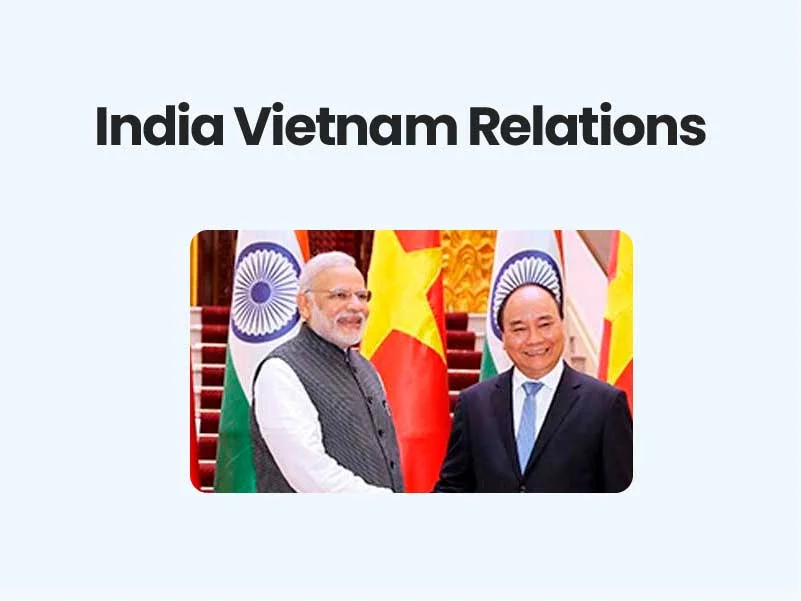
India Vietnam relations have been exceptionally friendly and cordial since their foundations were laid by founding fathers of the two countries – President Ho Chi Minh and President Rajendra Prasad and Prime Minister Nehru. The traditionally close and cordial relations have their historical roots in the common struggle for liberation from foreign rule and the national struggle for independence. Pandit Jawaharlal Nehru was one of the first visitors to Vietnam after its victory against the French at Dien Bien Phu in 1954. President Ho Chi Minh went to India in February 1958. President Rajendra Prasad visited Vietnam in 1959. In recent times, political contacts have strengthened as reflected in several high-level visits by leaders from both sides. Trade and economic linkages continue to grow. India’s thrust under the ‘Look East’ policy combined with Vietnam’s growing engagement within the region and with India has paid rich dividends. Vietnam is an important regional partner in South East Asia. India and Vietnam closely cooperate in various regional forums such as ASEAN, East Asia Summit, Mekong Ganga Cooperation, Asia Europe Meeting (ASEM) besides UN and WTO. India Vietnam Relations On the occasion of the 45th anniversary of the establishment of diplomatic relations between India and Vietnam and the 10th anniversary of the establishment of Strategic Partnership, the Vietnam Buddhist Sangha in collaboration with the Vietnam-India Friendship Association (VIFA) and the Embassy of India, in Hanoi, organized a major four-day “Buddhist Festival – Days of India” in Tay Thien, Tam Dao District, Vinh Phuc Province. An important delegation comprising 200 monks and nuns from Ladhak and Darjeeling, under the leadership of His Holiness Gyalwang Drukpa Jigme Pema Wangchen from the Hemis Jangchubling Monastery, Leh took part in the celebrations. International Day of Yoga: The third successive International Day of Yoga was held at the iconic Hoan Kiem Lake area of Hanoi on 17th June 2017. This was organized by the Mission, in collaboration with the People’s Committee of Hanoi, Ministry of Culture, Sports and Tourism, Ministry of Foreign Affairs, Ministry of Public Security and Ministry of National Defence of Vietnam, the United Nations Office in Hanoi. Youth Delegation: An Indian Youth Delegation visited Vietnam from 21-28 July 2016, under the Youth Exchange Programme between the two countries. This is the first visit under the MOU signed in 2014. The Vietnamese Youth Delegation visited India from 27th March to 5th April 2017. Political exchange: Institutional mechanisms for bilateral exchanges Trade and Economic Cooperation: Bilateral Trade: From a meagre US$200 million in the year 2000, bilateral trade between India and Vietnam has seen steady growth over the years. According to Indian statistics in 2019-20, bilateral trade between India and Vietnam reached US$12.34 billion. This marked a decrease of 9.9 percent year-on-year, largely on account of COVID-19 related trade disruptions. India’s Investments in Vietnam: India’s investments in Vietnam are estimated at around US$ 1.9 billion including investments routed through third countries. According to Vietnam’s Foreign Investment Agency, as of June 2020, India has 278 valid projects with total invested capital of US$ 887.27 million, ranking 26th among countries and territories investing in Vietnam. Vietnam’s Investments in India: As of 2019, Vietnam has six investment projects in India with total estimated investment of US$ 28.55 million, primarily in the areas of pharmaceuticals, information technology, chemicals and building materials. Development Partnership: India has a long-standing development partnership with Vietnam that has made positive contributions towards capacity building and socio-economic development of Vietnam. India has also been providing assistance to Vietnam within the ASEAN framework. Under the Mekong Ganga Cooperation (MGC) framework, India has been taking up Quick Impact Projects (QIPs), each valued at US$50,000, in different provinces of Vietnam for development of community infrastructure 7. Cultural Cooperation: The Vietnam Institute for Indian and South-West Asian Studies (VIISAS) under the Vietnam Academy of Social Sciences and the Centre for Indian Studies at the Ho Chi Minh National Academy of Politics are among the key centres in Vietnam focused on Indian studies and have academic cooperation MOUs with some Indian institutions. Tourism and People-to-People Contacts: Both countries have facilitated simplified visa regime to promote bilateral tourism. In December 2017, Vietnam extended e-visa facilities to Indian citizens travelling to Vietnam. India has e-tourist visa arrangement for Vietnamese citizens since 2015. The long-awaited direct flights between the two countries commenced in October 2019. It is expected that the direct flight connectivity will further increase two-way tourism as well as trade and business linkages. Capacity Building, Training, Scholarships: Vietnam has been a large recipient of training programmes under Indian Technical and Economic Cooperation (ITEC) programme. Vietnam was also among a select group of partner countries where Government of India launched the new e-ITEC programme in October 2019. Indian Community: An estimated 5000 people from India, including some short-term visitors, constitute the Indian community in Vietnam. A majority of them are based in and around Ho Chi Minh City (HCMC) in the southern part of Vietnam Challenges: Vietnam opposed the “Quad” or quadrilateral coalition among India, the US, Japan and Australia. The proposed sale of the BrahMos supersonic cruise missile has taken a back seat as there has been no response from Hanoi. The line of credit offered has yet to be operationalised for facilitating deeper defence cooperation. Way Forward: Both Countries need to leverage the economic opportunities available because of anti-China sentiments and several manufacturing firms deciding to shift from China. Coordinating at Global Level Coordinating With Other Regional Partners Both Countries should expedite the process of negotiations for finalisation of defence deals. Enroll today with the best civils service academy and take your first step towards your Civils journey. Feel free to reach out to us for any inquiries, collaborations, or support. We’re here to help. join now
Joint Comprehensive Plan of Action(JCPOA)
Joint Comprehensive Plan of Action(JCPOA) JCPOA is an agreement signed by Iran and the P5+1+1 (China, France, Germany, Russia, the United Kingdom, the United States and EU) on July 14, 2015. Significance: This nuclear deal or JCPOA seeks to prevent Iran from producing a nuclear weapon — something Iran insists it does not want to do — by putting curbs on its atomic programme in exchange for economic incentives. As per the deal, Iran reduced the number of its centrifuges used for enriching uranium by two-thirds, restricted its uranium enrichment to 3.67%, and removed the core of its heavy water facility in Arak. The nuclear deal was endorsed by UN Security Council Resolution 2231, adopted on July 20, 2015. Iran’s compliance with the nuclear-related provisions of the JCPOA is verified by the International Atomic Energy Agency (IAEA) according to certain requirements set forth in the agreement. Following the issuance of an IAEA report verifying implementation by Iran of the nuclear-related measures, the UN sanctions against Iran and some EU sanctions will terminate and some will be suspended. 15-year term: After the 15 years, the treaty will come to its term; then the extraordinary restrictions will no longer be applicable This is the first time that the United Nations Security Council has recognized the nuclear enrichment program of a developing country and backs an agreement signed by several countries within the framework of a resolution (United Nations Security Council Resolution 2231) Joint Comprehensive Plan of Action – Challenges: Iran can make things difficult for the U.S. in Afghanistan as also in Iraq and Syria. The U.S.’s ability to work with Russia in Syria or with China regarding North Korea will also be impacted. And sooner or later, questions may be asked in Iran about why it should continue with other restrictions and inspections that it accepted under the JCPOA, which would have far-reaching implications for the global nuclear architecture. Coming after the rejection of the Trans-Pacific Partnership (TPP), the Paris climate change accord and the North American Free Trade Agreement, President’s decision further diminishes U.S. credibility. The JCPOA limited Iran to enrich uranium only up to a 3.67% concentration and its stockpile to 300 kg of UF6 (corresponding to 202.8 kg of U-235), and further capped its centrifuges to no more than 5,060, besides a complete cessation of enrichment at the underground Fordow facility. It also limited Iran’s heavy water stockpile to 130 tonnes. The IAEA report raised the need for additional budgetary contributions from IAEA member states to meet the cost of implementing the JCPOA. IAEA monitoring activities in Iran are projected to cost 9.2 million euros ($10.4 million) in 2019, of which 4 million euros ($4.5 million) is extrabudgetary. The report noted that the agency has 3.1 million euros ($3.5 million) in extrabudgetary contributions available to meet the costs of JCPOA-related activities for 2019. India has managed to walk the diplomatic tightrope between the US and Iran. Enroll today with the best civils service academy and take your first step towards your Civils journey. Feel free to reach out to us for any inquiries, collaborations, or support. We’re here to help. join now