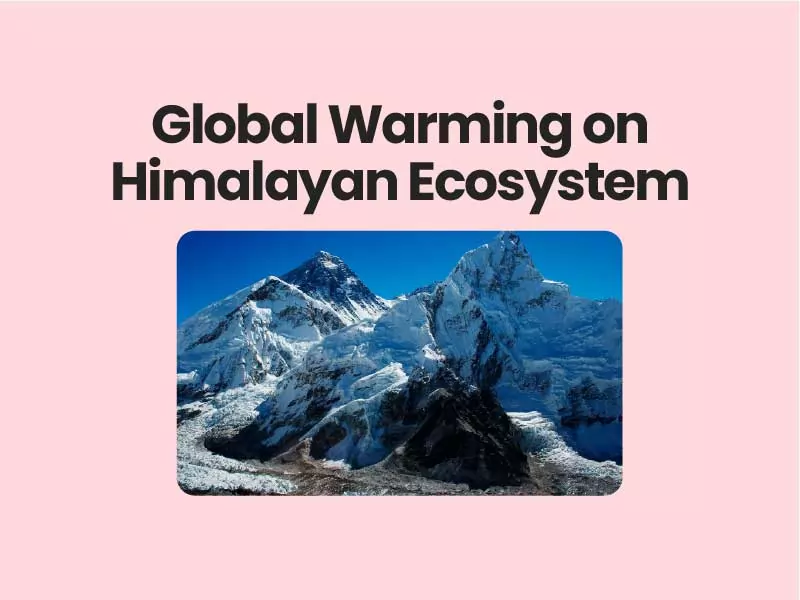
Impact of Global Warming on Himalayan Ecosystem
Climate change has strong influence on the precipitation over Himalayas as well as melting response of glaciers/ snow cover in Himalayas. This in turn affects the runoff pattern of rivers draining from the glaciated catchments of Himalayas. Three major river catchments along with their several tributaries originating from Indian as well as Nepal part of Himalayas, receive significant contribution from Himalayan cryosphere, especially during the non-rainfall lean period of the year.
The Hindu Kush Himalayan (HKH) region, the region — spread over 3,500 square kilometres across eight countries including India, Nepal and China — is also known as the Water Tower of Asia due to its reserve of frozen water.
International Centre for Integrated Mountain Development (ICIMOD):
- International Centre for Integrated Mountain Development (ICIMOD), an intergovernmental body that works for the mountains and people of HKH.
- The HKH region is warming faster than the global average. And would continue to do so for this century.
HKH:
- The assessment establishes HKH region firstly as an incredibly important asset for Asia and the world.
- It is a key source of water, energy, carbon stocks, as well as rich biodiversity. For example, the rivers starting from HKH are home to about 2 billion people, with 500 GW of hydropower potential.
- However, the region is under threat from climate change plus a host of other changes including ecosystem degradation, outmigration, and air pollution.
- Mountains warm up faster than global averages. Even if we could limit global warming to 1.5 degrees Celsius, mountain temperatures would rise above 2 degrees, and if current trends continue temperatures could go up by 4 to 6 degrees Celsius.
- This has dire consequences not only on glaciers, but on food, energy and ecosystems, and for the people who rely on them in terms of ecosystem change, changing water flow patterns, and increased hazards of disasters.
- In a 1.5 degree Celsius world, about one-third of our glaciers will disappear by 2100, and under the current emission scenario, we will lose two-thirds of our glacier volumes.
- Many major cities in and near the HKH have annual average PM2.5 concentrations almost 10 times higher than WHO guidelines. In addition to negative health impacts, this also adds to glacier melt.
- Already 70 to 80 per cent of habitat in biodiversity hotspots has been lost over the last 500 years, and one-fourth of the endemic species could be lost by 2100.
- Overall in the HKH region, poverty incidence is one-third compared to the national average that’s one-fourth.
- Over 30 per cent of HKH population suffers from food insecurity, and 50 per cent faces some form of malnutrition.
- About 80 per cent of rural populations living in HKH countries lack access to clean energy for cooking. There remains persistent gender and social inclusion in development.
Read Also Himalayan trillium
Issues and Challenges:
- Water and energy are essential requirements for an economy’s development. While they contribute independently to development, the two are inextricably connected.
- Energy is vital for enabling the water value chain and is needed whenever it is extracted, moved, treated, heated, pressurized, reused, or discharged.
- Similarly, water is needed throughout the energy supply chain, sometimes as a direct input as in the case of hydropower or geothermal energy, as a coolant in thermal power plants or more often for the extraction and processing of energy fuels.
- Hence, issues and challenges related to one sector have direct influence on the other.
- Increasing Water Stress:
- Increasing Energy Demand:
- Trade-offs between water and energy security
- Impacts on Financial Viability of energy projects
- Multiple regulatory institutions:
- Ecological Degradation
- Lack of clear understanding about the melt response of glaciers to climate change
- Limited support for glacier research on Himalaya
Way Forward:
- There is a lot of work to do to reduce air and water pollution, to promote sustainable energy, to halt biodiversity loss and to assist some of the most poor and vulnerable people to adapt. Countries have to work with one another to do this.
- Countries do come together around mountain issues, especially environment and livelihoods. And also take inspiration from the Arctic Council where countries do unite to share information, to jointly develop solutions, and to speak with a common voice to the global communities about the impacts of climate change and other concerns.
- Then there is a need to bring the results to the global community and in global events.
- Reducing water footprints of energy utilities:
- Integrated Water Storage Policy:
- Watershed management by Energy Utilities:
- Glacier/ Source vulnerability assessment for the Hydropower plants:
- Promotion of research on Himalayan glaciers:
- Developing a comprehensive understanding about the status of Himalayan glaciers:
- Integrated River Basin Management to rejuvenate water potential:
- Assessment of GLOF potential:
- Joint coordination committee for Water and Energy:
The HKH is indeed a unique region, and does need differing approaches, first, because of its topography and ecology, the impacts are quite different than other places — there is a rapid gradient in terms of species, and we already see flowering and migration patterns changing. And, the region is especially prone to different kinds of disasters like glacial lake outburst floods, and landslides.
Second, the HKH is home to unique societies and traditional knowledge, people who have learned to adapt to harsh environments, and people who have secrets to our future survival. Blanket approaches will not work, and much attention is needed to understand and learn from this unique environment.
Read Also Uttarakhand glacier burst. Central Asia Meet
Enroll today with the best civils service academy and take your first step towards yours Civils out journey.
Feel free to reach to us for any inquiries, collaborations, or support. We’re here to help