India – Asean Relations
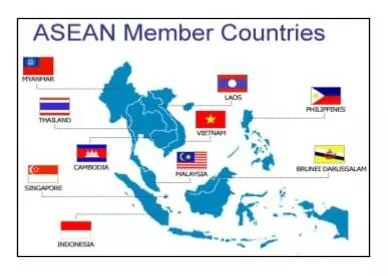
ASEAN (Association of Southeast Asian Nations) is a regional organization of 10 nations which was established to promote political and social stability amid rising tensions among the Asia-Pacific’s post-colonial states. Its members are Indonesia, Malaysia, Philippines, Singapore, Thailand, Brunei, Myanmar, Vietnam, Laos, and Cambodia.
ASEAN commands far greater influence on Asia-Pacific trade, political, and security issues than its members could achieve individually. India’s relationship with ASEAN has emerged as a key cornerstone of our foreign policy.
India-ASEAN Relation – Background
After its Independence in 1947, India followed a policy of Non-Aligned Movement (NAM) and became a champion of decolonisation, including in Southeast Asia.
However, during the 1970s, India’s perceived tilt towards the Soviet Union caused Southeast Asia to drift away from India as both followed different economic and political ideologies.
In a major shift away from policies of the Cold War era, India adopted the “Look East Policy” (LEP) soon after economic liberalization in 1991 to increase economic and commercial ties with East and Southeast Asian nations.
India became a Sectoral Partner of ASEAN in 1992, a Dialogue Partner in 1996 and a Summit-level Partner in 2002.
The partnership was upgraded to Strategic Partnership in 2012 as a result of the growth of India-ASEAN relationship in last two decades.
India announced Act East Policy in 2014 with an intent to upscale its engagement with ASEAN Member States.
India and ASEAN celebrated 25 years of their Dialogue Partnership, 15 years of Summit Level interaction and 5 years of Strategic Partnership in 2017.
The Act-East Policy emphasizes the 3 C’s of Connectivity, Commerce and Culture as the focus areas of action for a greater ASEAN-India integration.
Significance of ASEAN to India
- ASEAN’s centrality in India’s foreign policy – A cohesive, responsive, and prosperous ASEAN is central to India’s Indo-Pacific Vision and India’s Act East Policy and contributes to Security and Growth for All in the Region (SAGAR).
- Economic – ASEAN is the one of the largest market in the world comparative to the EU and North American markets.
- It’s also the 4th most popular investment destination globally.
- Investment opportunities for Indian businesses – Cost of production is lower in Laos, Cambodia, and Myanmar, which means that Indian firms can gain significantly by investing in these countries.
- Countering China – Cooperation between India and ASEAN is crucial to counter China’s power projection in the region. Both have territorial and border issues with China, disputes over the South China Islands and waters for ASEAN and over land boundaries for India.
- Integration with regional and global supply chains – Increasing engagement with ASEAN is pivotal to facilitate India’s integration with regional and global supply chain movements.
- North-East development – Connectivity projects with the ASEAN nations keeping Northeast India at the centre can ensure the economic growth of the land-locked north-eastern states.
- Collaboration with the ASEAN nations is necessary to counter insurgency in the Northeast, combat terrorism, etc.
- Maritime security – The Indian Ocean carries 90% of India’s trade and its energy sources. Presence of choke points such as the Malacca strait makes the South-East Asian region significant for countering traditional and non-traditional maritime threats like piracy and terrorism.
- Indian Diaspora – About 9-8% of the population in Malaysia and Singapore is of Indian origin, in Myanmar-4% and Indonesia about 0.5%.
Areas of Cooperation
- Economic Cooperation – ASEAN is India’s 4th largest trading partner.
- India signed FTA in goods in 2009 and an FTA in services and investments in 2014 with ASEAN.
- India has a Comprehensive Economic Cooperation Agreement (CECA) with various countries of the ASEAN region which has resulted in concessional trade and a rise in investments.
- Political Cooperation – ASEAN-India Centre (AIC) was established to undertake policy research, advocacy and networking activities with organizations and think-tanks in India and ASEAN.
- Delhi Dialogue – Annual Track 1.5 event for discussing politico-security and economic issues between ASEAN and India.
- Financial Assistance – India provides financial assistance to the ASEAN nations through various mechanism like ASEAN-India Cooperation Fund, ASEAN-India S&T Development Fund and ASEAN-India Green Fund.
- Connectivity – India has been undertaking several connectivity projects like India-Myanmar-Thailand Trilateral (IMT) Highway and the Kaladan Multimodal Project.
- India is also trying to establish a Maritime Transportation Agreement with ASEAN and also Plans for a Railway link between New Delhi in India to Hanoi in Vietnam.
- Socio-Cultural Cooperation – Programmes to boost People-to-People Interaction with ASEAN are organized, such as inviting ASEAN students to India, Special Training Course for ASEAN diplomats, Exchange of Parliamentarians, etc.
- Defence Cooperation – Joint Naval and Military exercises are conducted between India and most ASEAN countries.
- Vietnam has traditionally been a close friend on defense issues, Singapore is also an equally important partner.
- Maritime Cooperation – adopted Delhi Declaration and decided to identify Cooperation in the Maritime Domain as the key area of cooperation under the ASEAN-India strategic partnership.
- India is developing its maiden deep-sea port in a strategically located Sabang port in Indonesia.
REGIONAL COMPREHENSIVE ECONOMIC PARTNERSHIP (RCEP) AGREEMENT
- RCEP is a Free Trade Agreement (FTA) that has been signed between 15 countries including the 10 ASEAN members, China, Japan, South Korea, Australia, and New Zealand.
- RCEP was first proposed in 2011 with an aim to create a consolidated market for the ASEAN countries and their trade partners.
- RCEP now forms the world’s largest trade bloc, covering over 2.2 billion people and accounting for 30% of the world’s economy.
- Though India was a part of the RCEP’s negotiations, it dropped out in November 2019, citing significant outstanding issues that remain unresolved.
Reasons behind India pulling out of RCEP
Trade imbalance with RCEP members – India’s trade deficit with RCEP countries has almost doubled in the last five-six years.
Chinese Angle – From a geopolitical perspective, RCEP is China-led or is intended to expand China’s influence in Asia. India has already signed FTA with all the countries of RCEP except China.
Signing of RCEP can lead to cheaper products from China flooding the Indian market.
Lack of adequate protection for domestic industries – India’s proposals for strict Rules of Origin (to prevent routing of products from non-RCEP countries) and an Auto-trigger mechanism to impose tariffs when imports crossed a certain threshold which were not accepted.
Lack of Service component – Most developed RCEP countries where India can export services, have been unwilling to negotiate wide-ranging disciplines in services that can create new market access for trade in services in this region.
Concerns by local industries – A large number of sectors including dairy, agriculture, steel, automobiles, etc had expressed serious apprehensions on RCEP citing dominance of cheap foreign goods would dampen its business.
India’s FTA experience – India’s FTAs has generally led to greater imports than exports, giving rise to high trade deficits with FTA partners like South Korea, Japan, and ASEAN.
Possible Implications of India not joining RCEP
Protectionist image – Withdrawal from RCEP along with other recent measures like call for self-reliance under Atmanirbhar Abhiyan, etc can be perceived as India taking a protectionist stance in terms of trade policy.
Lost opportunity for India’s export sector – RCEP was envisaged to strengthen Asian supply chains, bring in investments and boost the member countries’ competitiveness in global markets.
Effect on bilateral ties with RCEP countries – There are concerns that the decision will hamper India’s bilateral trade with RCEP member countries as they would be inclined to bolster trade within the bloc.
Lost opportunity in securing a position in the post COVID world: RCEP is expected to help member countries emerge from the economic devastation caused by the pandemic through access to regional supply chains.
Arguments for reviewing India’s decision
- Global Economic Stagnation due to Covid-19 pandemic – RCEP can serve as a bulwark in containing the free fall of the global economy and re-energising economic activity.
- RCEP presents a unique opportunity to support India’s economic recovery, inclusive development, and job creation even as it helps strengthen regional supply chains.
- Economic Realism – India should deter seeing RCEP only from the Chinese perspective.
- India can draw inspiration from Japan & Australia, as they chose to bury their geopolitical differences with China to prioritise what they collectively see as a mutually beneficial trading compact.
- Strategic Need – RCEP’s membership is a prerequisite to having a say in shaping RCEP’s rules, which is necessary to safeguard India’s interests and the interests of several countries that are too small to stand up to the largest member, China.
- As the summary of the final agreement shows, the pact does cover and attempt to address some issues that India had flagged, including rules of origin, trade in services, movement of persons. Therefore, this makes the case of India to review its decision and look RCEP through the lens of economic realism.
Challenges in India-ASEAN Relations
- China factor – India’s effort in this regard is meagre when compared to China’s dominance in the region
- China’s assertive military, political and economic rise, as well as the South China Sea disputes have divided ASEAN without unanimity amongst them.
- Economic challenges – India has an unfavourable balance of trade with the ASEAN nations.
- RCEP deal – India walking out of RCEP can become a sticking point between India and ASEAN, since India’s domestic market was considered a key element in the RCEP negotiations.
- India has not signed RCEP for various reasons like non-transparency in RCEP, RCEP’s non-accounting of India’s service sector relaxations, etc.
- By not signing the RCEP India also lose access to new market opportunities created in East Asia.
- Slow development in Bilateral relations – Many bilateral deals with these nations are yet to be finalised, leading to the halting of various aspects of diplomatic ties.
- Delayed projects – Though India has committed to many connectivity projects, they have not been completed at the rate on par with China
- China, on the other hand, through its BRI, is able to gain the trust of these countries.
India’s pulling out of the RCEP deal shows the limitations of the ties with the ASEAN nations. Maintaining cordial ties, both bilaterally and multilaterally with these nations is essential for both India’s economic and security interests.
South-East Asian nations are looking at India to take on a greater role for the economic integration of the region and for ensuring an open and inclusive Indo-Pacific. Many of the members of the ASEAN perceive India as a much-needed counterbalance to China.
Way Forward
- An alternative economic corridor based multimodal connectivity such as Mekong-India Economic Corridor may be promoted, which will connect Indian coast with unexplored Southeast Asian coast and beyond.
- Strengthening land, air, and sea linkages will enhance people-to-people flows, as well as boost business, investment, and tourism.
- With China having three times more commercial flights than India to Southeast Asia, improving air connectivity between India and ASEAN countries should also be high on the agenda.
- India has proposed setting up of an ASEAN-India Network of Universities (AINU) to enhance our educational ties.
- India can become the military partner after the Atma Nirbar Bharat, Make in India projects are successfully implemented.
- No ASEAN country has close military ties with China as they never trusted China for military alliance.
- Concept of QUAD must be expanded to include the ASEAN countries and become a QUAD+ arrangement.
- Vietnam and Indonesia have expressed a positive note on QUAD in the region.
- Digital technologies – Given the reluctance of ASEAN states to take help from Chinese giants in the field (due to concerns regarding China’s ability to own data), Indian IT sector may take some advantage.
- Strengthening cultural connect – Tourism can be further encouraged between India and the ASEAN with some creative branding by the two sides.
Failure of South Asian Association for Regional Cooperation (SAARC) has made India look outside South Asia towards countries of Southeast Asia for economic and political cooperation.
The ASEAN region has become strategically important for India due to its growing importance in the world politics. And for India to be a regional power as it claims to be, continuing to enhance its relations with ASEAN in all spheres must be a priority.
Previous Year Questions
Indian Diaspora has an important role to play in South-East Asian countries’ economy and society. Appraise the role of Indian Diaspora in South- East Asia in this context (2017)
Enroll today with the best civils service academy in Trivandrum and take your first step towards your Civils journey .Feel free to reach out to us for any inquiries, collaborations, or support. We’re here to help.