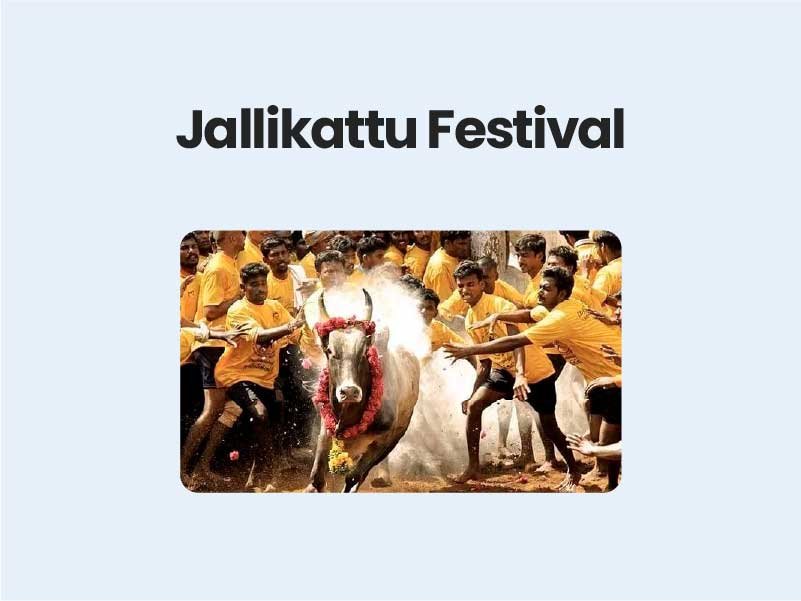
Jallikattu Festival
Out of India’s 37 indigenous cattle breeds, a large number come from Tamil Nadu. These include the Kangeyam, Thiruchengodu, Bargur, Palamalai, Alambadi, Kollimalai, Vadakarai, Manapparai, Umbalachery, Irucchali, Pulikulam, Thambiran Madu, Thenpandi, Thondainadu, Thurinjithalai and Punganur. Out of these, the Pulikulam breed, a native of the Sivagangai district, is mainly used for Jallikattu festival in Tamil Nadu.
- ‘Jallikattu’, otherwise known as ‘Eru Thazhuvuthal’ (Tamil for ‘Bull Embracing’) is a sport that has been played in southern Tamil Nadu during Thai Pongal since the Sangam Period.
Significance of Jallikattu Festival
- With the advent of green revolution, due to farm mechanisation, the use of draught animals has decreased drastically.
- According to the last Livestock Census of India, while the indigenous cattle population has decreased considerably, exotic and crossbred cattle have increased.
- Indigenous breeds and hybrids with dominant native genes produce A2 milk, which is good for human health.
- Jallikattu is considered to be a bio-cultural sport as it helps to conserve native cattle breeds.
- But, fortunately or unfortunately, the Supreme Court of India banned Jallikattu on May 7, 2014, based on a plea by the Animal Welfare Board of India (AWBI) and People for the Ethical Treatment of Animals (PETA).
Jallikattu Festival
- The participants are supposed to take control of the bull by holding its hump for as long as they can.
- The festival is celebrated on Mattu Pongal, the third day of the harvest festival. Its name is derived from the Tamil words ‘salli’ meaning coins and ‘kattu’ meaning package.
- This refers to the bag of coins which is tied to the bull’s horns which participants try to get hold of.
- The bull species called Bos indicus, or humped cattle, is specifically bred for Jallikatu. The bulls that do well at the event are used latter for breeding.
- According to a famous legend, Lord Shiva had asked his bull, Basava, to send a message to those on Earth that they should take an oil bath daily and have food once a month for a period of six months.
- But Basava mixed up the messages and ended up asking people to eat everyday and take an oil bath once a month.
- This angered Lord Shiva and he punished Basava by cursing him to aid humans in ploughing fields.
- Those who believe in this legend pray to the cattle stock and try to tame them during Jallikattu.
Tamil Nadu challenging the 2014 Supreme Court (SC) ban on a rural traditional sport—Jallikattu
- The participants are supposed to take control of the bull by holding its hump for as long as they can.
- The festival is celebrated on Mattu Pongal, the third day of the harvest festival. Its name is derived from the Tamil words ‘salli’ meaning coins and ‘kattu’ meaning package.
- This refers to the bag of coins which is tied to the bull’s horns which participants try to get hold of.
- The bull species called Bos indicus, or humped cattle, is specifically bred for Jallikatu. The bulls that do well at the event are used latter for breeding.
- According to a famous legend, Lord Shiva had asked his bull, Basava, to send a message to those on Earth that they should take an oil bath daily and have food once a month for a period of six months.
- But Basava mixed up the messages and ended up asking people to eat everyday and take an oil bath once a month.
- This angered Lord Shiva and he punished Basava by cursing him to aid humans in ploughing fields.
- Those who believe in this legend pray to the cattle stock and try to tame them during Jallikattu.
Why is PETA keen on banning Jallikattu?
In January 2016, the Central Government lifted the ban on request of Tamil Nadu Government. This notification was challenged by PETA and Other such welfare Organizations in the Supreme Court.
PETA insists that ‘cruelty’ is not limited to slaughter but includes unnecessary suffering and torture induced on animals for the purpose of human entertainment.
Therefore, PETA advocates that it is the fundamental duty of citizens of India to have compassion for all living creatures and to protect wildlife.
Why are Tamilians protesting the ban on Jallikattu?
They consider it symbolic of Tamilian pride as it is an ancient tradition that has been carried on for years. Jallikattu witnesses thousands of participants, attempting to tame the bulls by latching to their horns or humps.
Its innumerable references could be found in Dravidian Literature and the indigenous population of Tamilnadu has held this event for years. The Jallikattu protests are fuelled by the view that the ban impinges on the cultural identity of the populace.
Conclusion:
Jallikattu is a part of Tamil culture, it has to be conducted with protection to animals and human beings. It should be regulated by an authority. Age old traditions and cultures need to be revisited if they are in violation of the laws of the land.
Enroll today with the best civils service academy and take your first step towards your Civils journey.
Feel free to reach out to us for any inquiries, collaborations, or support. We’re here to help.