
McClelland’s Theory of Needs
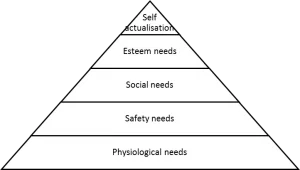
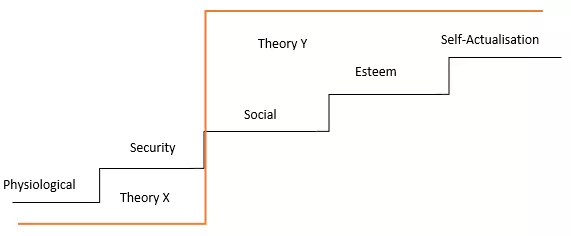
- It is similar to Theory of needs by Maslow and Alderfer.
- The theory is based on multiple needs for motivation and known as Achievement -Motivation
- It focused on 3 major needs-
- Need for Achievement- (nAch)The drive to excel, to achieve in relation to a set of standards thereby seeking personal responsibility for accomplishing a job.
- Need for Power-(nPow) The need to make others behave in a way that they would not have otherwise behaved i.e, to control others.
- Need for Affiliation-(nAff)The desire for friendly, relaxed and close interpersonal relationships.
- Every individual will have different degrees of all the three needs.
- Managers should suitably use individuals based on the 3 needs like
- High nAch individuals should be allocated with jobs accepted by them, that allow autonomy and provide feedback and have moderate risk.
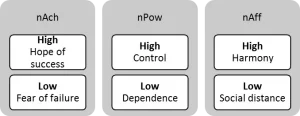
The managers with high nPow and low nAff are generally successful from the point of manager’s need, not from workers.
Goal Setting Theory
- Proposed by Edwin Locke where he observed that specific and difficult goals with provision for feedback lead to high performance.
- Goal setting involves the development of an action plan designed in order to motivate and guide a person or group toward a goal
- Goals are more deliberate than desires and momentary intentions. Therefore, setting goals means that a person has committed thought, emotion, and behavior towards attaining the goal.
- He indicated three moderators that indicate goal setting success
- Setting goals can affect outcomes in four ways:
- Choice: Goals may narrow someone’s attention and direct their efforts toward goal-relevant activities and away from goal-irrelevant actions.
- Effort: Goals may make someone more effortful. For example, if someone usually produces 4 widgets per hour but wants to produce 6 widgets per hour, then they may work harder to produce more widgets than without that goal.
- Persistence: Goals may make someone more willing to work through setbacks.
- Cognition: Goals may cause someone to develop and change their behavior.
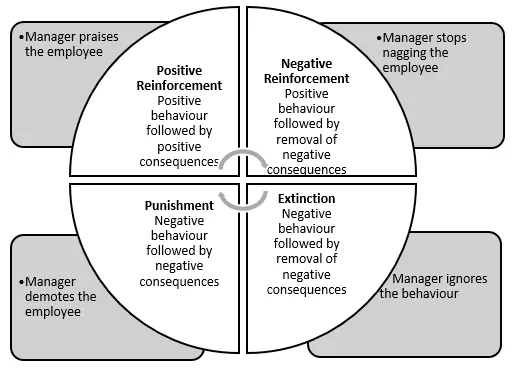
Reinforcement Theory
- It is an extension of goal setting theory.
- The theory advocated that behaviour is a function of its consequences.
- Goal setting theory observed that the perception of an individual emerges from within or oneself
- Reinforcement theory contradicted the view and observed that the perception itself is a byproduct of positive reinforcement of others.
Cognitive Evaluation Theory (CET)
- CET observed that the allocation or introduction of extrinsic rewards for the behavior that had been intrinsically rewarding tends to decrease the overall level of motivation.
- The impact of intrinsic, extrinsic factors and interrelationship of both over individual performance are observed .
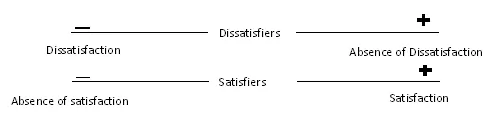
- It is similar to Herzberg’s two Factor theory.
- However, the theory explained those phenomena which Herzberg’s theory failed to do. For instance, Herzberg could not explain why when a person is recruited as a permanent employee from being voluntary loses enthusiasm and zeal. The excitement of voluntary work was a new task, sense of work and importance etc. But when pay and supervision which are extrinsic factors come into play, the perception of an individual changes from being a controller to performer.
- Therefore the introduction of extrinsic factors weakened the influence of intrinsics.
- It was found that though intrinsic factors motivate an individual the extrinsic factors are also motivational for particular jobs.
- The extrinsic factors may become intrinsic factors at a low level of organizations.
- The people with more intrinsic factors are more successful at higher levels of organisation.This is because at higher levels the job itself is motivating..Therefore at higher levels the motivation seekers who are tolerant to extrinsic value should be placed.
Job Design Theory
- Maslow, McGregor and Herzberg had touched upon the importance of looking at work itself as a possible source of motivation. However, it failed to come with substantial concepts.
- It was Job design Theory that came up with stronger evidence to suggest that the way elements in a job are organized can act as a source of motivation.
- The characteristics of a job could influence the perception of an individual and that perception defines the performance of the individual.
- It explained the basis of motivation through the JobCharacteristics Model (JCM).
- According to JCM a job can be described in 5 core dimensions.
- Skill Variety- Degree to which the job required a variety of different skills of workers.
- Task Identity-Degree to which the job required the completion of a whole and identifiable piece of work.
- Task Significance – Degree to which the job has substantial impact on other people.
- Autonomy -Degree to which the job provides substantial freedom and discretion
- Feedback
- JCM grouped these 5 dimensions into 3 psychological states/perceptions.
| Dimensions | Psychological states/Perceptions |
| Skill Variety | Experience of meaningfulness of work |
| Task Identity | |
| Task Significance | |
| Autonomy | Experience responsibility for the outcomes of work |
| Feedback | Knowledge of the actual results of the work activities. |
- The core dimensions can be combined into a single predictive index called Motivational Potential Scheme(MPs)
MPS= (Skill Variety+Task Identity+Task structure)/3*Autonomy*feedback
- The jobs will have high motivational potential when at least one of the three factors of experience of meaningfulness is high and both autonomy and feedback are high.If the jobs have high MPS then it indicates high motivation, performance and satisfaction and vice versa.
Equity Theory
- Propounded by J Stacy Adam.This theory is maturation of theory of motivation by Herbert Simon & Barnard.
- The individuals compare their job inputs and outcomes with those of others and they respond to eliminate any inequities.
- According to the theory, the individual enters into an organization to contribute but the contribution is contingent with satisfaction.i.e, relation between contribution and satisfaction.
- If the contribution is equivalent to satisfaction then there is equity.
- There are four referent comparisons that an employee can use –
- Self Inside: The individual compares with the different position inside his/her current organization.
- Self Outside: The individual compares with the different positions outside his/her current organization.
- Other Inside: The individual compares with another individual or group of individuals inside the employees organization assuming that the other individual had occupied his or her position.
- Other outside: The individual compares with another individual or group of individuals outside the employees organization assuming that the other individual had occupied his or her position.
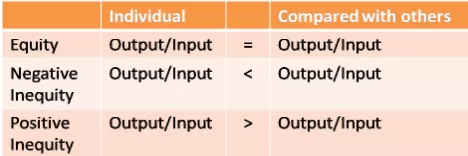
- There are 2 situations for lack of motivation – Positive(Over reward) and negative(under reward) equity.
- Incase of overreward, the individual develops a sense of guilt whereas under reward develops a sense of betrayal and stress.
- In both the cases the individual regresses to equity through –
- Changing the Input
- Changing the Output
- Distort perception of self
- Distort the perception of others
- Choose a different referent
- Leave the field.
Expectancy Theory by Victor Vroom
- He holds that people will be motivated to do things to reach a goal if they believe in the worth of that goal and if they can see that what they do will help them in achieving it. I.e, goal attractiveness & Perception of attainability of personal goal.
- Vroom’s theory is that people’s motivation toward doing anything will be determined by the value they place on the outcome of their effort, multiplied by the confidence they have that their efforts will materially aid in achieving a goal.
- In other words, Vroom makes the point that motivation is a product of the anticipated worth that an individual places on a goal and the chance he or she sees of achieving that goal.
- Vroom’s model is built around the concept of valence, expectancy and force. Vroom’s concept of force is equivalent to motivation and is again equivalent to the product of valence and expectancy.
- In his own terms, Vroom’s theory may be stated as :
Force = Valence × Expectancy
Where force is the strength of a person’s motivation, valence is the strength of an individual’s preference for an outcome, and expectancy is the probability that a particular action will lead to a desired outcome.
- The theory explained the basis for motivation through 4 important factors that are capsule into three important equations.
- The 4 factors are efforts, performance, rewards and personal goals. And the three equations are effort-performance, performance-reward and reward-personal goals relationship.
- According to his theory people get motivated when all the 3 equations are positive.
- However, the theory has been criticized on the following grounds :
- The theory is not empirically tested. It is complex and its validity cannot be fully tested.There are only a few research studies designed to test the theory.
- The theory cannot be applied in practice. From a theoretical standpoint, the model seems to be a step in the right direction but it does not give the manager practical help in solving motivation problems.

- There are so many technical and methodological problems to do research on the theory. Valence cannot be measured on ratio scales, each valence is explained in the terms of all other valances.