Recently, the Prime Minister of India participated in the Online Summit of Non-Aligned Movement (NAM) Contact Group 2020 themed “United against COVID-19”.
- This is the 1st time PM Modi is taking part in a NAM meeting since 2014 when he became the PM.
Covid-19 pandemic and India’s renewed interest in NAM, have earmarked the relevance of Non-Alignment Movement (NAM) to pursue effective work programmers at the international level.
Non-Aligned Movement was formed during the Cold War as an organization of States that did not seek to formally align themselves with either the United States or the Soviet Union but sought to remain independent or neutral.
The History of Non Aligned Movement – NAM
The end of World War II was followed by various incidents like strengthening of Socialist bloc, collapse of colonial empires, the emergence of a bipolar world and the formation of two military blocks (NATO and the Warsaw Pact).
In this context, the underdeveloped countries felt the need to take joint efforts for the common defense of their interests, the strengthening of their independence and sovereignty, and also to express a strong commitment with peace by declaring themselves as “non-aligned” from either of the two military blocks.
Bandung Conference 1955 – The concept of NAM has its origin in the Asia-Africa conference held in Bandung, Indonesia.
Belgrade Conference 1961 – NAM was founded and held its 1st Conference in Belgrade, Yugoslavia under the leadership of Josip Broz Tito of Yugoslavia, Gamal Abdel Nasser of Egypt, Jawaharlal Nehru of India, Kwame Nkrumah of Ghana, and Sukarno of Indonesia.
The purpose of the organization was enumerated in Havana Declaration of 1979 – to ensure “the national independence, sovereignty, territorial integrity and security of non-aligned countries” in their struggle against imperialism, colonialism, neo-colonialism, racism, and all forms of foreign subjugation.
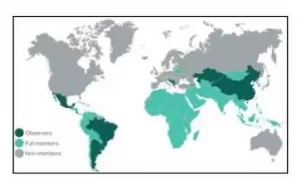
Presently, NAM has 120 members. There are 17 countries and 10 international organizations that are Observers at NAM.
The Founders of NAM have preferred to declare it as a movement but not an organization in order to avoid bureaucratic implications of the latter. NAM does not have a permanent secretariat or a formal hierarchy. Its administration is rotational and non-hierarchy.
Read Full GS Notes
Objectives of NAM
NAM has sought to “create an independent path in world politics that would not result in member States becoming pawns in the struggles between the major powers”.
The primary objectives focused on support of self-determination; national independence; the struggle against colonialism, neo colonialism; disarmament; socioeconomic development and the restructuring of the international economic order; as well as international cooperation on an equal footing.
However, the disintegration of USSR led to the formation of a Uni-polar world dominated by the US. With the end of cold war and end of colonialism & apartheid, it was seen that non-alignment lost its relevance as it failed to adjust itself to the changing global order.
Has NAM lost relevance? – Criticisms
Changing Geopolitics – NAM is seen as based on alignments rooted in the legacies of colonialism and the ideology of the Cold War. With the end of cold war and changing world order NAM is seen as losing its relevance.
Pragmatism by Member Nations – Most of the NAM countries, India in particular, have integrated themselves to varying degrees within the liberal economic order and have benefited from it.
- India joining the Quadrilateral Security Dialogue led by US, and Shanghai Cooperation Organisation led by China has shown India’s balancing approach in new world order.
Low Effectivity – Inability to adequately address problems and threats faced by the developing world has reduced the confidence in and credibility of the movement.
Nuclear Proliferation – India has become a member of the G20 and has declared itself as a nuclear weapons power and has for all practical purposes abandoned the call for global nuclear disarmament.
Lack of enough agreements or partnerships among the members on policies required to address challenges related to ensuring peace, security, and economic development of developing countries.
Alternative platforms like BRICS, IBSA, SCO and G20 etc have emerged with overlapping agendas, reducing need and scope for NAM.
The 21st-century world order is significantly different from that of the 20th-century. The importance of NAM, nevertheless, should not be undermined because it is a significant force that supported third world countries against western imperialism, coercion, and domination.
Though the world has changed, the problems have remained almost the same. In this context, NAM can prove its worth by striving to work for the emerging contemporary issues.
How is NAM still relevant?
New Cold War – World has again moved towards bi-polarity, one led by US and other by China-Russia.
- This can be reflected in Trade War, Quad initiative, Indo-pacific narrative, emergence of Shanghai Cooperation Organisation, naval presence in the Indian ocean, etc.
- The war-torn Syria is prime example of this, where both US and Russia is asserting power.
Resurgence of Colonialism: Neo-Colonialism
- China’s investment in Africa and Asia through its Belt and Road initiative is criticized for being neo-colonialism in nature whereas NAM can help in establishing the ethos of collective action.
Restructuring and Democratization of UN – NAM countries form 2/3rd of the membership of the UN General Assembly, and hence, it can form an important voting bloc.
- NAM, along with the G-77 gives superior numerical strength to developing countries and has helped keep many third world issues ahead of the agenda at the UN.
Combating Global Issues – NAM becomes relevant to mobilize international public opinion against terrorism, weapons of mass destruction (WMDs), nuclear proliferation, ecological imbalance, safeguarding interests of developing countries in WTO (World Trade Organization) etc.
Voice of Developing World – NAM can remains as a global platform where developing and smaller nations can bring to the fore their grievances and press the international community for reforms.
- If disputes arise between developed and developing nation at any point of a concerned topic for example WTO, then NAM act as a platform which negotiates and conclude disputes peacefully.
Importance of Non Aligned Movement NAM for India
- Support for India’s candidature in UNSC – NAM’s total strength comprises 120 developing countries and most of them are members of the UN General Assembly.
- Thus, NAM members act as an important group in support of India’s candidature as a permanent member in UNSC.
- Global South Cooperation – India is widely perceived as a leader of the developing world. Thus, India’s engagement with NAM will further help in the rise of India’s stature as the leader of the developing world or global south.
- In times of increasing protectionism, NAM can provide a platform for South-South cooperation.
- Strengthening of Multipolar World Order – A multipolar world order is in concurrence with Indian foreign policy.
- NAM can help in formation of a multipolar world with India becoming a major pole.
Given the relevance of NAM in present times, it remains a critical diplomatic forum for the pursuit of India’s foreign policy interests. Therefore, India must refrain from treating NAM as a ritual to be performed every three years and start engaging with NAM constructively.
Way Forward
- NAM as a concept can never be irrelevant, as principally it provides a strong base to foreign policy of its members.
- A democratic, effective, flexible, credible, transparent, and representative, multilateral organisation like NAM is imperative for 21st century world order.
- India should strengthen the NAM platform by asserting its soft power and providing an active leadership, and become a torchbearer for smaller countries at multilateral platforms.
- NAM should not be positioned as ‘for’ or ‘against’ any ideology or groups of nations. Rather NAM should identify cross-sectoral challenges that require immediate attention.
- E.g., counterterrorism, global governance reform, sustainable development, and South-South cooperation.
- NAM platform can be used to garner support by South-East Asian countries like Vietnam, Malaysia, Indonesia and Philippines against Chinese assertion in South China Sea and related island and border disputes.
- NAM can provide a platform for Afro-Asian cooperation and a strong position for poor African nation to have healthy negotiations with China and US for economic development without compromising the sovereignty of their land
In the era after COVID-19, World expects emergence of a new global order. As a nation seeking to become an independent pole in global affairs, India could do more with forums like NAM in mobilizing support on issues of interest to itself.
Thus, just like the start of cold war provided the ground for NAM in the 20th century, the Covid-19 pandemic has provided an opportunity for India to lay the foundation of NAM 2.0. In this context, the virtual NAM summit hosted by India is a step in the right direction.