Rural Non-Farm Sector
The Rural Non-Farm Sector (RNFS) encompasses all non-agriculture activities: mining and quarrying, household and non-household manufacturing, processing, etc. According to different international studies on India’s labour market, between 2011 and 2015, the number of agriculture jobs fell by 26 million while non-farm ones rose by 33 million.
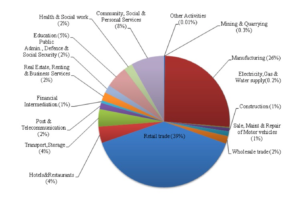
- The top four sectors contributing to the non-farm jobs between financial years 2011 and 2015 are Trade and Hospitality(15.6 per cent), Construction(14.3 per cent), Transport(5.7 per cent) and Education and Health(1.6 per cent).
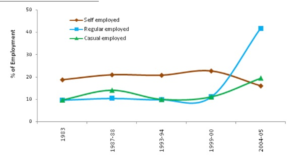
Trends in employment status in rural labour force (male + female) by sector
Importance of Rural Non-Farm Sector:
The non-farm sector, particularly in rural areas is being accorded wide recognition in recent years for the following reasons:
- Employment growth in the farm sector has not been in consonance with employment growth in general.
- A planned strategy of rural non-farm development may prevent many rural people from migrating to urban industrial and commercial centers.
- When the economic base of the rural economy extends beyond agriculture, rural-urban economic gaps are bound to get narrower along with salutary effects in many other aspects associated with the life and aspirations of the people.
- Rural industries are generally less capital-intensive and more labour absorbing.
- Rural industrialization has significant spin-offs for agricultural development as well.
- Rural income distribution is much less unequal in areas where a wide network of non-farm avenues of employment exists; the lower strata of rural societies participate
Distribution of major Non-agricultural establishments in rural India during 2005
Strengths:
Institutional basis for rural non-farm sector: In India, the institutions underlying the development of the rural non-farm sector are very strong.
These include secure property rights; a well-developed financial system with preferential access to credit for the sector; supporting institutions such as the KVIC, State Khadi Board, NHHDC, Small Industries Development Bank of India (SIDBI), State industrial corporations; policies and programs promoting linkages with agriculture, especially agro-industries; domestic marketing channels for rural nonfarm production; as well as government support in export promotion.
The institutional mechanisms for a rapid growth of the rural nonfarm sector are already in place.
Decentralization process: Over the last two decades the State governments in India have been able to exercise far more independence in decision-making than in the pre-1980 period.
Regional parties are an integral part in coalition governments at the Center. In turn, they have negotiated economic autonomy in the formation of state specific policies for development.
Moreover, with the opening up of the economy in 1991, foreign direct investment (FDI) has come to play an important role in the overall policy environment.
State governments are in competition with one another to attract higher FDI levels both in manufacturing and infrastructure.
In some ways, it mirrors the path followed by China, although the volume of FDI coming to India is less than 10 percent of what is flowing into China. On the positive side, however, this creates an opportunity for higher levels of investment in the future.
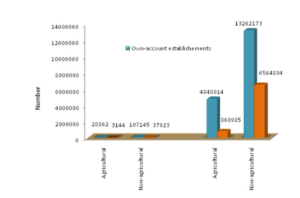
Distribution of enterprises in rural India during 1998 and 2005
Challenges:
- Infrastructure
- Regulatory restrictions on small-scale sector
- Quality of manpower
- Forward and backward linkages
- Migration of skilled laborers
- Education and Awareness
Government Innitiatives:
- Deen Dayal Antyodaya Yojana – National Rural Livelihoods Mission
- Aajeevika Grameen Express Yojana (AGEY)
- Development of Rural Tourism
- Deendayal Upadhyay Grameen Kaushal Yojana
- Mahatma Gandhi National Rural Employment Guarantee Act (MGNREGA)
Way Forward
- More livelihood and poverty alleviation programmes will bring in more participation in the nonfarm activities, thus reducing the dependence on agriculture.
- To improve the marketing links between the village entrepreneurs and the larger business firms located in the towns/cities.
- China’s TVEs Model
- Need to be focused on may include human resource development, financial/credit facilities, research and development and women’s participation with a view to making the activities self-sustaining in the changing competitive environment.
- Supply Chain Integration
Enroll today with the best civils service academy and take your first step towards your Civils journey.
Feel free to reach out to us for any inquiries, collaborations, or support. We’re here to help.