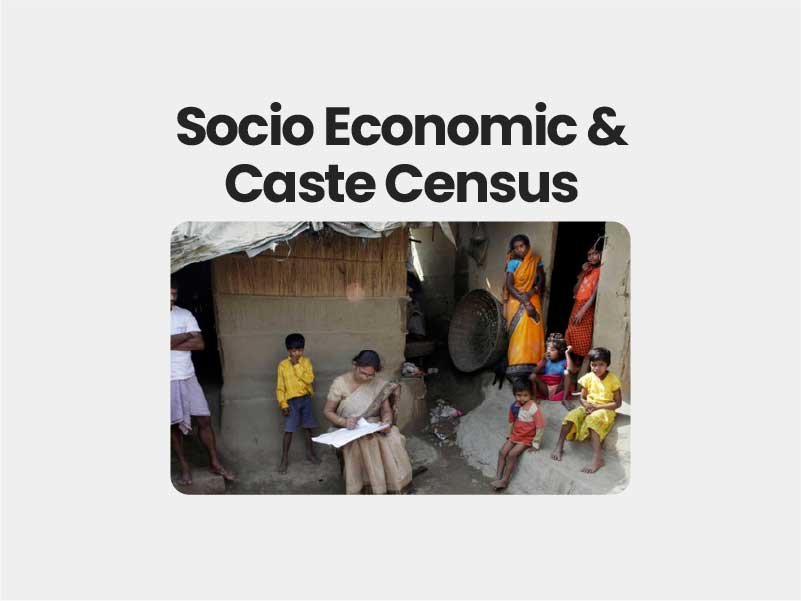
Socio Economic And Caste Census
India is looking to revamp parameters for the Socio Economic Caste Census-2021 that will define eligibility of a rural household in the country for various benefits offered under government schemes.
The new criterion, under works, could lead to exclusion of households from flagship schemes after the new updated census is out.
SECC 2021:
- “Based on the changes proposed on the parameters, a fresh questionnaire would be prepared to assess the status of these households.
- Sources said that the list of automatically excluded could see additions like those covered under the PM pension scheme for workers and the PM Kisan scheme.
- Besides, the automatically included criteria of household without shelter could be knocked off after massive pace of construction of rural houses under the PM Awas Yojana.
- The plan is also to use Aadhaar as a single identifier of beneficiaries for all its social sector schemes while assessing the socio economic status of all the beneficiaries under SECC-2021 to reduce frauds and duplication of social and economic benefits, besides providing a monitoring mechanism for the living standards of SECC provides the government the names and number of families in each panchayat and details their status on seven deprivation parameters.
- The rural development ministry will finalise the parameters and soon kickstart the exercise to compile the second in series SECC, due for launch next year.
SECC-2011:
- The SECC-2011 had identified households based on 13 automatic exclusion parameters, five automatic inclusion parameters and seven deprivation criteria.
- Out of 179.1 million rural households identified, 39.3% or 70.5 million households fell in the automatic exclusion category, 0.92% or 1.65 million households were in the automatic inclusion category, while 106.9 million were considered for deprivation.
SECC-2011 is a study of socio economic status of rural and urban households and allows ranking of households based on predefined parameters. - SECC 2011 has three census components which were conducted by three separate authorities but under the overall coordination of Department of Rural Development in the Government of India.
- Census in Rural Area has been conducted by the Department of Rural Development (DoRD). Census in Urban areas is under the administrative jurisdiction of the Ministry of Housing and Urban Poverty Alleviation (MoHUPA).
- Caste Census is under the administrative control of Ministry of Home Affairs: Registrar General of India (RGI) and Census Commissioner .
The following needs to be consciously taken on record while using SECC data:
(i) The SECC data is respondent based input along with the counter sign of enumerator.The data is the “revealed data” by the household to the enumerator. However, collected data also meets the approval of Gram Sabha and Panchayats.
(ii) The structure of the houses of household is described in SECC as Kuccha or Pucca depending on the respondent based information on predominant material used in walls and roof
(iii) Ownership status of the house is respondent based information.
(iv) Main source of income related to household has been clarified in rural areas as cultivation, manual casual labour, part time or full time domestic service, begging, non-agriculture own enterprise, begging/charity/alms and others. The various components of ‘other’ have however not been enumerated.
(v) Some nuances of data needs to be clarified. For instance, “Non-adult member” questionnaire has used the age group of 16-59 instead of 14-59. Similarly the question on income of the main earner does not ask logical question on any other earner.
Thus, when the household reports less than Rs. 5000/ month as the income of the main earner the natural second question of any other earner would have defined poverty status of the house sharply in income term. However, the approach of SECC is torely on enumerating multidimensionality of poverty and rank households accordingly for receiving benefits of governments’ positive interventions.
Thus, even in the absence of the same, these households can be tracked on multi variable analysis on poverty by keeping in view the insecurity and uncertainty of wage jobs and insecure, unsafe and poor quality of households, etc.
(vi) SECC data is compilation of 24 lakhs enumeration blocks where each enumeration block has roughly 125 households. These are the same enumeration blocks that were formed during census. This allows SECC data to rank household and categorise them on the basis of socio economic status using automatic exclusion criteria, automatic inlusion criteria and deprivation criteria.
Census 2011 and Socio Economic Census 2011
(vii) The data of SECC does not and cannot super impose itself fully on the census data. While there is a high degree of compatibility in the two sets of data the findings could be different because the duration of census and that of SECC is different.
Census 2011 on the other hand was conducted during the period 9th to 28th February 2011. Socio Economic Caste Census 2011 was largely carried out in 2011 and 2012 with a few states taking enumeration and verification in 2013 also.
(viii) It is relevant to note that the regular Population Census is carried out under Census Act, 1948. According to this Act, Government must keep individual’s personal information confidential. Besides aim of regular Population Census is to provide overview, it is not concerned with any particular individual / household. In short personal data given in Population Census is confidential.
- On the contrary all the personal information given in the Socio Economic Caste Census (SECC) is open for use by Government departments to grant and/ or restrict benefits to households. This required the right of verification of socio economic profile prepared by enumerators, verifiers and supervisors of state government of households to be shared in transparent manner with households, Panchayats and Gram Sabha.
- This entailed mid track change in process of SECC 2011 which had to introduce in November 2012 a process of complaints/ objections to be entertained under a pre-defined process after publication of draft SECC list. Accordingly, all published Draft District Lists were put for public scrutiny before Panchayat and were displayed in Gram Sabha except names of caste/tribe/religion details.
- Complaints / Objections were to be thereafter examined by designated officers within mandated 45-82 days. However, this process resulted in to considerable time over run since more than 1.41 crore households out of 17.97 crore had raised objections which brought time over run of more than 485 days in certain cases.
- Since valid information on 100 % households is now available, a distinct credibility is added to the final data which is now open for examination and deriving actionable meanings.
- According to the official, there is a consensus within the government that certain number of households would have moved from their existing category to another on account of success of development programmes in the last 10 years and hence the need for a re-look.
Enroll today with the best civils service academy and take your first step towards your Civils journey.
Feel free to reach out to us for any inquiries, collaborations, or support. We’re here to help.