
1. Keeping the recent developments in view, how can the energy crisis of India be circumvented by harnessing non-conventional energy resources? (10 Marks)
Answer: Non conventional energy resources are those which are non exhaustible in general and extracted using unconventional methods. They are a vital alternative to the non renewable sources of energy like coal, petroleum etc. to circumvent the energy crisis faced by India.
India is dependent upon the coal for thermal energy production. About 60% of energy is sourced using coal as raw material. Even though India has started to produce surplus energy for its requirements, it faces high amount of AT&C losses in distribution and supply of power making it energy deficient.
Energy crisis of India can be circumvented by harnessing non conventional energy resources through:
- Solar Energy: Solar photovoltaic and solar thermal power production can be done through new technologies such as off grid solar production, grid connected solar technology etc.
- Wind Energy: Wind-Solar photovoltaic hybrid system, wind offshore turbines, reducing the tariffs associated with wind energy components etc. can enhance the production.
- Biomass Energy: The biological material derived from living can be harnessed through composting the municipal solid waste, manufacturing waste etc. and also through burning the timber. It is also necessary to develop technology for biorefineries that will convert biomass into a range of valuable fuels, chemicals, materials, and products
- Hydro Energy: Large and Small hydroelectric power plants produce electricity using turbines and generators, construction of dam across the rivers to harness its renewable energy potential.
- In addition to this, different technologies have been developed to harness the unconventional source of energy like Coal Bed Methane, shale gas etc.
- Nuclear energy is harnessed by recycling the already used fuel in a breeder reactor and it produces more fuel than it consumes while also producing additional energy for India.
Indian Government has already initiated plans and policies to meet the renewed energy demands. As part of combating the energy crisis, India has enhanced its commitment to produce 450 giga watts of renewable energy.
2. Make a critical appraisal of the factors affecting river water quality in India. (10 Marks)
Answer: With nearly 70% of water being contaminated, India is placed at 120th amongst 122 countries in the water quality index.
Water pollution: It is a serious problem in India as almost 70 per cent of its surface water resources and a growing percentage of its groundwater reserves are contaminated by biological, toxic, organic, and inorganic pollutants.
- Overexploitation of groundwater through unsustainable irrigation practises like canal irrigation, borewell irrigation etc. cause arsenic, fluoride contamination.
- The hinterland regions, areas where net evaporation takes place etc. constitute areas of water salinity.
- The coastal regions of India are affected by the mean sea level rise and as a result, the saline water intrudes into the coastal regions as well.
- Industrial effluents are discharged into the river water without any water quality treatment. About 70 percent of the effluents are not treated and disposed off into the environmental media untreated.Eg: Kanpur leather industry into river Ganga, River Bellandur in Bengaluru.
- Agricultural fields use excess nutrients through chemical fertilisers which in turn cause nutrient runoff into the nearby river bodies causing eutrophication.
Measures to improve water quality:
- Mobilize community participation: States should tap into the local knowledge base of problems and challenges surrounding water supply systems, while ensuring true representation through partnerships with NGOs and other relevant organizations.
- Decentralize O&M and pricing: Governments need to allow local bodies to implement, maintain, and price local drinking water supply. This ensures a strong incentive structure where the people most affected by the supply are the ones responsible for its maintenance and sustainability.
- Provide adequate capacity building and technical support: Community efforts should be supplemented by support in the form of investments, technical know-how, financial management skills, etc.
3. Give a reasoned account on the increasing interstate migration in India. (10 Marks)
Answer: The Economic Survey of India 2017 estimates that the magnitude of inter-state migration in India was close to 9 million annually between 2011 and 2016. The reasons for the increasing inter state migration in India is:
Pull factor:
- Urbanisation: Most common type of migration is movement towards other states due to urbanisation in nearby states. People move there for better employment, better standard of living etc.
- Ecological conditions of the destination are also a factor for migration. The soil fertility, prospects of agricultural productivity, water availability etc. cause influx of migrants.
Push factor:
- Agricultural factors: The states like Punjab and Haryana are prosperous in agriculture due to the success of the Green Revolution. Migrants move to these states from UP, Bihar etc during harvest periods.
- Resource crunch: Many of the states face extreme resource crunch, extreme drought like situations forcing people to migrate. Eg: Migration from Vidarbha, Latur etc.
- Security related aspects like Left Wing Extremism, Insurgency, imposition of AFSPA etc. force people to move in exodus from North East India, Red Corridor affected areas, border areas etc.
- Cultural aspects like cultural homogeneity between the two states especially the border areas are a cause for migration as well. Eg: Tamilians in Nellore, AP and Telugus in Chennai, TN.
- Climate change factors like increase in sea level, decrease in agricultural productivity, soil and water salinisation, submergence of livelihood areas are a cause of migration too especially near the coastal areas.
Seasonal migrants among the inter state migrants dominate the low-paying, hazardous and informal market jobs in key sectors in urban destinations, such as construction, hotel, textile, manufacturing, transportation, services, domestic work etc. They have poor access to health services, which results in very poor occupational health. Also their work will be mostly engaged in the unorganised sector leading to poor skill development. Migrant workers regularly face conflicts and disputes at worksites.The common issues they face are non-payment of wages, physical abuse, accidents and even death such as the anti migrant worker sentiments recently suffered in Gujarat, Rajasthan etc.
Recent introduction of Ayushman Bharat Yojana by the Government is mindful of the concerns faced by the migrant workers. It helps to address some of the concerns faced by such migrants.
4. Discuss the role of inland water transport in the regional development of India. (10 Marks)
Answer: India has an extensive network of inland waterways in the form of rivers, canals, backwaters and creeks. Of the total navigable length of 14,500 km, 5200 km of the river and 4000 km of canals can be used by mechanized crafts. These can be effectively used for the regional development in India.
- Alternative to Road Transport: Freight transportation by waterways if properly utilised in India like that of the developed countries can ensure road de congestion and better last mile connectivity. In this regard, India has recognized 111 waterways of which 6 are declared as national waterways.
- Regional development and connectivity development: The inland water transportation sector can play an important role in improving domestic connectivity and regional integration. For example, the National waterway 2, stretching from Dhubri to Sadiya, has immense potential to cater to the traffic in the north eastern region of the country. Basic commodities like foodgrains, fertilizers, etc. can be transported through the route.
- Hinterland development: National waterway 4 which connects the upcoming capital of Amaravati to the coastal parts of the state is extremely important for the development of new industrial hinterlands proposed under the various nodes of Visakhapatnam Chennai Industrial Corridor.
- Industrial development: The significance of NW5 lies in its location close to Talcher-Paradip region which is abundant in resources and industries and therefore provide opportunities for evacuation of different commodities including thermal coal, coking coal and iron-ore.
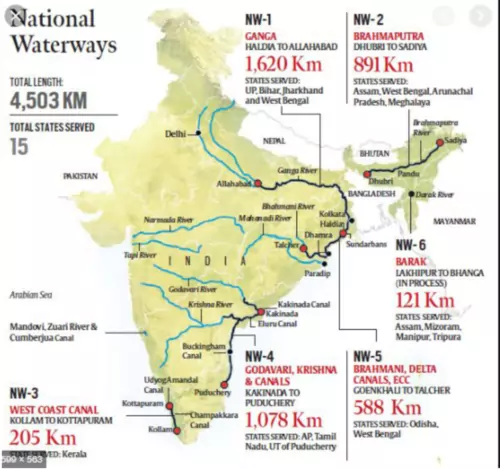
- Employment Generation: The development of National Waterway 1 from Allahabad to Haldia is widely helpful in employment generation and narrowing the urban-rural divide as well. Key opportunities lie in 11 major power plants being located on the banks of NW1 with a cumulative capacity of 12,000 MW as well as multiple chemical and food exporters in UP and West Bengal.
- Logistics Development: India’s first multi-modal terminal was inaugurated on the NW1 in Varanasi as well. This helps to generate employment by receiving the container cargo from the Kolkata port and as a result boost economic development.
- Environmental Sustainability: Inland water transport is beneficial to the environment as it emits less carbon emissions in comparison with other sources of travel helping in sustainable development. It also helps to promote tourism through water. Such new avenues can be opened up through the inland water transport.
However, all weather connectivity cannot be ensured in the case of inland rivers, also the heavy siltation in the river beds reduce the possibility of inland travels everytime. Such issues have to be tackled on a regular basis for regular inland water connectivity.
Download Full Answerkey(Recommended)
5. What are the factors affecting the sustainable development of North East India? Discuss the role of UDAN scheme in this regard. (10 Marks)
Answer: Economic backwardness of North-East (NE) India compared to mainland India is not a recent phenomenon. Since the colonial period, the region has been a witness to highly inequitable rates of growth and development. Some of the important factors that affect the sustainable development of North East India are:
Insurgency: The insurgency movements derive their roots from various internal and external factors. Continuous tussle between government and the insurgents is the greatest impediment in the path to development. Inner Line Permit: ILP is a special permit that is required of outsiders to enter the northeastern states of Arunachal Pradesh, Nagaland and Mizoram. Treating the Northeast as an untouchable reserve acts as a hindrance to its development
Lack of infrastructure: One of the reasons for the economic backwardness of the NE states is the poor state of basic infrastructural facilities. Only in recent years, serious efforts have been made for the provision of these facilities and new airports and airstrips apart from railway’s extension to the region has been started.
Geography: Difficult geographic terrain makes porous border very difficult to access thus acting as a haven for insurgents, terrorists and illegal migration. It also discourages infrastructural development activities that can bring prosperity to the region in economic and social aspects. Business enterprises are unwilling to invest in the region due to the presence of insecurity and insurgency. Lack of communication and connectivity: The region is in dire need of better connectivity that discourage trade facilitations between states or even among nearby regions.
Gap between government and people
Presence of the provisions like AFSPA is one of the most contentious and controversial issue escalating the gap between government and people. This also creates a major stage for unrest in the region. Role of the military is seen as a face of central government and the disgruntled people feel more secure with insurgents rather than co-operating in developmental activities.
Historical reasons: Historically, long colonial exploitation and since independence, the government’s neglect has let the region being marginalized. The absence of political, social and economical rights has resulted in regional isolation and backwardness which requires a great effort to reverse it
However, the government of India has come up with numerous schemes and programs which is aimed at developing the North East region and ultimately make them at par with rest of India. Ude Desh ka Aam Nagrik(UDAN) is a scheme launched by civil aviation ministry to develop regional airport and to give a boost to regional
connectivity. Better transportation by means of air in the Northeast region will also be highly helpful in improving the outcomes of the Indian government’s ‘Act East’ policy, which at a large scale demands to enhance trade ties between the region and South-East Asian economies.
UDAN will definitely give a boost to connectivity in Northeast India. To provide a major boost to air connectivity in the Northeast, 92 new routes will be opened in the region in the second round of UDAN scheme. There is also a provision of procuring seaplanes that could seat 9-10 passengers and land on smaller airstrips, which will also boost connectivity and tourism both. The construction of the Pakyong airport in Sikkim is complete and it will make reaching the northern part of the state, especially tourist attractions such as Nathu La Pass, easier.
6. Defining agroforestry, examine its prospects and challenges in improving the livelihood of farmers in India. (10 Marks)
Answer: Agroforestry is the interaction of agriculture and trees, including the agricultural use of trees. This comprises trees on farms and in agricultural landscapes, farming in forests and along forest margins and tree-crop production, including cocoa, coffee, rubber and oil palm.
Agroforestry is agricultural and forestry systems that try to balance various needs:
- to produce trees for timber and other commercial purposes;
- to produce a diverse, adequate supply of nutritious foods both to meet global demand and to satisfy the needs of the producers themselves;
- to ensure the protection of the natural environment so that it continues to provide resources and environmental services to meet the needs of the present generations and those to come.
Prospects of agroforestry in improving livelihood of farmers
- Reduction in crop failure
Reduction in incidence of total crop failure, common to single-cropping or monoculture system will help farmers reduce the risk of complete or partial loss.
- Soil erosion control
Reduction of surface run-off, nutrient leaching and soil erosion through impending effect of tree roots and stems of these processes which in turn helps in better productivity
- Reduction of deforestation
More efficient recycling of nutrients by deep-rooted trees on the site and
- Increased soil fertility
Increment in soil nutrients through addition and decomposition of litter-fall and Improvement of soil structure through the constant addition of organic matter from decomposed litter
- Ecosystem stabilisation
Improvement of microclimate, such as lowering of soil surface temperature and reduction of evaporation of soil moisture through a combination of mulching and shading.
- Economic benefits
Saves time in fuelwood and fodder collection. Increment in maintenance of outputs of food, fuelwood, fodder, fertilizer and timber and increase in levels of farm incomes due to improved and sustained productivity.
- Social benefits
Improvement in rural living standards from sustained employment and higher incomes; Improvement in nutrition and health due to increased quality and diversity of food outputs and stabilization and improvement of upland communities through elimination of the need to shift sites of farm activities.
Challenges in adopting agroforestry by farmers
- Lack of capital
More capital is required for setting up agroforestry practices when compared to single crop cultivation. This might discourage the farmers.
- Lack of technical skills
The fact that agroforestry is more complex, less well understood and more difficult to apply, compared to single-crop farm.
- Lack of manpower
Requirement for more labour inputs, which may cause scarcity at times in other farm activities
- Environmental aspects
Possible competition of trees with food crops for space, sunlight, moisture and nutrients which may reduce food crop yield and rapid regeneration by prolific trees, which may displace food crops and take over entire fields.
- Socio-economic aspects
Longer period required for trees to grow to maturity and acquire an economic value and resistance by farmers to displace food crops with trees, especially where land is scarce
- Market inaccessibility
- Invasive alien species such as eucalyptus, acacia etc. take most water from the agricultural fields.
7. “Hidden and messy urbanisation in India often comes with a socio-economic and ecological cost”. In light of this statement, discuss measures for inclusive urbanisation in India. (15 Marks)
Answer: Although they have made progress, South Asian countries have struggled to make the most of the opportunity urbanization provides them to transform their economies to join the ranks of richer nations in both prosperity and livability, according to a new World Bank report.
Difficulty in dealing with the pressures urban populations put on infrastructure, basic services, land, housing and the environment lie at the heart of the relative lack of livability of the Indian cities. That fosters the “messy and hidden” urbanization that constrains the concentration of economic activity that could bring about faster improvements in prosperity. Massive rate of Urbanisation without considering the future needs or present issues and random urbanisation to accommodate people and industry results in huge socio-economic and ecological cost.
Socio-economic and ecological cost:
- Messy urbanization is reflected in the almost 65.5 million Indians who, according to the country’s 2011 Census, live in urban slums, as well as the 13.7 percent of the urban population that lived below the national poverty line in 2011.
- As a city grows, the cost of housing and infrastructure also grows, since there are less water, land and building material available, and greater congestion problems. As a city decays in this way, governments often do not meet the service needs of residents and urban development is dominated by private capital.
- Unemployment grows, as do drug abuse, crime and homelessness.
- Affects the rates of crime, violence and peaceful coexistence.
- Water supply and sanitation: The provision of water and sanitation services to growing urban settlements, peri-urban and slum areas presents critical challenges. The increased demand for water from the growing population can place added stress on already stretched resources.
- Wastes and pollution: Urbanisation affects land, water, air and wildlife because of the number of people, the amount of buildings and construction, and the increased demands on resources. It has impacts on the physical environment.
- Formation of heat islands are a serious ecological impact of messy urbanisation.
- Rapid urbanisation leads to decrease in quality of life and living.
- One major element of city economies that still generates less attention to the informal economy.
- Cities are highly vulnerable to climate change impacts. This disproportionately affect the poor, who normally settle in compact settlements and slums, on riverbanks and steep slope areas where land is more affordable or settled illegally. These areas are often prone to floods, storms and landslides.
Measures to bring in Inclusive Urbanisation:
“The world is going through an unprecedented transition. The global balance of power is shifting, extreme poverty has dropped to historic lows, more people than ever before now live in cities, and new technologies are revolutionizing social behaviours and entire industries.”
- Transportation and mobility systems: Traffic is one of the major development problems of any major city. The development options to ease traffic include mass transit public transport, increased car-centric road transportation or shared economy solutions.
- Energy systems: Cities face a trade-off in energy generation systems between options that have lower up-front costs but are often polluting and inefficient (e.g., diesel generators and coal fired plants) and investments in renewable sources (solar, wind or hydro) that may have higher capital costs but are less polluting, produce fewer GHG emissions and often have lower life-cycle costs.
- Environmental protection and waste management: innovative waste management such as waste-to-energy technologies (e.g., methane from landfills), reusing and recycling as an economic opportunity and ecosystem-based sewage treatment. Solid waste management measures including composting and generating energy from methane combustion can also help reduce methane emissions in landfills, increase forest carbon sequestration and contribute to overall reduction of greenhouse gases.\
- Ensuring spatial equality and social equality helps to bring in inclusive urbanisation.
- Governance systems: openness and participation oriented governance promotes inclusive urbanisation.
- Job creation, informality and entrepreneurship Cities actively promote local economic development by creating employment opportunities that build on the comparative advantages and unique qualities of their localities.
An inclusive city enables all groups of people to contribute to creating opportunities, to share in the benefits of development (access to sustainable livelihoods, legal housing and affordable basic services) and to participate in decision-making.
8. Ecological hotspots in India are not detrimental to development rather it opens up opportunities for sustainable development. Analyse the statement in light of the Western Ghats and Kasturirangan report. (15 Marks)
Answer: Ecological hotspots are areas with outstanding biodiversity or a high concentration of biological values. These values can refer to threatened or endemic species, unique ecosystems, or globally important numbers of a particular species. The concept is based on an approach in which conservation activities and funds focus on a relatively small number of key sites for biodiversity.
By misinterpreting the need for biological hotspot conservation the people living around, industries nearby and various other stakeholders are hindering the development process and also creating huge environmental issues. The right awareness on this can aid sustainable development.
Setting up of Kasturirangan committee shows that the authorities has given due consideration to the concerns of the people on the aspect of practicality of Gadgil report which came prior to Kasturirangan report. Kasturirangan report on Western Ghats gives a clear picture of this, the expert committee made clear demarcation of the land zones based on its sensitivity.
- Over 56,000 square kilometres of ecologically sensitive areas (ESA) in the Western Ghats could not be earmarked as ‘no-go’ zones due to State governments’ ‘insensitivity’.
- The recent monsoon floods in Kerala and parts of Karnataka should serve as alarm bells for the administrations in the States of Goa, Gujarat, Maharashtra, Kerala, Tamil Nadu and Karnataka, which have failed to mark ESA in the Western Ghats.
The restrictions were made based on this sensitive nature and it includes:
- A ban on mining, quarrying and sand mining.
- No new thermal power projects, but hydro power projects allowed with restrictions.
- A ban on new polluting industries.
- Building and construction projects up to 20,000 sq. m was to be allowed but townships were to be banned.
- Forest diversion could be allowed with extra safeguards.
The Kasturirangan panel has recommended that there should be a complete ban on mining activity in Ecologically Sensitive Area (ESA) zone and current mining activities should be phased out within five years, or at the time of expiry of the mining lease. This panel recommended banned development of any township or construction over the size of 20,000 sq. m in this ESA zone.
This panel has not recommended a ban on hydroelectric projects in the zone which was banned in Gadgil report. For dams, it has demanded an uninterrupted ecological flow of at least 30% level of the rivers flow till individual baselines for dams are set. No thermal power is allowed in report. Red industries which are highly polluting be strictly banned in these areas.
On the other hand, the main mistake done in this report that they included ecologically non-sensitive areas under ESA, and left out many ecologically sensitive areas. But it seems that if the Kasturirangan Committee report is implemented, it will directly affects the resources of area. It will also disastrous for the environment. There will be shortage of water and other required resources in that area. The mining will also increase the pollution level of that area which results to damage of fertile land which is used by the farmer for agriculture purpose. They will not be able to do farming there. Finally, farmers will have to quit the area. The employment gets snatched away with this recommendation.
9. Describe the salient features of the Sagar Mala Project highlight its role in port-led development of coastal regions in India. (15 Marks)
Answer: The Sagarmala project seeks to develop a string of ports around the Indian coastal region. The objective of this initiative is to promote “port-led development” along India’s 7500km long coastline.
It looks towards transforming the existing Ports into modern world class Ports and integrate the development of the Ports, the Industrial clusters and hinterland and efficient evacuation systems through road, rail, inland and coastal waterways.
The Union Ministry of Shipping has been appointed as the nodal ministry for this initiative.
To implement this, State governments would set up State Sagarmala committees, headed by the chief minister or the minister in charge of ports.
At the central level, a Sagarmala Development Company (SDC) will be setup to provide equity support to assist various special purpose vehicles (SPVs) setup for various projects.
Features:
- Port Modernization & New Port Development: De-bottlenecking and capacity expansion of existing ports and development of new Greenfield ports.
- Port Connectivity Enhancement: Enhancing the connectivity of the ports to the hinterland, optimizing cost and time of cargo movement through multi-modal logistics solutions including domestic waterways (inland water transport and coastal shipping).
- Port-linked Industrialization: Developing port-proximate industrial clusters and Coastal Economic Zones to reduce logistics cost and time of EXIM and domestic cargo.
- Coastal Community Development: Promoting sustainable development of coastal communities through skill development & livelihood generation activities, fisheries development, coastal tourism etc.
- Coastal Shipping & Inland Waterways Transport: Impetus to move cargo through the sustainable and environment-friendly coastal and inland waterways mode.
Advantages:
- Sagarmala, integrated with the development of inland waterways, is expected to reduce cost and time for transporting goods, benefitting industries and export/import trade.
- Simplifying procedures used at ports for cargo movement and promotes usage of electronic channels for information exchange leading to quick, efficient, hassle-free and seamless cargo movement.
- Sustainable development of the population living in the Coastal Economic Zone community and rural development, tribal development and employment generation, fisheries , skill development, tourism promotion etc.
- Setting up coastal clusters for bulk commodities like coal, cement and steel and providing last mile connectivity to ports with national highways and railway network.
- It’ll provide a platform for central, state and local authorities to work in tandem and coordination under the established principles of Cooperative Federalism.
- It will help realize the vision of BLUE ECONOMY.
Implementation perspective:
Development of port-proximate industrial capacities near the coast, in future, is a step in this direction. In this regard, the concepts of Coastal Economic Zones (CEZs), Coastal Economic Units (CEUs), Port-Linked Industrial & Maritime Clusters and Smart Industrial Port Cities have been introduced.
- Coastal Economic Zones (CEZs): CEZs could be spatial economic regions comprising of a group of coastal districts or districts with a strong linkage to the ports in that region. CEZs are also envisaged to tap synergies with the planned industrial corridor projects
- Coastal Economic Units (CEUs): CEUs will be specific industrial estate projects with a demarcated boundary similar to the DMIC nodes. The CEUs will house the industrial clusters / projects proposed within the CEZ.
Each CEZ will consist of multiple CEUs and more than one industrial cluster can be housed within a CEU. Within each industrial cluster there can be several manufacturing units. To accelerate the CEU development process, it is proposed that CEUs be prioritized in locations where land parcels are available in areas close to a deep draught port and with strong potential for manufacturing. An Inter-Ministerial Committee (IMC) was constituted under the aegis of NITI Aayog for development of CEZs in India.
10. Discuss the role of Micro, Small and Medium Enterprises in the economic development of backward regions in India. (15 Marks)
Answer: Micro, Small and Medium Enterprises Development (MSMED) Act, 2006 which was notified on October 2, 2006, deals with the definition of MSMEs. The MSMED Act, 2006 defines the Micro, Small and Medium Enterprises based on
- The investment in plant and machinery for those engaged in manufacturing or production, processing or preservation of goods and
- The investment in equipment for enterprises engaged in providing or rendering of services.
As per the Act, the enterprises can be defined as:
- A micro enterprise if the investment in plant & machinery is under Rs.25 lakhs
- A small enterprise if the machinery and plant investment is between Rs.25 lakhs and Rs. 5 crores
- A medium enterprise if the said investment is between Rs.5 crores and Rs.10 crores.
Though MSMEs are small investment enterprises, their contribution to the Indian economy is very significant.
Role of MSMEs:
- To generate large scale employment: In India, capital is scarce and labour abundant. MSMEs are thought to have lower capital-output and capital-labour ratios than large-scale industries, and therefore, better serve growth and employment objectives.
- Not only do MSMEs generate the highest employment per capita investment, but they also go a long way in checking rural-urban migration by providing people living in isolated areas with a sustainable source of employment.
- To sustain economic growth and increase exports: Non-traditional products account for more than 95% of the MSME exports. Since such products are mostly handcrafted and hence eco-friendly there exists a great potential to expand the quantum of MSME led exports.
Also, MSMEs act as ancillary industries for Large Scale Industries providing them with raw materials, vital components and backward linkages.
- Inclusive growth:
- MSMEs promote inclusive growth by providing employment opportunities in rural areas especially to people belonging to weaker sections of the society. For example, Khadi and Village industries require low per capita investment and employ a large number of women in rural areas.
Issues faced by MSMEs:
- Access to credit: 90% of MSMEs are dependent on informal sources for funding due to lack of sufficient collateral and high capital needs
- Access to markets: Low outreach and non availability of new markets.
- Lack of skilled manpower and ineffective marketing strategy.
- Difficult for MSMEs to sell products to government agencies.
Competition from MNCs and other big industries.
- Technology access: MSMEs, particularly in unorganized sector, show lower adaptability of technology and innovation.
- Quality and export: Low quality products impact export competitiveness. Also inadequate access to quality raw materials and use of traditional machines causes low productivity.
- Ease of doing business: Heavy government procedures and rules for establishing new units. Due to the bureaucratic delays in getting clearances and the poor litigation system, business becomes a slower process.
Solutions:
- Access to credit:
- Launch of the 59 minute loan portal to enable easy access to credit for MSMEs. The loans up to Rs. 1 crore can be granted in-principle approval through this portal, in just 59 minutes.
- A 2% interest subvention for all GST registered MSMEs, on fresh or incremental loans.
- All companies with a turnover more than Rs. 500 crore, must now compulsorily be brought on the Trade Receivables e-Discounting System (TReDS).
- Joining this portal will enable entrepreneurs to access credit from banks, based on their upcoming receivables.
- Access to markets:
- Public sector companies have now been asked to compulsorily procure 25%, instead of 20% of their total purchases, from MSMEs. Out of the 25% procurement mandated from MSMEs, 3% must now be reserved for women entrepreneurs.
- All public sector undertakings of the Union Government must now compulsorily be a part of Government e-Marketplace (GeM). They should also get all their vendors registered on GeM.
- Technology upgradation: 20 hubs and 100 spokes in the form of tool rooms will be established across the country to facilitate product design. A tool room is a room where tools are stored or, in a factory, a space where tools are made and repaired for use throughout the rest of the factory.
- Ease of doing business: In order to simplify the government procedures, the return under 8 labour laws and 10 Union regulations must now be filed only once a year.
- Environmental Clearance under air pollution and water pollution laws, have been merged into one. Also, the return will be accepted through self-certification.
- For minor violations under the Companies Act, the entrepreneur will no longer have to approach the Courts, but can correct them through simple procedures.