
Exchange Traded Funds
Exchange Traded Funds ETFs or exchange traded funds are similar to index mutual funds. However, they trade just like stocks. ETFs were started in 2001 in India. They comprise a portfolio of equity, bonds and trade close to its net asset value. These funds mainly track an index, a commodity, or a pool of assets. They have the following advantages over mutual funds and equity/debt funds:1. Lower Costs: An investor who buys an ETF doesn’t have to pay an advisory/management fee to the fund manager and taxes are relatively lower in ETFs.2. Lower Holding Costs: As commodity ETFs are widely traded in, there isn’t any physical delivery of commodity. The investor is just provided with an ETF certificate, similar to a stock certificate. Gold ETF: When it comes to making gold purchases, especially for investment purposes, gold coin and bar tend to be the preferred options. However, all things taken into consideration, the ideal gold investment vehicle turns out to be gold ETFs. A gold ETF aims to track the price of domestic physical gold and invests in 99.5% purity gold bullion. When you invest in a gold ETF, you purchase gold in an electronic form. One gold ETF unit is equal to 1 gm of gold and is backed by physical gold of very high purity. One can buy and sell gold ETFs just the way you trade in stocks. Just like a stock of any company, gold ETFs are listed and traded on stock exchanges and can be bought and sold continuously at market prices. Hence, gold ETF combines the flexibility of stock investment and the simplicity of gold investments. Since ETFs are held in demat form, one needn’t worry about the safety aspect. Also, the cost of acquisition in gold ETF is very low, given the absence of making charges and other related expenses. As a result, ETFs have much lower expenses compared with physical gold investment. One can even consider doing an SIP for as low as Rs 1,000 a month to collect gold units over time to meet future requirement. Read Also Gig Economy Enroll today with the best civils service academy and take your first step towards yours Civils out journey. Feel free to reach to us for any inquiries, collaborations, or support. We’re here to help join now
Juice Jacking
Juice Jacking Mobile phones can get infected through a type of cyber attack called Juice Jacking. A USB port is not simply a power socket, you can also use it to transfer and sync your data. A hacker can tamper with a USB charging port at a public charging station to steal passwords and export data. Juice Jacking – Threats: The State Bank of India has warned its customers against plugging-in their phone at charging stations at various public places and also informed people about ‘juice jacking’, a USB charger scam could end up draining bank account of a customer. Juice jacking is a type of cyber attack involving a charging port that doubles as a data connection, typically over USB. It is also called known as USB data blocker. 1. Data theft: Data is stolen from the connected device; there are crawlers that can search your phone for personally identifiable information (PII), account credentials, banking-related or credit card data. These crawlers have the ability to copy all information to their own devices. There are also many malicious apps that can clone all your phones’ data to another phone. 2. Malware installation: Once the connection is established, malware is automatically installed in the connected device. The malware remains on the device until it is detected and removed by the user. There are many categories of malware that cybercriminals can install through juice jacking, including adware, cryptominers, ransomware, spyware, or Trojans. Steps to Mitigate the Risks: The main way to avoid juice jacking is to stay away from public charging stations or portable wall chargers. Carry a personal charger or a power bank or use USB condoms which are adaptors that allow the power transfer but don’t connect the data transfer pins. Switch off your phone or lock your phone and then plug it into the charging port. But this technique only works on few mobile models Enroll today with the best civils service academy and take your first step towards your Civils journey. Feel free to reach out to us for any inquiries, collaborations, or support. We’re here to help. join now
Nandur Madhameshwar
Nandur Madhameshwar Nandur Madhameshwar The International Ramsar Convention on Wetlands has declared Nandur Madhameshwar wetland in Niphad tahsil of Nashik district as Ramsar wetland. This is the first wetland in the state and among the nine wetlands in India declared by the Convention as Ramsar sites . Nandur Madhmeshwar wetland has been formed by shallow backwaters of Nandur Madhmeshwar dam and is known as Maharashtra ‘s Bharatpur. It lies in the 100 sq km Nandur Madhameshwar sanctuary formed in 1986, Nandur Madhameshwsr has measured up to the seven out of nine criteria set for recognition by the Ramsar Convention. These are “rare species and threatened ecological communities, biological diversity, support during critical lifecycle stage or in adverse conditions, more than 20,000 water birds, more than one percent water bird population of one species or sub-species of water birds, significant and representative fish and fish spawning ground. Nandur Madhameshwar boasts of threatened plants like Indian sandalwood, threatened birds like Indian Spotted Eagle, Eastern Imperial Eagle, Common Pochard, Bristled Grass Bird, Wooly-necked stork, White-rumped vulture, Indian vulture and Egyptian vulture, threatened fish Deolali Minnow and mammal like leopard. As for biological diversity, the wetland houses 536 species of aquatic and terrestrial plants, eight mammal species, 265 bird species, 24 fresh water fish species and 41 butterfly species. It supports migratory birds species by serving as a wintering and stopover site and as breeding site for resident birds. It has more than one percent population of Common Pochard, White Stork, Common Crane, Eurashian Spoonbill and Glosdy Ibis bird species. Among fish, the wetland has Butter cat fish, Deolali minnow, Slender rasbora, Novacula razorbelly minnow and globally threatened specie Shalini barb. Read Also Galathea Bay The advantages of being declared Ramsar site: It will help in conservation and wise use of the wetland. Receive national and international cooperation for conservation and management Receive Central funding, boost tourism Generate employment for locals and bring economic benefits for surrounding areas due to increased tourism Create awareness for conservation of other wetlands in the state. Wetlands: The wetlands are land areas covered by water, either temporarilyseasonally or permanently. They play a key role in flood control, water supply and providing food, fibre and raw materials. Such land areas also support migratory birds from colder regions of the world in summers, apart from mangroves that protect coastlines and filter pollutants. Ramsar Convention: Ramsar Convention is a contract among 90 countries aiming at conserving wetlands across the world. It was signed at Ramsar in Iran in 1971 and became operational in 1975. Since then, 37 sites in India have so far been declared as sites of international importance. Nandur Madhameshwar’s number in the list is 2410. The Ramsar Convention is the only global treaty that focuses specifically on wetlands The 2nd of February each year is World Wetlands Day, marking the date of the adoption of the Convention on Wetlands on 2 February 1971. “Wetlands and Biodiversity” is the theme for 2020. The Ramsar Convention works closely with six other organisations known as International Organization Partners (IOPs). These are: Birdlife International International Union for Conservation of Nature (IUCN) International Water Management Institute (IWMI) Wetlands International WWF International Wildfowl & Wetlands Trust (WWT) Read Also Kanjli Wetland Enroll today with the best civils service academy and take your first step towards yours Civils out journey. Feel free to reach to us for any inquiries, collaborations, or support. We’re here to help JOIN NOW
Mt. Everest ‘grows’ taller as China
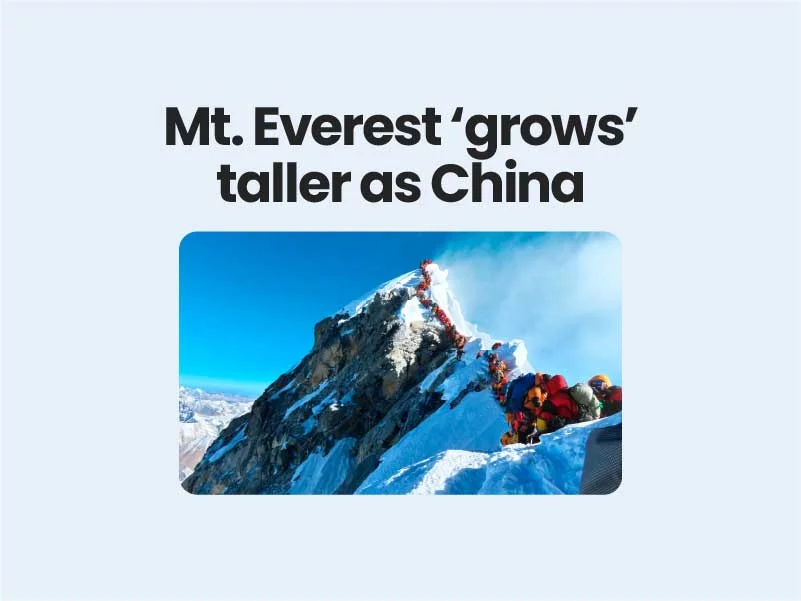
Mt. Everest ‘grows’ taller as China, Nepal announce new height Nepal and China jointly announced the new height of Mount Everest as 8,848.86 metres in a highprofile virtual ceremony, with their Presidents exchanging letters and the Foreign Ministers in attendance, all aimed at showcasing both a deepening strategic relationship and the amicable resolution. Everest — also known as Sagarmatha in Nepal and Mount Qomolangma in China — was “an important symbol of the ChinaNepal friendship”, China’s President Xi Jinping said, calling it a “peak of ChinaNepal friendship”. The mountain lies on the border between Nepal and Tibet and the summit can be accessed from both sides, although the Nepal route is more popular. The project had “overcome all kinds of difficulties and finally reached a conclusion on the snowcovered height based on the International Height Reference System” Advantage of China: For Nepal and China, the height of Everest wasn’t merely an academic debate. It also had ramifications for a lucrative tourism industry. Officials told the Kathmandu Post the slightly higher “snow height” was “one of the key reasons why Nepal had been drawing Everest aspirants in droves”. Ang Tsering Sherpa, former president of theNepal Mountaineering Association, told that climbers from Nepal “started to swell from 2007 when China started issuing Everest climbing certificates stating the height as 8,844.57 metres against 8,848 metres in certificates issued by Nepal for the same peak”. “Now, there will be a common height,” he said, but it will give China an advantage in the climbing stakes as “climbing Everest through the northern side is much cheaper than climbing from the southern side”. The new height replaced the longassociated 8,848 metreheight, which was, the legacy from 1954, and a measurement carried out by the Survey of India Enroll today with the best civils service academy and take your first step towards your Civils journey. Feel free to reach out to us for any inquiries, collaborations, or support. We’re here to help. join now
Jotedars
Jotedars Many zamindars were facing a crisis at the end of the eighteenth century, a group of rich peasants were consolidating their position in the villages. In Francis Buchanan’s survey of the Dinajpur district in North Bengal we have a vivid description of this class of rich peasants known as jotedars. Significance: The Tebhaga movement was led by the share croppers of the Bengal region against the oppressive jotedars in 1946-47. The uprising was due to the share cropping system that prevailed in the Bengal. During the early nineteen century a new class of rich peasants known as jotedars emerged in the Bengal region. The jotedars collected huge tracts of land in rural areas. They also controlled the local markets, money lending activities, exercised control over the poor cultivators. In rural villages these jotedars exercised more control than the Zamindars, who often lived in urban areas. The large agricultural areas under the jotedars were cultivated through sharecroppers (also known as bhagadars), who handed over half of the crop after the harvest to the jotedars. The jotedars were mainly concentrated in the North Bengal, whereas in other parts of the Bengal they are known as haoladars, gantidars, or mandals. Jotedar Vs Zamindar: Jotedar Zamindar Jotedars were landed peasentry who used to own large tracts of land. Zamindars were the owners of land, water, mountains, villages and almost everything under the sun. They generally were quite wealthy. The zamindars had the power to settle people on their lands, employ them for tilling if fields and other jobs. Jotedars belonged to the upper castes Bengalis. They also levied taxes on production of crops, handicrafts, fishing etc. This class used to employ the share croppers on landless peasents in their lands for tilling. Prelims 2022 Detailed Answer Key After the royalty, zamindars used to wield the highest power in rural Bengal. The rise of Jotedars inevitably weakened zamindari authority: Within the villages, the power of Jotedars was more effective than that of Zamindars. The Zamindars who often lived in Urban areas whereas the Jotedars were located in the villages and exercised direct control over a considerable section of poor villagers. They forcefully resisted efforts by zamindars to increase the Jama of the village, prevented zamindars officials from executing their duties, mobilised ryots, who were dependent on them, and deliberately delayed payments of revenue to zamindar. When the estates of the zamindars were auctioned for failure to make revenue payment, Jotedars were often the purchasers. Which is the best UPSC Test Series Check Now https://www.youtube.com/watch?v=AX2CRSHbAoM Enroll today with the best civils service academy and take your first step towards yours Civils out journey. Feel free to reach to us for any inquiries, collaborations, or support. We’re here to help JOIN NOW
Rat hole mining
Rat hole mining It is a primitive and hazardous method of mining for coal, with tunnels that are only 3-4 feet in diameter (hence, rat-hole), leading to pits ranging from 5-100 sq. mt deep. There are two types of rat-holes: when dug into the ground these are vertical shafts leading to the mines where horizontal tunnels are dug; the second type is where horizontal holes are dug directly in the hillsides to reach coal seams (bed of coal). The coal is taken out manually, loaded into a bucket or a wheelbarrow and dumped on a nearby un-mined area. From here, it is carried to larger coal dumps near highways for trade and transportation. Rat hole mining cheaper than other conventional mining methods and also hilly geography necessitate such mining method. Coal reserves: Coal reserves are primarily found in the Eastern India in states of Telangana, Madhya Pradesh, Maharashtra, Jharkhand, Chhattisgarh, West Bengal and predominantly in North-East regions like Assam and Meghalaya. Despite the presence of coal reserves, commercial mining is not practiced in the North-Eastern regions because of terrain’s unsuitability as well as nature of coal deposits. Open mining cannot be practiced due to the added difficulties. Further, the coal found in North-East contains lots of sulfur. This overall reduces the energy efficiency and therefore this type of coal is categorized as bad quality of coal. Impact of Rat Hole Mining : 15 workers were trapped in a 320-350 feet-deep coal mine in the East Jaintia Hills district of Meghalaya after it was flooded by waters of the nearby Lytein river. Rescue operations led by the National Disaster Response Force and the Indian Navy are on to locate the trapped workers. The recent mishap is one of several such accidents that have taken place over the past few years, leading to the death of workers. Water from rivers and streams in the mining area has become unfit for drinking and irrigation, and is toxic to plants and animals. A study by the North-Eastern Hill University, Shillong, says the Kopili river has turned acidic due to the discharge of acidic water from mines and the leaching of heavy metals. Layers of rock above the coal removed during mining contain traces of iron, manganese and aluminium that get dissolved from mining sites through the acid run-off or are washed into streams as sediment. due to small size of tunnel, there is incidences of employing children as worker; no social security for migrants workers from nearby states. Cultural concern: rampant illegal mining destroying natural caves in jaintia hills. Rat-hole mining is illegal: The National Green Tribunal banned rat-hole mining in Meghalaya in 2014 on a petition that said acidic discharge from the mines was polluting the Kopili river. But the practice continues unabated. Meghalaya Mines and Mineral Policy, 2012 does not address rat hole mining issue The government of Meghalaya controls only 5% land rest either community or privately owned which undermines effective regulations Misuse of 6th Schedule of Constitution which provides tribal communities right over -land and use of its resources- by illegal miners and local councils Way forward: Mining has provided jobs to local people. Following the ban, there are demands for rehabilitation or alternative employment. Effective implementation of 6th schedule Diversifying livelihood opportunities Stringent implementation of the Mines and Minerals (Development and Regulation) Act which prohibits operation of illegal mining under state accountability Enroll today with the best civils service academy and take your first step towards yours Civils out journey. Feel free to reach to us for any inquiries, collaborations, or support. We’re here to help JOIN NOW
HelpAge India
HelpAge India NGO HelpAge India received the “2020 UN Population Award” in the institutional Category for its contribution towards serving disadvantaged elderly people and raising awareness on their cause. HelpAge India is a leading charity in India working with and for disadvantaged elderly for nearly 4 decades. It was set up in 1978 and is registered under the Societies’ Registration Act of 1860. There are an estimated 106 million elderly in India. HelpAge advocates for their needs such as for Universal Pension, quality healthcare, action against Elder Abuse and many more at a national, state and societal level with Central and State governments. It advocates for elder friendly policies and their implementation thereof. It works hand-in-hand with Senior Citizens Associations understanding elder needs working with and for them. The aim is to serve elder needs in a holistic manner, enabling them to live active, dignified and healthier lives. HelpAge’s focus over the years has moved from Welfare to Development. It provides elderly relief through various agecare interventions such as – it runs one of the largest mobile healthcare programs through its Mobile Healthcare Units spanning the country providing free healthcare services to destitute elders. It helps elders earn their livelihood through the formation of Elder-Self-Help Groups making self-reliant. It conducts cataract surgeries to restore their sight, looks after their basic needs though its Support-a-Gran program, runs Elder Helplines across the country, provides relief & rehabilitation for elders post disasters and provides active-ageing opportunities. UN Population Award: The UN Population Award, established by the United Nations General Assembly (UNGA) in 1981, recognises contributions in the fields of population and reproductive health. The award ceremony was held virtually in the UN”s New York office. Enroll today with the best civils service academy and take your first step towards yours Civils out journey. Feel free to reach to us for any inquiries, collaborations, or support. We’re here to help JOIN NOW
Malabar Gliding Frog
Malabar Gliding Frog Malabar Gliding Frog- A green frog with a slender body, webbed feet, unusual body positions, very well camouaged and gliding in the air. This was how a juvenile Malabar gliding frog (Rhacophorus malabaricus), a rare amphibian that can glide in the air up to 10-12 m, was spotted in the orchard of a house at Pullad, near Kozhencherry in Kerala. The frog endemic to the rain forests of the Western Ghats in his orchard, it was the second time he spotted this rare species in the orchard in the past two years. Their gliding abilities help these frogs cover 10-12 ft in one leap. The frog has got a body length of 10 cm, making it one of the largest mossy frogs. The ngers and toes are like sticks to attach to and walk through tree branches. Males are smaller than females. In the International Union for Conservation of Nature (IUCN) Red List , it is placed in the Least Concern category. The Malabar gliding frog population is declining due to deforestation, climate change, developmental activities, and toxic chemicals. They built foam nests above small pools of water, into which the tadpoles drop after hatching. These frogs have the skin which is green in colour and resembles moss growing on the rock. The breeding period is during the monsoon and usually, the females choose to spawn on the lush green leaves overhanging a waterbody. Western ghats: Older than the Himalaya mountains, the mountain chain of the Western Ghats represents geomorphic features of immense importance with unique biophysical and ecological processes. The site’s high montane forest ecosystems influence the Indian monsoon weather pattern. Moderating the tropical climate of the region, the site presents one of the best examples of the monsoon system on the planet. It also has an exceptionally high level of biological diversity and endemism and is recognized as one of the world’s eight ‘hottest hotspots’ of biological diversity. The forests of the site include some of the best representatives of non-equatorial tropical evergreen forests anywhere and are home to at least 325 globally threatened flora, fauna, bird, amphibian, reptile and fish species. At least 325 globally threatened (IUCN Red Data List) species occur in the Western Ghats. The globally threatened flora and fauna in the Western Ghats are represented by 229 plant species, 31 mammal species, 15 bird species, 43 amphibian species, 5 reptile species, and 1 fish species. Of the total 325 globally threatened species in the Western Ghats, 129 are classified as Vulnerable, 145 as Endangered and 51 as Critically Endangered. Gujarat, Maharashtra, Goa, Karnataka, Tamil Nadu, and Kerala are the six Indian states covered by the Western Ghats. Enroll today with the best civils service academy and take your first step towards yours Civils out journey. Feel free to reach to us for any inquiries, collaborations, or support. We’re here to help JOIN NOW
INS Himgiri Project 17 A Stealth Frigate
INS Himgiri Project 17 A Stealth Frigate Himgiri, the first of the three Project 17A ships being built at M/s Garden Reach Shipbuilders and Engineers Limited (GRSE), Kolkata was launched on 14 December 2020. She made her first contact with the waters of Hoogly River at 1335 Hrs at the launch ceremony, General Bipin Rawat, Chief of Defence Staff (CDS) was the Chief Guest. In keeping with Naval traditions Smt Madhulika Rawat, spouse of CDS launched the ship to the chanting of invocations from the Atharva Veda. The ship has taken its name and crest of the second Frigate of the Leander Class of ships, which incidentally was launched 50 years ago in 1970. Under the Project 17A program, a total of seven ships, four at Mazagon Dock Shipbuilders Limited (MDL) and three ships at GRSE are being built with enhanced stealth features, advanced indigenous weapon and sensor fit along with several other improvements. The launch of ‘Himgiri’ has showcased GRSE’s commitment towards the building of three state-of-the-art warships of P17A for Indian Navy. Over the years, GRSE has emerged as a leading shipyard having built over 100 ships. The yard has scaled up its infrastructure and skill sets to meet new challenges in building of P17A ships. P17A ships are the first gas turbine propulsion and largest combat platforms ever built at GRSE. Since its inception, Project 17A has upheld India’s vision for Atmanirbhar Bharat. P17A ships have been indigenously designed by Directorate of Naval Design (Surface Ship Design Group) – DND(SSG), and are being built at indigenous yards namely MDL and GRSE. Naval shipbuilding provides a great opportunity to energise our economy post COVID-19. Project 17A ships are sourcing 80% of the material/ equipment required for the project from indigenous vendors and with employment generation for over 2000 Indian firms and MSMEs within the country. Modular construction of the ship through outsourcing, and integrated construction methodology are being used to enhance GRSE’s productivity for delivery of ship targeted in August 2023. Enroll today with the best civils service academy and take your first step towards your Civils journey. Feel free to reach out to us for any inquiries, collaborations, or support. We’re here to help. join now
Global Energy Transition Index
Global Energy Transition Index World Economic Forum (WEF) announced that India has moved up two positions and has ranked 74th on a global energy transition index. With a better ranking, India has shown improvement in key parameters of economic security, economic growth, and environmental sustainability. WEF is a Geneva-based international organisation that is for public and private cooperation. Releasing the ranking it further stated that the ongoing COVID-19 crisis will compromise the transition to clean energy by both the developed and developing countries. Key Highlights: World Economic Forum in its report stated that as per its study for measuring the readiness for the transition to clean energy, out of 115 economies 94 have shown progress since 2015. But even with the progress, environmental sustainability is still behind. Sweden has acquired a top position on the Energy Transition Index (ETI) for the third consecutive year and has been followed by Finland and Switzerland in the top three. Out of G20 countries, only France at 8th rank and UK at 7th rank have been in the top 10. The theme of WEF 2020 is Stakeholders for a Cohesive and Sustainable World. It is basically a networking event where countries project themselves to garner investment. The Energy Transition Index, a composite score of 40 indicators, benchmarks 115 countries on the current performance of their energy system, and their readiness for transition to a secure, sustainable, affordable, and inclusive future energy system. The global energy transition has been moving at a slow, but steady pace. Of the 115 countries benchmarked on the ETI, 94 corresponding to more than 70% of global CO2 emission have improved their scores since 2015. The gap between countries in the top quartile, and the rest of the countries seems to be narrowing – which highlights the emerging global consensus on the necessary priorities for energy transition, and increased sharing of best practices among countries. COVID-19 has stress tested the energy system The economic development and growth dimension of energy transition is currently being challenged by the cascading effects of COVID-19. There has nonetheless been unprecedented collaboration among leading Oil & Gas producing countries to provide stability to markets, but the recent price volatilities will be a stress test for the energy system Over the past five years, most countries have reduced the level of energy subsidies, reflecting the movement towards cost-reflective pricing. Cost of utility bills, already a sensitive issue in many countries, will exacerbate the affordability challenge as unemployment rises due to economic consequences. The progress on environmental sustainability remains slow, but 2019 was a landmark year. Central banks recognized the systemic risks from uncoordinated and abrupt transition, world’s largest asset managers cited the importance of ESG considerations in investment, and many countries and companies announced net zero goals. COVID-19 might result in a shift in stakeholder priorities in the near term. Goals and Challenges: Distinct fall in investment flows and trade flows Protectionism Many economists are projecting that by the end of 2020 there might be a mild global recession. All the major, fastest-growing economies including India and China have slowed down presently. Most of the European economies are showing a growth of less than 1%. Systems approach: building the fundamentals for energy transition Energy transition readiness is captured by the stability of the policy environment and the level of political commitment, the investment climate and access to capital, the level of consumer engagement, the development and adoption of new technologies, etc. Some of these factors are beyond the scope of the energy system but nevertheless determine the effectiveness and future trajectory of energy transition in a country. Those countries that are most energy-ready have adopted diverse pathways to improve their readiness. They have simultaneously improved on multiple enablers, underscoring the importance of a systemic approach to energy transition. The cascading effects of COVID-19 The transformation of the energy system over the past decade, although slower than required to achieve the objectives of the Paris Agreement to combat climate change, has been unprecedented. But this hardearned momentum now risks being lost, as the ongoing COVID19 pandemic continues to cause economic and social damage. Beyond the uncertainty over its longterm consequences, COVID-19 has unleashed cascading effects in real time: The erosion of almost a third of global energy demand Unprecedented oil price volatilities and subsequent geopolitical implications Delayed or stalled investments and projects Uncertainties over the employment prospects of millions of energysector workers The crisis has forced the unthinkable. Society has had to relinquish valuable commodities and freedoms to collectively address the global outbreak. An effort of similar proportions is required for a successful energy transition. Effective energy transition is timely, inclusive, sustainable, affordable and secure. It provides solutions to global energy-related challenges, while creating value for business and society, without compromising the balance of the energy triangle. While a long-term vision and objectives are necessary, remaining flexible in a dynamic environment is also critical. Given the complexity and scale of the energy system, which includes different fuel sources, technologies for extraction and conversion, and end-use sectors, an effective energy transition needs to balance the priorities of diverse stakeholder groups. The World Economic Forum’s initiative on “Fostering Effective Energy Transition” offers a platform to foster common understanding among all stakeholder groups on the destination of energy transition, necessary imperatives, market and policy enablers, and the resulting human impact Importers vs exporters: Since 2015, fuel-importing countries have improved as a faster rate than fuel-exporting countries. Key points of differentiation are on environmental sustainability, capital and investment in new energy infrastructure, and the inertia from legacy energy system structure. Sweden leads the overall rankings for the third consecutive year, followed by Switzerland and Finland. The performance of G20 countries is mixed. France and United Kingdom are the only G20 countries in the top 10. China, India, and Italy made consistent improvements on overall ETI score since 2015, while Russia, Japan, South Korea and Germany made moderate gains. Scores for United States, Canada, Brazil and Iran were either stagnant, or declining. It’s a generational