
Aero India 2021
Aero India 2021 Aero India exhibition is organised every alternate year. It is one of the major exhibition for aerospace and defence industries with a public air show. It enables industry professional to gain market insights, announce new developments and gain media coverage, and offers a unique platform to international aviation sector to bolster business. Aero India 2021 is the 13th edition being organised at Bengaluru, Karnataka from 03-07 February 2021. Aero India 2021 provides opportunity to demonstrate products to the potential customer and investors. In 2021 Exhibitors are likely to showcase their products using latest technologies to the potential customers. This is an important international event likely to be attended by thousands of business visitors and lakh general visitors Highlight of Aero india 2019: 403 Exhibitors 238 Indian Exhibitors 165 Foreign Exhibitors 61 Aircrafts Displayed 28386 sqm Exhibition spaces 44 Foreign Delegations In 2019, it was organized by Hindustan Aeronautics Ltd. (HAL) and in 2021, it will be organized by the Defense Exhibition Organization, Ministry of Defense. Aero India is a biennial international military and civil airshow. The Yelahanka air base, about 30 km from the city centre Bengaluru, has been hosting the air show in February since it was started in 1996. Read Also India’s Two-Front Challenge Logo: The logo is inspired by the Tejas Light Combat Aircraft (LCA). The Tejas LCA together with its variants, is the smallest and lightest Multi-Role Supersonic Fighter Aircraft of its class. This single engine, Compound-Delta-Wing, Tailless Aircraft is designed and developed to meet diverse needs of the Indian Air Force (IAF) and Indian Navy (IN).The Teja’s LCA Programme has achieved the rare distinction of completing over 4000 Successful Test Flights. The tri-colored silhouette of the Teja’s LCA with the Ashok Chakra in the Centre is the core motif of this logo, reminiscent of the spirit of New India. The defined outlines of the ‘A’ in Aero is symbolic of a fighter jet while conveying that Aero India is a premier global aerospace exhibition. https://www.youtube.com/watch?v=sWHYylsrWXk Enroll today with the best civils service academy and take your first step towards your Civils journey. Feel free to reach out to us for any inquiries, collaborations, or support. We’re here to help. join noow
Parliamentary scrutiny
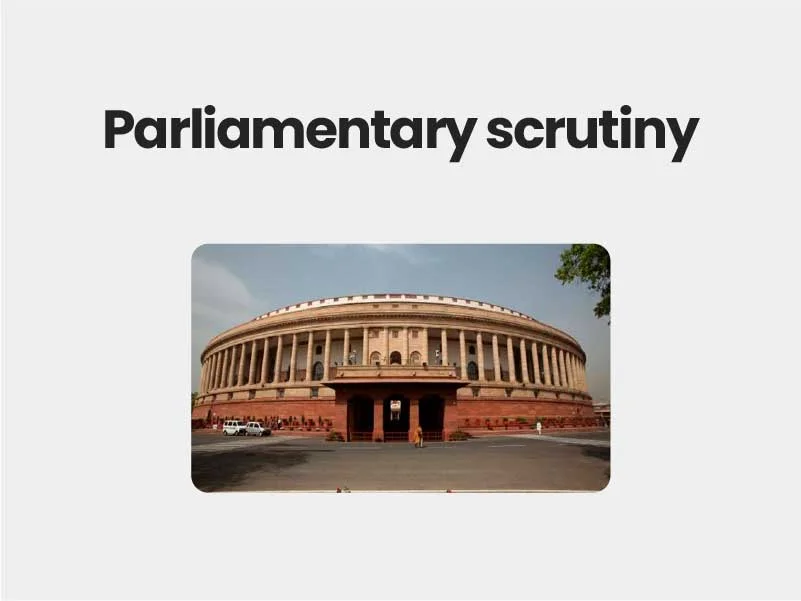
Parliamentary scrutiny Parliamentary scrutiny – The new Farm bills passed by parliament in the last monsoon session have evoked a scale of protest unforeseen by the government. Over the years, the Indian Parliament has increasingly adopted the committee system as did the other democracies in the world. This helped in housekeeping, to enhance the efficacy of the House to cope with the technical issues confronting it and to feel the public pulse. But the committee approach also helped to guard its turf and keep it abreast to exercise accountability on the government. Parliamentary Committees: Parliamentary Committees are of two kinds – Standing Committees and ad hoc Committees. The former are elected or appointed every year or periodically and their work goes on, more or less, on a continuous basis. The latter are appointed on an ad hoc basis as need arises and they cease to exist as soon as they complete the task assigned to them. Standing Committees: Among the Standing Committees, the three Financial Committees – Committees on Estimates, Public Accounts and Public Undertakings – constitute a distinct group as they keep an unremitting vigil over Government expenditure and performance. While members of the Rajya Sabha are associated with Committees on Public Accounts and Public Undertakings, the members of the Committee on Estimates are drawn entirely from the Lok Sabha. The Estimates Committee reports on ‘what economies, improvements in organisation, efficiency or administrative reform consistent with policy underlying the estimates’ may be effected. It also examines whether the money is well laid out within limits of the policy implied in the estimates and suggests the form in which estimates shall be presented to Parliament. The Public Accounts Committee scrutinises appropriation and finance accounts of Government and reports of the Comptroller and Auditor-General. It ensures that public money is spent in accordance with Parliament’s decision and calls attention to cases of waste, extravagance, loss or nugatory expenditure. The Committee on Public Undertakings examines reports of the Comptroller and Auditor-General, if any. It also examines whether public undertakings are being run efficiently and managed in accordance with sound business principles and prudent commercial practices. Besides these three Financial Committees, the Rules Committee of the Lok Sabha recommended setting-up of 17 Department Related Standing Committees (DRSCs). Accordingly, 17 Department Related Standing Committees were set up on 8 April 1993. In July 2004, rules were amended to provide for the constitution of seven more such committees, thus raising the number of DRSCs from 17 to 24. The functions of these Committees are: To consider the Demands for Grants of various Ministries/Departments of Government of India and make reports to the Houses; To examine such Bills as are referred to the Committee by the Chairman, Rajya Sabha or the Speaker, Lok Sabha, as the case may be, and make reports thereon; To consider Annual Reports of ministries/departments and make reports thereon; and To consider policy documents presented to the Houses, if referred to the Committee by the Chairman, Rajya Sabha or the Speaker, Lok Sabha, as the case may be, and make reports thereon. Parliamentary scrutiny – Challenges Committees of scrutiny and advice, both standing and ad hoc, have been confined to the margins or left in the lurch in the last few years. While 60% of the Bills in the 14th Lok Sabha and 71% in the 15th Lok Sabha were wetted by the DRSCs concerned, this proportion came down to 27% in the 16th Lok Sabha. The government has shown extreme reluctance to refer Bills to Select Committees of the Houses or Joint Parliamentary Committees. Our Parliamentary Committees have a tradition of working in a non-party manner. The reports of these committees are based on consensus. It may be a bit difficult for people to believe that the instrumentalities of parliament could rise above parties. But that is how they function.The systems of parliament are inclusive. They have the capacity to harmonise contradictions. Despite the adversarial politics playing out in full force in the House, the calm atmosphere prevailing in the committee rooms and the purposiveness shown by the members in dealing with issues are a tremendously reassuring factor. To make these systems gradually non-functional and irrelevant is to invite disaster. Enroll today with the best civils service academy and take your first step towards your Civils journey. Feel free to reach out to us for any inquiries, collaborations, or support. We’re here to help. join now
National Family Health Survey (NFHS)
National Family Health Survey (NFHS) The National Family Health Survey (NFHS) is a large-scale, multi-round survey conducted in a representative sample of households throughout India. The NFHS is a collaborative project of the International Institute for Population Sciences(IIPS), Mumbai, India; ORC Macro, Calverton, Maryland, USA and the East-West Center, Honolulu, Hawaii, USA. The Ministry of Health and Family Welfare (MOHFW), Government of India, designated IIPS as the nodal agency, responsible for providing coordination and technical guidance for the NFHS. NFHS was funded by the United States Agency for International Development (USAID) with supplementary support from United Nations Children’s Fund (UNICEF). IIPS collaborated with a number of Field Organizations (FO) for survey implementation. Each FO was responsible for conducting survey activities in one or more states covered by the NFHS. Technical assistance for the NFHS was provided by ORC Macro and the East-West Center. Objectives of National Family Health Survey : The main objective of successive rounds of the NFHS is to provide reliable and comparable datasets on health, family welfare and other emerging issues. Four rounds of NFHS (1992–93, 1998–99, 2005–06 and 2015–16) have been successfully completed in India. All the rounds of NFHS have been conducted by the International Institute for Population Sciences (IIPS), Mumbai, as the national nodal agency. Earlier the Health Ministry itself used to conduct District Level Health Survey (DLHS) and Annual Health Survey (AHS). MoHFW has decided to conduct integrated NFHS with a periodicity of three years in lieu of different surveys from 2015-16 onwards to meet the evolving requirements for frequent, timely and appropriate data at the National, State and District levels. The NFHS-5 is being conducted in around 6.1 lakh sample households to provide disaggregated data up to district levels. And this data so generated when completed would be comparable with NFHS-4 without any loss of information. Read HelpAge India Significance: The First National Family Health Survey (NFHS-1) was conducted in 1992-93. The survey collected extensive information on population, health, and nutrition, with an emphasis on women and young children. Eighteen Population Research Centres (PRCs), located in universities and institutes of national repute, assisted IIPS in all stages of conducting NFHS-1. All the state-level and national-level reports for the survey have already been published (48 reports in all). The Second National Family Health Survey (NFHS-2) was conducted in 1998-99 in all 26 states of India with added features on the quality of health and family planning services, domestic violence, reproductive health, anemia, the nutrition of women, and the status of women. The results of the survey are currently being published. The Third National Family Health Survey (NFHS-3) was carried out in 2005-2006. Eighteen Research Organizations including five Population Research Centres carried out the survey in 29 states of India. The funding for NFHS-3 is provided by USAID, DFID, the Bill and Melinda Gates Foundation, UNICEF, UNFPA, and MOHFW, GOI. ORC Macro, USA, is providing technical assistance for NFHS-3, and the National AIDS Control Organization (NACO) and the National AIDS Research Institute (NARI) are providing technical assistance for the HIV component. NFHS-5: India’s population is stabilising, as the total fertility rate (TFR) has decreased across majority of the states. 17 states analysed in the fifth round of National Family Health Survey (NFHS), except for Bihar, Manipur and Meghalaya, all other states have a TFR of 2.1 or less, which implies that most states have attained replacement level fertility, an analysis by the Population Foundation of India (PFI) . The first set of findings from the fifth NFHS, conducted in 2019-20, was released by the Ministry of Health and Family Welfare on Saturday, December 12, four years after the last survey (NFHS-4, 2015-16). NFHS 5 merits urgent attention, as this is the most comprehensive and robust data at scale on health and family welfare and emerging issues in this area, stated PFI. All 17 states have witnessed an increase in the use of modern contraceptives of family planning. The proportion of women with unmet need for family planning, who want to stop or delay child-bearing but are not using any method of contraception, has declined in all states, except Meghalaya and Andhra Pradesh. Except for Manipur, all states have reported an increase in users getting information on side effects of current contraceptive methods. Concern areas: Anaemia among women remains a major cause of concern. In all the states, anaemia is much higher among women compared to men. Female sterilisation continues to dominate as the modern method of contraception in states like Andhra Pradesh (98 per cent), Telangana (93 per cent), Kerala (88 per cent), Karnataka (84 per cent), Bihar (78 per cent) and Maharashtra (77 per cent). Male engagement in family planning continues to be limited and disappointing as seen by the low uptake of condoms and male sterilisation across states. Despite the efforts being made, it is alarming to see the increase in child marriages in a number of states, reveals the data. There has been an increase in child marriages in Tripura (40.1 per cent from 33.1 per cent in 2015-16), Manipur (16.3 per cent from 13.7 per cent in 2015-16) and Assam (31.8 per cent from 30.8 per cent in 2015-16), while states like West Bengal (41.6 per cent) and Bihar (40.8 per cent) still have high prevalence of child marriages. States such as Manipur, Andhra Pradesh, Himachal Pradesh and Nagaland have also shown increase in teenage pregnancies. Along with increase in child marriages, Tripura has also shown an increase in teenage pregnancies, from 18.8 per cent in 2015-16 to 21.9 per cent in 2019-20. While spousal violence has generally declined in most of the states and UTs, it has witnessed an increase in five states, namely Sikkim, Maharashtra, Himachal Pradesh, Assam and Karnataka. Karnataka witnessed the largest increase in spousal violence, from 20.6 per cent in NFHS 4 to 44.4 per cent in NFHS-5. Sexual violence has increased in five states (Assam, Karnataka, Maharashtra, Meghalaya and West Bengal), as per the data. Government Innitiatives: POSHAN Abhiyaan: It is considerable improvement in vaccination coverage among children age 12-23 months across all states and UTs. Mission Indradhanush ICDS Way Forward
Livelihood Enterprise Development Programme (LEDP)
Livelihood Enterprise Development Programme (LEDP) As skill upgradation trainings alone have limited impact on livelihood creation among the SHG members, it was thought prudent to create sustainable livelihoods among SHG members and to attain optimum benefit out of skill upgradation and a new scheme titled Livelihood and Enterprise Development Programme (LEDP) was launched in December 2015. It envisages conduct of livelihood promotion programmes in clusters. There is provision for intensive training for skill building, refresher training, backward-forward linkages and handholding & escort supports. It also encompasses the complete value chain and offers end-to-end solution to the SHG members. It is to be implemented on a project basis covering 15 to 30 SHGs in a cluster of contiguous villages where from SHG members may be selected. The skill upgradation training is provided in batches of 25-30 members and covers agri & allied activities as well as rural off-farm sector activities. LEDP will not only facilitate promotion of sustainable livelihoods but also derive full advantage from promotional assistance. NABARD will provide grant support for skill upgradation programmes, establishment of demonstration unit and need based critical infrastructure. LEDP has been mainstreamed in May 2017. Objectives: To enhance the capacities of SHG members through identifying the skill gaps, appropriate skill upgradation, exposure visits, demonstrations and support for livelihood activities in the locality. To enhance the income levels of SHG members by taking up livelihood ac-tivities with credit support of banks through SHG or through individual/JLG mode. To develop a shared vision of change, enhance capacity/knowledge of SHG members for managing their enterprise, business development and marketing. To facilitate collaboration with Resource Agencies for provision of common infrastructure/ incidental services including establishing business tie-up arrangement or assured buy-back of the finished products. Enroll today with the best civils service academy and take your first step towards your Civils journey. Feel free to reach out to us for any inquiries, collaborations, or support. We’re here to help. join now
Rossby waves

Rossby waves Rossby waves are formed when polar air moves toward the Equator while tropical air is moving poleward. Because of the temperature difference between the Equator and the poles due to differences in the amounts of solar radiation received, heat tends to flow from low to high latitudes; this is accomplished, in part, by these air movements. Rossby waves are a dominant component of the Ferrel circulation. The tropical air carries heat poleward, and the polar air absorbs heat as it moves toward the Equator. The existence of these waves explains the low-pressure cells (cyclones) and high-pressure cells (anticyclones) that are important in producing the weather of the middle and higher latitudes. Jet streams: Jet streams are wind streams that reach great speeds in narrow zones at a high altitude. They occur where atmospheric pressure gradients are strong. The greatest wind speeds occur in the center of the jet stream, with velocities decreasing away from it. Each hemisphere normally exhibits westerly polar and subtropical jet streams. An easterly jet occurs in summer over Asia and Africa. Read Also Nanomicelles Oceanic Rossby Waves: Waves in the ocean come in many different shapes and sizes. Slow-moving oceanic Rossby waves are fundamentally different from ocean surface waves. Unlike waves that break along the shore, Rossby waves are huge, undulating movements of the ocean that stretch horizontally across the planet for hundreds of kilometers in a westward direction. They are so large and massive that they can change Earth’s climate conditions. Along with rising sea levels, King Tides, and the effects of El Niño, oceanic Rossby waves contribute to high tides and coastal flooding in some regions of the world. Rossby wave movement is complex. The horizontal wave speed of a Rossby (the amount of time it takes the wave to travel across an ocean basin) is dependent upon the latitude of the wave. In the Pacific, for instance, waves at lower latitudes (closer to the equator) may take months to a year to cross the ocean. Waves that form farther away from the equator (at mid-latitudes) of the Pacific may take closer to 10 to 20 years to make the journey. The vertical motion of Rossby waves is small along the ocean’s surface and large along the deeper thermocline — the transition area between the ocean’s warm upper layer and colder depths. This variation in vertical motion of the water’s surface can be quite dramatic: the typical vertical movement of the water’s surface is generally four inches or less, while the vertical movement of the thermocline for the same wave is approximately 1,000 times greater. In other words, for a four inch or less surface displacement along the ocean surface, there may be more than 300 feet of corresponding vertical movement in the thermocline far below the surface. Due to the small vertical movement along the ocean surface, oceanic Rossby waves are undetectable by the human eye. Scientists typically rely on satellite radar altimetry to detect the massive waves. Atmospheric Rossby Waves: According to the National Weather Service, atmospheric Rossby waves form primarily as a result of the Earth’s geography. Rossby waves help transfer heat from the tropics toward the poles and cold air toward the tropics in an attempt to return atmosphere to balance. They also help locate the jet stream and mark out the track of surface low pressure systems. The slow motion of these waves often results in fairly long, persistent weather patterns. Enroll today with the best civils service academy and take your first step towards your Civils journey. Feel free to reach out to us for any inquiries, collaborations, or support. We’re here to help. join now
Positive Pay System
Positive Pay System The concept of Positive Pay involves a process of reconfirming key details of large value cheques. Under this process, the issuer of the cheque submits electronically, through channels like SMS, mobile app, internet banking, ATM, etc., Certain minimum details of that cheque (like date, name of the beneficiary / payee, amount, etc.) to the drawee bank, details of which are cross checked with the presented cheque by CTS. Any discrepancy is flagged by CTS to the drawee bank and presenting bank, who would take redressal measures. National Payments Corporation of India (NPCI) shall develop the facility of Positive Pay in CTS and make it available to participant banks. Banks, in turn, shall enable it for all account holders issuing cheques for amounts of ₹50,000 and above. While availing of this facility is at the discretion of the account holder, banks may consider making it mandatory in case of cheques for amounts of ₹5,00,000 and above. Only those cheques which are compliant with above instructions will be accepted under dispute resolution mechanism at the CTS grids. Member banks may implement similar arrangements for cheques cleared / collected outside CTS as well. Banks are advised to create adequate awareness among their customers on features of Positive Pay System through SMS alerts, display in branches, ATMs as well as through their web-site and internet banking. Positive Pay System shall be implemented from January 01, 2021. This directive is issued under Section 10 (2) read with Section 18 of Payment and Settlement Systems Act, 2007 (Act 51 of 2007). Enroll today with the best civils service academy and take your first step towards your Civils journey. Feel free to reach out to us for any inquiries, collaborations, or support. We’re here to help. join now
Chillai Kalan
Chillai Kalan These 40 days are when the chances of snowfall are highest and the maximum temperature drops considerably. During Chillai Kalan, the weather in Kashmir valley continues to remain dry and cold with minimum temperatures hovering below freezing point and the snow during this 40-day period freezes and lasts longer. Even after Chillai-Kalan ends, the cold wave, however, continues even after that. Therefore Chillai-Kalan is followed by a 20-day-long period called ‘Chillai-Khurd’ (small cold) that occurs between January 31 and February 19 and a 10-day-long period ‘Chillai-Bachha’ (baby cold) which is from February 20 to March 2. Considered to be the core of winter, Chillai Kalan usually brings snowfall, sub-zero temperatures causing freezing of water bodies including the Dal lake, closure of highways, etc. The Season which concludes by January end has many interesting traditional aspects related to it. During winter, due to the snowfall, Kashmir looks totally different with snow-covered mountains and tourist destinations including Gulmarg, Pahalgam looks very beautiful that attract a number of tourists also. Kashmir is called the paradise of earth. During this harsh period of winter, a thin layer of ice forming on the surface of water bodies and freezing of taps has been a common phenomenon these forty days. Enroll today with the best civils service academy and take your first step towards your Civils journey. Feel free to reach out to us for any inquiries, collaborations, or support. We’re here to help. Join Now
Nirbhaya Act
Nirbhaya Act Nirbhaya Act Criminal Law (Amendment) Act 2013 (Nirbhaya Act) is an Indian legislation passed by the Lok Sabha on 19 March 2013, and by the Rajya Sabha on 21 March 2013, which provides for amendment of Indian Penal Code, Indian Evidence Act, and Code of Criminal Procedure, 1973 on laws related to sexual offences. It was originally an Ordinance promulgated by the President of India, Pranab Mukherjee, on 3 April 2013, in light of the protests in the 2012 Delhi gang rape case. This new Act has expressly recognised certain acts as offences which were dealt under related laws. These new offences like, acid attack, sexual harassment, voyeurism, stalking have been incorporated into the Indian Penal Code. Changes in law Certain changes has been introduced in the CrPC and Evidence Act, like the process of recording the statement of the victim has been made more victim friendly and easy but the two critical changes are: The ‘character of the victim’ is now rendered totally irrelevant, and There is now a presumption of ‘no consent’ in a case where sexual intercourse is proved and the victim states in the court that she did not consent. Nirbhaya Act Criminal Law (Amendment) Act 2013. Which is the best UPSC Test Series Check Now Criminal Law (Amendment) Act, 2013- Nirbhaya Act It amended as well as inserted new sections in the IPC with regard to various sexual offences. New offences like, acid attack, sexual harassment, voyeurism, stalking have been incorporated into the IPC. It expands the definition of rape to include oral sex as well as the insertion of an object or any other body part into a woman’s vagina, urethra or anus. The new amendment defines ‘consent’, to mean an unequivocal agreement to engage in a particular sexual act; clarifying further, that the absence of resistance will not imply consent. One of the most notable omissions of the Act is its failure to criminalize marital rape. It is an exception to section 375, provided that the wife is not under 15 years of age. Earlier the offence of rape (sexual assault) was gender neutral, while now this offence is women centric. Only a man is assumed to be capable of committing such offence and that too against a woman only. The aspect of gender neutrality was required in following aspects: When a man or transgender person is raped. In a few instances, even women have carried out sexual assaults against other wome. Read Also Water, Sanitation And Women’s Rights Justice Verma Committee (JVC) Recommendation: Punishment for Rape: The panel has not recommended the death penalty for rapists. It suggests that the punishment for rape should be rigorous imprisonment or RI for seven years to life. It recommends that punishment for causing death or a “persistent vegetative state” should be RI for a term not be less than 20 years, but may be for life also, which shall mean the rest of the person’s life. Gang-rape, it suggests should entail punishment of not less than 20 years, which may also extend to life and gang-rape followed by death, should be punished with life imprisonment. Punishment for other sexual offences: The panel recognised the need to curb all forms of sexual offences and recommended – Voyeurism be punished with upto seven years in jail; stalking or attempts to contact a person repeatedly through any means by up to three years. Acid attacks would be punished by up to seven years if imprisonment; trafficking will be punished with RI for seven to ten years. Registering complaints and medical examination: Every complaint of rape must be registered by the police and civil society should perform its duty to report any case of rape coming to its knowledge. “Any officer, who fails to register a case of rape reported to him, or attempts to abort its investigation, commits an offence which shall be punishable as prescribed,” the report says. The protocols for medical examination of victims of sexual assault have also been suggested. The panel said, “Such protocol based, professional medical examination is imperative for uniform practice and implementation.” Bill of Rights for women:A separate Bill of Rights for women that entitles a woman a life of dignity and security and will ensure that a woman shall have the right to have complete sexual autonomy including with respect to her relationships. The major differences between the Ordinance passed by the government and the J. S. Verma Committee recommendations were: The Justice J. S. Verma Committee recommended 20 years imprisonment for gang-rape and life imprisonment for rape and murder but refrained from using the term “death penalty” though there was public outcry to sentence rapists with death sentence following the brutal gang-rape and murder of a 23-year-old medical student in Delhi on December 16, 2012. However, the ordinance passed by the Cabinet went for a harsher punishment for a rapist – a minimum of 20 years imprisonment for rapists and even death penalty in extreme cases. Verma panel reccomended criminalization of marital rape but the ordinance rejected it. The Justice J. S. Verma Committee recommended restriction of politicians facing sexual offence charges from contesting elections. Ordinance rejected this recommendation. The panel recommended that the senior police or army officials be held responsible for sexual offences committed by their junior but the ordinance rejected it. The Justice J. S. Verma Committee wanted to make videography of recording statement from victim mandatory but the ordinance made it optional. The Justice J. S. Verma Committee wanted the definition for sexual offences as rape but the ordinance replaced it with the word “sexual assault”. UPSC Prelims Free Mock Test Criticisms: The law has been severely criticized for being gender biased and giving women the legal authority to commit exactly the same crimes (against which they seek protection) against men with impunity. The Criminal Law (Amendment) Ordinance, 2013 has been strongly criticised by several human rights and women’s rights organisations for not including certain suggestions recommended by the Verma Committee Report like, marital rape, reduction of age
Currency Manipulation

Currency Manipulation The United States has once again included India in its monitoring list of countries with potentially “questionable foreign exchange policies” and “currency manipulation”. This comes a year after India was removed from the watchlist in the US Treasury Department’s semi-annual foreign-exchange report to the US Congress. Currency manipulator: This is a label given by the US government to countries it feels are engaging in “unfair currency practices” by deliberately devaluing their currency against the dollar. The practice would mean that the country in question is artificially lowering the value of its currency to gain an unfair advantage over others. This is because the devaluation would reduce the cost of exports from that country and artificially show a reduction in trade deficits as a result. Parameters used: An economy meeting two of the three criteria in the Trade Facilitation and Trade Enforcement Act of 2015 is placed on the Monitoring List. This includes: A “significant” bilateral trade surplus with the US — one that is at least $20 billion over a 12-month period. A material current account surplus equivalent to at least 2 percent of gross domestic product (GDP) over a 12-month period. “Persistent”, one-sided intervention — when net purchases of foreign currency totalling at least 2 percent of the country’s GDP over a 12 month period are conducted repeatedly, in at least six out of 12 months. Once on the Monitoring List, an economy will remain there for at least two consecutive reports “to help ensure that any improvement in performance versus the criteria is durable and is not due to temporary factors,” according to the US treasury department. The administration will also add and retain on the Monitoring List any major US trading partner that accounts for a “large and disproportionate” share of the overall US trade deficit, “even if that economy has not met two of the three criteria from the 2015 Act”. Other countries in the latest monitoring list: The US Department of the Treasury Office of International Affairs, in its latest report to the US Congress, has included India, Taiwan and Thailand to its Monitoring List of major trading partners that “merit close attention” to their currency practices and macroeconomic policies. Other countries in the latest list comprise China, Japan, Korea, Germany, Italy, Singapore, Malaysia. India was last included in the currency watchlist in October 2018, but removed from the list that came out in May 2019. The designation of a country as a currency manipulator does not immediately attract any penalties, but tends to dent the confidence about a country in the global financial markets. India: India, which has for several years maintained a “significant” bilateral goods trade surplus with the US, crossed the $20 billion mark, according to the latest report. Bilateral goods trade surplus totalled $22 billion in the first four quarters through June 2020. Based on the central bank’s intervention data, India’s net purchases of foreign exchange accelerated notably in the second half of 2019. Following sales during the initial onset of the pandemic, India sustained net purchases for much of the first half of 2020, which pushed net purchases of foreign exchange to $64 billion–or 2.4% of GDP–over the four quarters through June 2020. Enroll today with the best civils service academy and take your first step towards your Civils journey. Feel free to reach out to us for any inquiries, collaborations, or support. We’re here to help. Join Now
MSP Operations during Kharif Marketing Season 2020-21
MSP Operations during Kharif Marketing Season 2020-21 In the ongoing Kharif Marketing Season (KMS) 2020-21, Government continues to procure Kharif 2020-21 crops at its MSP from farmers as per its existing MSP Schemes. Paddy procurement for Kharif 2020-21 has progressed smoothly in the procuring States & UTs of Punjab, Haryana, Uttar Pradesh, Telangana, Uttarakhand, Tamil Nadu, Chandigarh, Jammu & Kashmir, Kerala, Gujarat, Andhra Pradesh, Chhattisgarh, Odisha, Madhya Pradesh, Maharashtra, Bihar and Jharkhand with purchase of over 422.01 LMTs of paddy up to 21.12.2020 against the last year corresponding purchase of 346.10 LMT showing an increase of 21.93 % over last year. Out of the total purchase of 422.01 LMT, Punjab alone has purchased 202.77 LMT till the close of procurement season in the state on 30.11.2020 which is 48.05% of total procurement in the country. Benefits: About 50.77 Lac farmers have already been benefitted from the ongoing KMS procurement Operations with MSP value of Rs. 79675.58 Crore. Further, based on the proposal from the States, approval was accorded for procurement of 51.66 LMT of Pulse and Oilseeds of Kharif Marketing Season 2020 for the States of Tamil Nadu, Karnataka, Maharashtra, Telangana, Gujarat, Haryana, Uttar Pradesh, Odisha, Rajasthan and Andhra Pradesh under Price Support Scheme (PSS). Further, sanction for procurement of 1.23 LMT of Copra (the perennial crop) for the States of Andhra Pradesh, Karnataka, Tamil Nadu and Kerala was also given. For other States/UTs, approval will also be accorded on receipt of proposals for procurement of Pulses, Oilseeds and Copra under PSS so that procurement of FAQ grade of these crops can be made at notified MSP for the year 2020-21 directly from the registered farmers, if the market rate goes below MSP during the notified harvesting period in the respective States/UTs by the Central Nodal Agencies through State nominated procuring agencies. Upto 21.12.2020, the Government through its Nodal Agencies has procured 209700.17 MT of Moong, Urad, Groundnut Pods and Soyabean having MSP value of Rs. 1123.62 Crores benefitting 115432 farmers in Tamil Nadu, Maharashtra, Gujarat, Haryana and Rajasthan. Similarly, 5089 MT of copra (the perennial crop) having MSP value of Rs.52.40 crore has been procured benefitting 3961 farmers in Karnataka and Tamil Nadu upto 21.12.2020 as against the last year corresponding purchase of 293.34 MT of copra. In respect of Copra and Urad, rates are ruling above MSP in most of the major producing States. The respective State/UTs Governments are making necessary arrangements for commencement of procurement from the date as decided by the respective States based on the arrivals in respect of Kharif Pulses and Oilseeds. Procurement operations of seed cotton (Kapas) under MSP are going on smoothly in the States of Punjab, Haryana, Rajasthan Madhya Pradesh, Maharashtra, Gujarat, Telangana, Andhra Pradesh, Odisha and Karnataka. Till 21.12.2020 a quantity of 6069485 cotton bales valuing Rs.17772.90 Crore has been procured benefitting 1174689 farmers. Enroll today with the best civils service academy and take your first step towards your Civils journey. Feel free to reach out to us for any inquiries, collaborations, or support. We’re here to help. Join Now